The Difference Between Shared Code and Shared Responsibility
Architecture Principles · 2026-08-14
Shared code is not the same as shared responsibility. This article looks at how reuse can quietly create coupling, why ownership matters more than location, and how to decide whether code really belongs together.
The Difference Between Shared Code and Shared Responsibility
1. Reuse Is Not the Same as Responsibility
Shared code is often introduced with good intentions.
A small piece of logic appears in two places. A helper method is extracted. A common utility class is created. A shared project is added so the same code does not have to be written twice.
At first, this can feel like a clear improvement. There is less duplication. There is one place to change the behavior. The codebase appears more organized because repeated details have been gathered into a common location.
But shared code and shared responsibility are not the same thing.
Two parts of a system may need similar code without being responsible for the same decision. They may use the same technical operation, but for different reasons. They may validate similar data, format similar values, or build similar messages, while still belonging to different workflows with different rules.
When these differences are ignored, reuse can quietly turn into coupling. A change made for one workflow can affect another workflow that only happened to use the same helper. A class that started as a convenient shared utility can become a place where unrelated decisions accumulate. Over time, it becomes harder to tell who owns the behavior and why it exists.
This is where the distinction matters.
Shared code is about avoiding unnecessary repetition. Shared responsibility is about owning the same concept, rule, or decision. Code should usually be shared only when the responsibility is genuinely shared too.1
Otherwise, the system may look cleaner on the surface while becoming less clear underneath.
2. Why Shared Code Feels Attractive
Shared code is attractive because duplication is easy to see.
When the same few lines appear in two classes, the repetition stands out. It feels untidy. It looks like something that should be cleaned up. Most developers have learned, with good reason, that repeated code can lead to repeated fixes, inconsistent behavior, and unnecessary maintenance.
So, the instinct to extract common code is understandable.
If two workflows build a similar display name, create a similar validation message, or map similar values from one shape to another, moving that logic into a shared helper can feel like progress. The code becomes shorter. The repeated lines disappear. There is now one named place for the operation.
That can be useful.
The problem is that visible duplication is often easier to notice than hidden coupling. We can see the repeated lines immediately. We cannot always see the future cost of joining two parts of the system together.
A shared method creates a relationship. A shared class creates a dependency. A shared project creates a place where multiple parts of the system may start relying on the same decisions. That relationship may be harmless when the code represents a genuinely shared concept. But it can become expensive when the code was shared only because it looked similar.
This is why reuse can feel better than it really is.
It removes the obvious duplication, but it may also remove a useful separation. It makes the code look cleaner locally, while making the ownership less clear globally. The immediate improvement is visible. The long-term trade-off is often delayed.
Good design does not reject shared code. But it treats sharing as a design decision, not just a cleanup step.
3. When Shared Code Is Actually Helpful
Shared code is not a problem by itself.
Some code really does represent a common concept. Some behavior really should be defined in one place. Some decisions are shared because the system has one rule, one policy, or one technical contract that several workflows need to respect.
In those cases, sharing can make the design clearer.
A value object that represents an email address, a result type used consistently across application services, or a small abstraction for sending messages may all be examples of useful shared code. The important point is not that the code is used from several places. The important point is that the responsibility behind the code is genuinely common.
Good shared code usually has a stable reason to exist.
It does not belong to one workflow while being borrowed by another. It does not contain special cases for unrelated callers. It does not need to know why each consumer is using it. Instead, it expresses a concept that is meaningful across the system.
For example, several workflows may need to know whether an email address is structurally valid. That can be a shared concept. But deciding whether a specific customer is allowed to receive a specific email may belong to one workflow. The first rule may be common validation. The second may be business behavior.
Those two responsibilities should not automatically be placed together just because both involve email.
Shared code is helpful when it reduces repetition without hiding ownership. It is helpful when it gives a common concept a clear name. It is helpful when changes to that code are expected to affect all consumers in the same way.
That is the key test.
If a change would naturally apply everywhere the code is used, sharing may be appropriate. If a change would be correct for one caller but risky for another, the code may not be as shared as it first appears.
4. The Hidden Cost of Sharing Too Early
Sharing code too early can make a design look more mature than it really is.
Early in a feature, two pieces of code may look similar because the requirements are still simple. The same input is checked. The same value is transformed. The same kind of message is created. Extracting the common part can feel natural because the differences have not appeared yet.
But many differences only become visible later.
One workflow may need stricter validation. Another may need a different error message. One caller may need to preserve a value exactly as entered, while another may need to normalize it. One part of the system may treat a missing value as invalid, while another treats it as optional.
When code has already been shared, those differences become harder to express cleanly.
The shared method starts to grow parameters. Boolean flags appear. Optional callbacks are added. Conditions are introduced for specific callers. The method name stays general, but the implementation becomes a collection of small exceptions.
This is often a sign that the code was shared before the responsibility was understood.
The cost is not only technical. It also affects how developers think about the code. When behavior lives in a shared helper, it can feel like the helper owns the decision. But if the decision actually belongs to a specific workflow, the shared location hides that ownership.
As a result, changes become more cautious than they need to be. Developers hesitate because they do not know who else depends on the behavior. A small change requires checking unrelated features. A simple rule becomes harder to adjust because it has been placed in a common location too soon.
Sometimes it is better to tolerate a little duplication until the shape of the responsibility is clearer.
Duplication can be removed later. Unclear ownership is harder to untangle.
5. Shared Responsibility Creates Unclear Ownership
The biggest risk with shared code is not always the dependency itself.
The bigger risk is that ownership becomes unclear.
When a piece of code is used by several workflows, it can become difficult to tell who is allowed to change it. A developer may open a shared helper to fix one problem, only to discover that the same helper is used by five unrelated features. The change may be correct for the current task, but uncertain for the others.
That uncertainty slows the work down.
Instead of asking, “What should this workflow do?”, the developer has to ask, “Who else might be affected if I change this shared code?” The responsibility has moved from a clear business or application decision into a common place where several concerns overlap.
This often happens gradually.
A shared class starts with one small method. Then another caller needs a slight variation. A third caller needs a special rule. A fourth caller wants the same method, but with a different interpretation of failure. Over time, the shared class no longer represents one clear concept. It represents the history of everyone who found it convenient.
At that point, the code may still be technically reusable, but the responsibility is no longer clean.
Unclear ownership makes code harder to reason about. It becomes harder to name methods precisely, harder to write focused tests, and harder to know whether a change is local or system-wide. The shared code becomes a negotiation point between workflows that should perhaps have remained separate.
Clear ownership does not mean every feature must duplicate everything.
It means each rule should live where its meaning is strongest.2 If a rule belongs to a specific workflow, that workflow should own it. If a rule belongs to a genuinely shared concept, the shared code can own it. But when the ownership is unclear, sharing tends to hide the problem rather than solve it.
A useful question is: who should be responsible when this behavior changes?
If the answer is “all callers together,” shared responsibility may be appropriate. If the answer is “one workflow, depending on its needs,” the code probably needs a clearer home.
6. A Shared Helper Can Become Everyone’s Dependency
A helper class often starts as a small convenience.
It collects a few operations that do not seem to belong anywhere else. It avoids repeating simple code. It gives developers a quick place to put behavior that feels too small for a dedicated abstraction and too general for a single workflow.
That can be harmless for a while.
The problem begins when the helper becomes an easy answer to unrelated design questions. A formatting method is added. Then a validation method. Then a mapping method. Then a method that knows about a configuration value. Then another method that handles a special case for one caller.
The class may still be called something innocent, such as StringHelper, DateHelper, EmailHelper, or CommonUtilities. But its role has changed. It is no longer just helping. It is becoming a dependency that many parts of the system rely on.
This creates two kinds of coupling.
The first is technical. More classes reference the same helper, so changing it becomes more risky. The second is conceptual. Different workflows start sharing a place for decisions that may not actually belong together.
This is why helper classes can become difficult to remove.
They are often introduced without a clear boundary, so they are also used without much thought. Over time, they collect behavior from several parts of the system. Each method may seem reasonable in isolation, but the class as a whole becomes unclear.
A useful helper should usually be small, specific, and boring. It should have a narrow reason to exist. It should not become a substitute for deciding where a responsibility belongs.
When a helper keeps growing, the question should not only be, “Can this code be reused?”
The better question is, “What responsibility is this helper starting to own?”
If that question is hard to answer, the helper may be hiding several responsibilities that deserve clearer homes.
7. Duplication Is Sometimes Less Dangerous Than Coupling
Duplication is often treated as something that should be removed as soon as it appears.
That instinct is understandable. Repeated code can create maintenance problems. A bug may be fixed in one place and forgotten in another. Two implementations may drift apart unintentionally. A rule may become inconsistent because the same idea has been written several times.
But duplication is not always the most dangerous problem.
Sometimes the greater risk is coupling two parts of the system before they truly belong together.
A little duplicated code may be easy to understand, easy to change, and easy to delete later. Each workflow owns its own behavior. Each rule can evolve independently. A change in one place does not automatically create risk somewhere else.
By contrast, shared code can make unrelated workflows depend on the same decision. That may reduce repeated lines, but it can also reduce freedom. A change that should have been local now requires checking every caller. A small adjustment becomes a shared negotiation.
This is especially important when the similarity is only structural.
Two methods may look almost identical while serving different purposes. Two validation rules may check the same field while expressing different business meanings. Two mapping operations may copy the same values while belonging to different workflows.
In those cases, duplication may be telling the truth more clearly than a shared abstraction would.
The code is similar, but the responsibility is separate.
This does not mean duplication should be ignored forever. It means duplication should be understood before it is removed. If the same responsibility keeps appearing in several places, sharing may be the right next step. But if the code only happens to look alike, combining it may create a false relationship.
A useful rule is to wait until the reason for sharing is stronger than the discomfort of repetition.
When that reason is clear, shared code can improve the design. Until then, a little duplication may be the safer and more honest choice.
8. Common Code Should Serve a Common Concept
Common code works best when it represents a common concept.
That may sound obvious, but it is an important distinction. Code is often shared because it looks similar, not because it means the same thing. Two workflows may both handle dates, emails, names, files, or identifiers, but that does not automatically mean they share the same responsibility.
Similarity is not enough.
A common concept has a stable meaning across the places where it is used. It can be named without referring to one specific caller. It can be changed with a reasonable expectation that all consumers should receive the same behavior.
For example, an EmailAddress value object can represent a common concept if the system has one basic understanding of what an email address is. A Money type can be common if the rules for amount and currency are consistent. A Result type can be common if several workflows need to communicate success, failure, and error details in the same general way.
In these cases, the shared code has a clear identity.
It is not just a place where repeated lines were moved. It expresses something the system actually recognizes as a shared idea.
The problems begin when code is shared without that common meaning. A method called ValidateCustomer may be used by several features, but each feature may care about a different kind of validity. One workflow may need to know whether the customer can log in. Another may need to know whether the customer can receive invoices. A third may need to know whether the customer can be deleted.
Those are not necessarily the same concept.
Placing them behind one shared validation method may hide important differences. The method becomes harder to name, harder to test, and harder to change. It may start returning vague results because it is trying to satisfy several callers with different needs.
Common code should make a shared concept clearer.
It should not blur separate concepts together just because they use some of the same data. When code is shared for the right reason, its name becomes more precise. When code is shared for the wrong reason, its name often becomes more generic.
That is usually a warning sign.
The more general the name becomes, the more carefully the responsibility should be questioned.
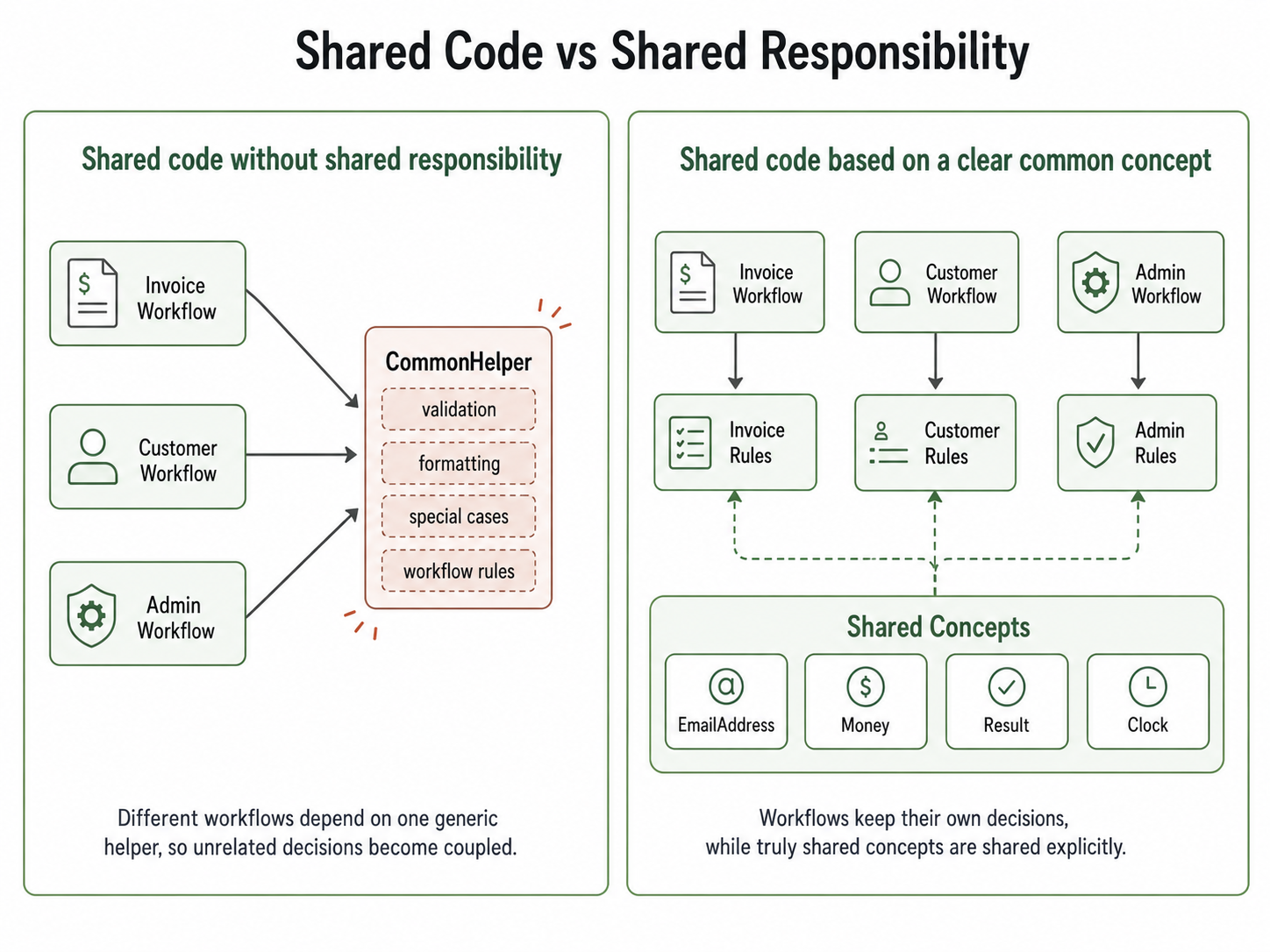
Shared code should usually represent a genuinely shared concept, not just a convenient place where several workflows happen to meet.
9. Boundaries Should Not Be Removed Just to Avoid Repetition
Boundaries often introduce a little repetition.
An application service may translate a request into a domain operation. An adapter may map an infrastructure result into an application-level outcome. A UI model may contain some of the same fields as a command or DTO. At first glance, this can look inefficient.
It can be tempting to remove the boundary and pass the same object through every layer.
That may reduce code in the short term. There are fewer mapping methods. Fewer types. Fewer small pieces of translation. The structure becomes flatter, and the repeated fields disappear.
But the repetition may have been serving a purpose.
A boundary is not only a technical separation. It is also a place where meaning is translated. The UI may describe what the user entered. The application layer may describe what the system is being asked to do. The domain may describe the rule or decision being protected. Infrastructure may describe how something is stored, sent, or retrieved.
Those are different responsibilities, even when some of the data looks the same.
When boundaries are removed only to avoid repetition, the code may become easier to write but harder to reason about. A persistence model starts shaping application workflows. A UI concern leaks into business logic. A provider-specific response travels further into the system than it should.
The repeated code was visible. The lost boundary is less visible.
This is why removing duplication should not automatically mean removing separation. Sometimes the right answer is not to share one object everywhere, but to keep the boundary and make the translation simple, explicit, and boring.
A few lines of mapping code may be a fair price for keeping responsibilities clear.3
The important question is not, “Can these two shapes be combined?”
The better question is, “Do these two shapes represent the same responsibility?”
If they do, combining them may simplify the design. If they do not, the boundary may be worth keeping, even if it means accepting some repetition.
10. How to Tell Whether Code Really Belongs Together
Code belongs together when it changes for the same reason.
That is often a better test than asking whether the code looks similar. Similarity can be accidental. Two pieces of code can have the same shape, use the same data, or perform the same technical operation while still belonging to different responsibilities.
A stronger question is: what would make this code change?
If two callers would need the same change for the same reason, sharing may be appropriate. If one caller would need the change while the other should remain untouched, the code probably does not belong together yet.
This is also why naming is useful.
When code has a clear shared responsibility, it is usually possible to give it a precise name. The name describes a real concept in the system, not just a technical action. It does not need to be vague to cover every caller. It does not need to hide behind words like Common, Shared, Utility, or Helper.
A precise name suggests that the responsibility is understood.
A vague name often suggests that several responsibilities have been placed in the same location.
Another useful test is whether the code can be explained without listing its consumers. If the explanation depends on saying, “This is used by the invoice workflow, except when it is used by the customer workflow, and also partly by the admin workflow,” the shared code may not represent one concept. It may simply be a meeting point for unrelated needs.
The tests can reveal the same problem.
If the tests for shared code have to describe many unrelated scenarios, caller-specific exceptions, or combinations of flags, the code may be carrying too much responsibility. Good shared code should usually be testable through the concept it represents, not through the history of every feature that uses it.
Code that belongs together tends to have a stable center.
It has one reason to exist. It has one kind of language. It can change without surprising unrelated parts of the system. It may be used in several places, but those places depend on the same idea, not just the same lines of code.
That is the distinction worth protecting.
The goal is not to avoid sharing. The goal is to share only when the shared code has a responsibility that is clearer than the duplication it replaces.
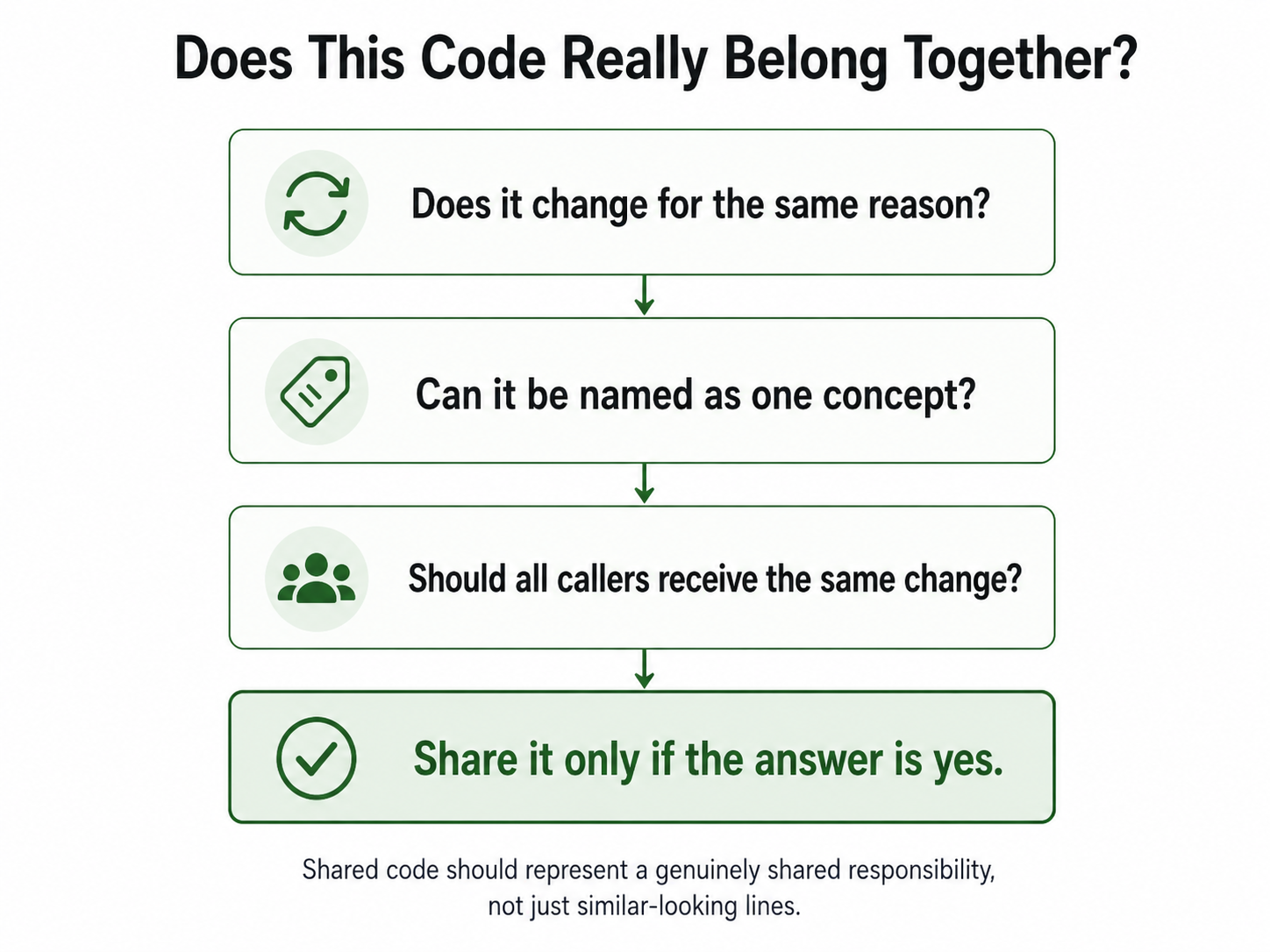
Before sharing code, check whether it changes for the same reason, can be named as one concept, and should affect all callers in the same way.
11. Refactoring Toward Clearer Ownership
When shared code starts to carry too many responsibilities, the answer is not always to delete it immediately.
A better first step is to look for ownership.
Some parts of the shared code may represent a real common concept. Those parts can stay shared. Other parts may belong to specific workflows and should move closer to the place where their meaning is strongest.
This kind of refactoring is often smaller than it first appears.
A large helper does not have to be replaced in one dramatic change. It can be separated gradually. Caller-specific conditions can be moved back into the caller. Common validation can be split from workflow decisions. Technical formatting can be separated from business rules. A vague method can become two or three more precise methods with clearer names.
The goal is not to make the code less reusable.
The goal is to make the ownership more honest.
One useful approach is to group the shared code by reason for change. If one set of methods changes when invoice rules change, those methods probably belong near the invoice workflow. If another set changes when email formatting rules change, that may be a separate responsibility. If a small core concept remains stable across several workflows, that part may still deserve to be shared.
Tests can help guide this process.
If a shared helper has tests that describe unrelated workflows, those tests may point directly to responsibilities that should be separated. After refactoring, the tests should become more focused. Workflow tests should describe workflow behavior. Shared-concept tests should describe the shared concept.4 Infrastructure or formatting tests should stay close to the technical responsibility they protect.
Refactoring toward clearer ownership often makes the code look slightly less compact.
There may be a few more small classes. There may be some simple mapping or delegation. There may even be a little deliberate duplication. But the design usually becomes easier to understand because each part has a clearer reason to exist.
That is often a good trade-off.
Code does not become better only by becoming smaller. It becomes better when decisions are easier to find, easier to change, and easier to trust.
12. Closing
Shared code is useful when it gives a real shared responsibility a clear home.
It can reduce repetition, improve consistency, and make common concepts easier to find. But sharing should not happen only because two pieces of code look alike. Similarity is a signal to examine the design, not proof that the code belongs together.
The more important question is ownership.
Who should be responsible when this behavior changes? Should every caller receive the same change? Does the shared code represent one concept, or has it become a meeting place for several unrelated needs?
When those questions are ignored, reuse can make the system harder to change. A helper becomes a dependency. A common method collects special cases. A shared project becomes a place where boundaries slowly disappear. The code may look cleaner because the duplication is gone, but the responsibility has become less visible.
Good architecture does not avoid sharing.
It shares carefully.
It accepts that some duplication may be temporary, useful, or even honest. It protects boundaries when they clarify meaning. It gives common concepts names and homes. And it keeps workflow-specific decisions close to the workflows that own them.
Shared code should make responsibility clearer, not harder to find.
That is the difference worth preserving.
Need a second opinion on a .NET codebase?
I offer practical architecture and maintainability advisory for .NET teams working on long-lived business applications.
Want occasional updates?
Subscribe to receive occasional practical notes on .NET architecture, maintainable software, project progress, and new articles.