Testing Architecture Through Behavior, Not Structure
Testing · 2026-05-18
An exploration of how architectural quality is reinforced through behavior-focused testing rather than tests tightly coupled to internal implementation details, with emphasis on maintainability, refactoring safety, mocks, integration tests, and sustainable system evolution.
Testing Architecture Through Behavior, Not Structure
1. Introduction
Automated tests are often described as a safety net for software development. In well-structured systems, they provide confidence that behavior remains correct as the code evolves. Over time, however, many test suites begin to create friction instead of safety. Refactoring becomes increasingly difficult, harmless internal improvements cause large numbers of failing tests, and developers gradually become reluctant to change code that should otherwise be straightforward to improve.
In many cases, the problem is not the presence of tests, but what the tests are actually validating. The distinction is subtle at first, but becomes increasingly important as systems grow.
A common mistake in software projects is allowing tests to become tightly coupled to internal implementation details. Instead of verifying what the system does, the tests begin verifying how the system happens to achieve it internally at a particular moment in time. They may assert specific method calls, exact interaction sequences, internal data structures, or the precise collaboration between classes inside a component. While such tests can initially appear thorough, they often become fragile as the architecture evolves.
This creates an important architectural problem. Good software architecture is intended to support change over time. Internal structure should be allowed to evolve as understanding improves, performance requirements change, or responsibilities are reorganized. If the test suite prevents that evolution by tightly constraining implementation details, the architecture gradually loses one of its most important qualities: adaptability.
Behavior-oriented testing approaches the problem differently. Instead of focusing primarily on internal structure, it focuses on observable behavior: inputs, outputs, externally visible side effects, and business outcomes. A well-designed behavioral test verifies that the system continues to fulfill its responsibilities correctly while leaving room for internal refactoring and architectural improvement.
This does not mean that structure is unimportant, nor that all forms of interaction testing are inherently wrong. Rather, it means that tests should primarily protect the externally meaningful behavior of the system, while allowing implementation details to change when necessary.
Well-designed tests and well-designed architecture ultimately support the same goal: enabling systems to evolve safely over time.
2. The Structural Testing Trap
Many fragile test suites originate from a well-intentioned desire for precision. Developers want confidence that the code behaves correctly, and modern testing frameworks make it easy to inspect and verify almost every internal interaction within a system. Over time, however, this can lead to tests that become more tightly coupled to the implementation than the production code itself.
A common example is excessive interaction verification. Instead of validating the final behavior or outcome, tests may assert that specific methods were called a certain number of times, in a specific order, with specific intermediate values. This often appears in heavily mocked unit tests, where the majority of the test is focused on verifying collaboration details between internal components.
Consider a service that stores a clipboard item. A behavior-oriented test would typically verify that:
- the item is successfully persisted,
- duplicates are handled correctly,
- invalid data is rejected,
- or the expected result is returned.
A structurally focused test, on the other hand, may verify that:
- a repository method was called exactly once,
- a mapper was invoked before validation,
- a specific helper class was used internally,
- or operations occurred in a precise sequence.
The problem is not that these details are always meaningless. The problem is that they often represent implementation decisions rather than externally meaningful behavior. As soon as the internal design changes — perhaps through refactoring, optimization, simplification, or architectural improvement — the tests begin failing even though the observable behavior remains correct.
This creates several long-term problems.
First, harmless refactoring becomes unnecessarily expensive. Developers may avoid improving code because updating the tests becomes tedious and time-consuming.
Second, the tests can begin resisting architectural evolution. Replacing internal collaborators, merging responsibilities, removing abstractions, or simplifying orchestration logic may require large-scale test rewrites despite no functional change to the system.
Third, structural tests often create a false sense of safety. A test suite may contain hundreds of assertions about internal interactions while still failing to verify whether the overall behavior actually works correctly from the perspective of the application or user.
In extreme cases, the architecture itself begins adapting to the tests rather than to the actual needs of the system.
Classes become artificially fragmented simply to make mocking easier, abstractions are introduced primarily for testing purposes, and internal implementation details become effectively frozen because changing them breaks large portions of the test suite.
This is one of the reasons why brittle tests tend to accumulate gradually in long-lived systems. The issue rarely appears immediately. Early in development, the implementation and the tests evolve together. The problems emerge later, when the architecture needs to change but the tests no longer tolerate internal movement.
Good testing architecture therefore requires careful distinction between behavior that truly matters externally and internal structure that should remain free to evolve.
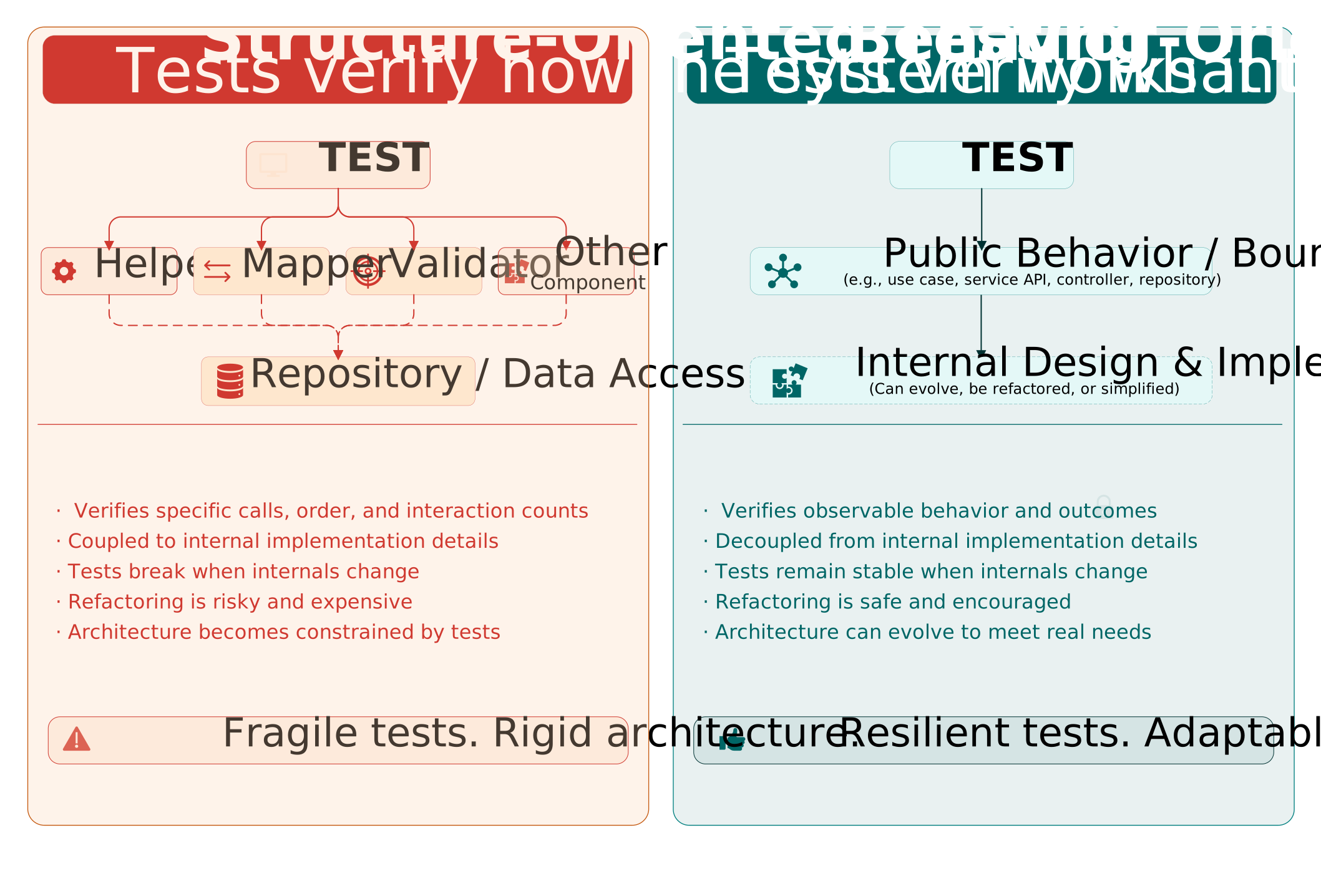
Structure-oriented tests often couple themselves to implementation details, while behavior-oriented tests validate externally meaningful outcomes and allow the internal design to evolve safely. Click the diagram to open it in full size.
3. What Behavior-Oriented Testing Means
Behavior-oriented testing means testing the system from the perspective of what it is responsible for doing, rather than how it happens to be structured internally. The test should describe a meaningful situation, exercise the relevant part of the system, and verify the observable result.
The central question is not:
Which internal methods were called?
but rather:
Did the system fulfill its responsibility correctly?
For example, if a component is responsible for storing clipboard items, the most important tests should verify outcomes such as:
- a valid item is stored and can be retrieved,
- a duplicate item is handled according to the expected rule,
- an invalid item is rejected,
- a pinned item remains available when ordinary history is trimmed,
- or search returns the expected matches.
These are behavioral statements. They describe what the system promises to do. They remain meaningful even if the internal implementation changes.
The same principle applies at different levels of the system. An application service can be tested by verifying the result of the use case it coordinates. A repository can be tested by verifying that data is persisted and queried correctly. A validation component can be tested by verifying that valid input is accepted and invalid input is rejected. A user interface flow can be tested by verifying that user actions lead to the expected visible result or application state.
This does not require every test to run through the full application. Behavior-oriented testing is not the same as end-to-end testing. A behavioral test can still be small and focused. The important distinction is that it tests a responsibility, not an implementation detail.
A useful way to think about this is that a good test should usually survive a refactoring. If a class is renamed, a helper method is extracted, an internal collection is replaced, or responsibilities are reorganized behind the same public contract, the test should not fail unless the externally meaningful behavior has changed.
This makes the test suite a better architectural asset. It protects the promises made by the system without freezing the internal design. As a result, developers can improve the code with greater confidence, knowing that the tests will report actual behavioral regressions rather than harmless structural changes.
4. Architecture That Naturally Supports Behavioral Testing
Behavior-oriented testing becomes much easier when the architecture already has clear responsibilities and well-defined boundaries. A system that separates concerns cleanly also makes it easier to decide what should be tested, where it should be tested, and what kind of behavior each test should verify.
In a layered architecture, each layer should have a distinct role. The user interface should handle presentation and user interaction. Application services should coordinate use cases. Domain logic should express business rules. Infrastructure should deal with external concerns such as databases, files, network calls, or email delivery. When these responsibilities are clear, tests can focus on the behavior expected from each part of the system.
This is closely related to the problem discussed in The Cost of Unclear Boundaries in Layered Architecture. 1
Application services are a good example. As discussed in Application Services Should Orchestrate - not own Everything, an application service should usually coordinate a use case rather than contain all the logic itself. This makes behavioral testing more natural. The test can verify that the use case produces the correct result, while more specific business rules can be tested where they actually belong. 2
The same applies to validation. When validation has no clear owner, tests tend to become scattered and repetitive. Some validation is tested in the UI, some in the application layer, some in the domain, and some only indirectly through infrastructure behavior. When ownership is clearer, the tests can be placed closer to the responsibility they protect. 3
Good architecture also makes external boundaries explicit. Databases, file systems, HTTP APIs, email senders, and similar dependencies can be represented through abstractions at the edge of the system. This allows tests to replace external infrastructure where appropriate, without forcing the internal design to be built around mocks.
The important point is that testability should not require artificial fragmentation. A system should not need an interface for every class or a mock for every collaboration. Instead, the architecture should expose meaningful seams around responsibilities and external dependencies. Those seams make it possible to test behavior without locking the implementation into its current internal shape.
In this way, behavioral testing is not only a testing technique. It is also a reflection of architectural clarity. When the architecture is well-structured, the tests can describe what each part of the system is responsible for doing. When the architecture is confused, the tests often become confused as well.
5. The Role of Mocks — and Their Risks
Mocks are useful tools, but they are also easy to overuse. They can help isolate code from slow, unreliable, or external dependencies, but they can also make tests overly dependent on internal implementation details.
A good use of mocks is to replace something outside the behavior being tested. For example, it is often reasonable to mock:
- an email sender,
- an HTTP API client,
- a payment provider,
- a file system dependency,
- or another external service.
In these cases, the mock represents a boundary between the system and the outside world. The test can then verify the behavior of the system without requiring an actual SMTP server, web API, payment service, or physical file operation.
The risk appears when mocks are used for nearly every internal collaborator. A test may create mocks for validators, mappers, repositories, factories, helpers, and small services that are all part of the same behavior. The test then spends more effort describing the internal route through the code than the outcome that actually matters.
This often leads to interaction-heavy tests. Instead of verifying that a use case produced the correct result, the test verifies that one object called another object, which called another object, which then returned a particular intermediate value. Such tests can pass even when the overall behavior is incomplete, and fail when the implementation is improved without changing the behavior.
Mocks can also influence architecture in unhealthy ways. Developers may introduce interfaces primarily to make classes mockable, even when there is only one implementation and no meaningful boundary. Over time, this can produce an architecture with many abstractions but little real separation of concerns. The system looks flexible, but much of the flexibility exists only to satisfy the test setup.
This does not mean that mocking is wrong. It means that mocks should usually be placed at meaningful boundaries. When a dependency represents infrastructure, an external system, a slow operation, or a source of nondeterminism, mocking or faking it can make tests faster and more reliable. When a dependency is simply an internal part of the same behavior, using the real implementation often gives a stronger and less brittle test.
A useful guideline is to ask whether the mocked dependency is part of the behavior being tested or merely a boundary around it. If it is part of the behavior, replacing it with a mock may weaken the test. If it is a boundary to something external, replacing it may make the test more focused and practical.
Used carefully, mocks support behavioral testing. Used excessively, they turn tests into detailed descriptions of today’s implementation.
6. Integration Tests as Architectural Validation
Integration tests play an important role in validating architecture because they verify that separate parts of the system actually work together. Unit tests can give confidence in individual responsibilities, but they do not always prove that the boundaries, wiring, serialization, persistence, and infrastructure decisions behave correctly as a whole.
This is especially important in layered systems. A repository may look correct in isolation, an application service may have clear orchestration logic, and infrastructure adapters may be neatly abstracted. But the architecture is only successful if these pieces cooperate correctly when combined.
Integration tests are useful for verifying behavior such as:
- data can be saved and retrieved through the real persistence mechanism,
- dependency injection resolves the intended services,
- configuration is interpreted correctly,
- JSON is serialized and deserialized as expected,
- HTTP endpoints accept valid requests and reject invalid ones,
- or infrastructure adapters preserve the contracts expected by the application layer.
These tests are not just technical checks. They validate architectural assumptions. They verify that the intended architectural boundaries behave correctly in practice, not only in isolation.
7. Refactoring Safety and Long-Term Maintainability
One of the main reasons for writing automated tests is to make change safer. A good test suite should give developers confidence that they can improve the internal design of the system without accidentally breaking its behavior.
This is where behavior-oriented testing becomes especially valuable.
In a long-lived system, the first version of a design is rarely the final one. Classes may be renamed, responsibilities may be moved, persistence details may change, and application services may be simplified as the domain becomes better understood. These changes are not signs of failure. They are part of normal software evolution.
If the tests are tightly coupled to the current structure, however, even healthy refactoring becomes expensive. A developer may change an internal collaboration, remove an unnecessary abstraction, or combine two small components, only to discover that dozens of tests now fail even though the system still behaves correctly.
When this happens repeatedly, the test suite begins to discourage improvement. Developers learn that refactoring comes with a high test-maintenance cost, so they avoid it unless absolutely necessary. Over time, the code becomes harder to improve, not because the architecture cannot change, but because the tests have made change unnecessarily painful.
Behavior-focused tests reduce this problem. When tests verify meaningful outcomes rather than internal steps, the implementation can be reorganized with much less friction. As long as the observable behavior remains correct, the tests continue to pass. This gives the architecture room to evolve.
A useful test suite should therefore act as a guardrail, not a cage. It should detect real regressions, but it should not prevent harmless internal movement.
8. Finding the Right Balance
Behavior-oriented testing should not be misunderstood as a rejection of unit tests, mocks, or structural concerns. The point is not to replace one rigid testing style with another. The point is to choose tests that provide confidence without unnecessarily restricting the internal design.
Some behavior is best tested at a small unit level. A validation rule, ranking calculation, formatting decision, or domain rule can often be tested directly and precisely. These tests are valuable because they are fast, focused, and easy to understand.
Other behavior is better tested through a larger slice of the system. Persistence, configuration, serialization, dependency injection, and API boundaries often require integration tests because the relevant behavior only appears when several parts work together.
Mocks also have their place. They are useful when a dependency is external, slow, unreliable, expensive, or difficult to control. In such cases, replacing the dependency can make the test more practical while still preserving the behavior being validated.
There are also situations where structure itself matters. For example, a test may need to verify that a security boundary is enforced, that a transaction is used around a critical operation, that a cache is invalidated when data changes, or that a background operation does not block the user interface. In these cases, the structural detail is not accidental implementation. It is part of the required behavior.
The important distinction is whether the structure being tested represents an actual architectural requirement or merely the current implementation.
9. Practical Guidelines
A behavior-focused testing strategy does not require complicated rules. It mostly requires discipline about what each test is allowed to depend on.
- Test public behavior first.
- Mock external boundaries, not ordinary internal design.
- Avoid verifying call counts unless the count is part of the behavior.
- Prefer assertions that describe the result.
- Keep tests intention-revealing.
- Use integration tests for architectural confidence.
- Be cautious with abstractions created only for testing.
- Treat tests as long-term assets.
10. Conclusion
Testing architecture well is not mainly about proving that every internal part was used in a specific way. It is about proving that the system continues to fulfill its responsibilities as the code evolves.
When tests focus too much on structure, they can make the architecture harder to change. They may preserve today’s implementation even when tomorrow’s design should be simpler, clearer, or more efficient. In that situation, the test suite no longer supports maintainability. It becomes another source of coupling.
Behavior-oriented tests provide a better foundation for long-term confidence. They protect the outcomes that matter: accepted input, rejected invalid data, correct persistence, expected side effects, meaningful results, and reliable workflows. At the same time, they leave room for the internal design to improve.
The guiding principle is that tests should protect the system’s promises, not freeze its implementation.
A well-designed test suite should make developers more willing to improve the code, not more afraid to touch it. When tests validate behavior rather than accidental structure, they become a natural extension of good architecture: they preserve correctness while allowing the system to evolve.
References
2. Application Services Should Orchestrate - not own Everything
Need a second opinion on a .NET codebase?
I offer practical architecture and maintainability advisory for .NET teams working on long-lived business applications.
Want occasional updates?
Subscribe to receive occasional practical notes on .NET architecture, maintainable software, project progress, and new articles.