The Difference Between Workflow and Business Rules
Architecture Principles · 2026-06-12
A practical exploration of the difference between workflow coordination and business rules — and why systems become harder to understand when orchestration layers gradually absorb business meaning.
The Difference Between Workflow and Business Rules
1. Introduction: Workflow and business rules are not the same thing
In many systems, workflow and business rules gradually become intertwined until they are difficult to distinguish from one another.
A publishing process may require:
- approval,
- validation,
- notifications,
- persistence,
- indexing,
- caching,
- audit logging,
- and external synchronization. Over time, the orchestration code coordinating those activities often begins absorbing the actual business meaning of the operation itself.
The workflow slowly becomes the place where the system decides:
- whether publishing is allowed,
- what conditions must be satisfied,
- what state transitions are valid,
- and what the business operation actually means. At first, this may appear practical.
The workflow already coordinates the process, so adding “just one more rule” seems harmless. The application service already has access to the required data. The orchestration layer already controls the sequence. The handler already knows the current state.
But over time, an important architectural distinction begins disappearing:
- workflow coordinates,
- business rules decide. Those responsibilities are related, but they are not the same thing.
Workflow concerns usually involve:
sequencing,
coordination,
retries,
transactions,
integration timing,
approval flow,
notifications,
and process orchestration. Business rules involve:
business meaning,
invariants,
allowed operations,
state transitions,
policies,
and decisions about what is valid or permitted within the domain itself. The difference matters because the two responsibilities evolve differently.
Workflows often change because:
integrations change,
infrastructure changes,
approval processes change,
sequencing changes,
or external systems change. Business rules change because:
the business itself changes,
policies change,
regulations change,
or the understanding of the domain changes. When workflow and business meaning become tightly coupled, systems gradually become harder to reason about because orchestration layers start owning responsibilities that conceptually belong elsewhere.
For example, a publishing workflow may initially begin as coordination:
await _approvalService.ValidateApprovalAsync(
    articleId,
    ct);
await _notificationService.NotifyEditorsAsync(
    articleId,
    ct);
await _searchIndexer.IndexAsync(
    articleId,
    ct);
At this stage, the workflow coordinates operations.
But business decisions often begin appearing nearby:
if (request.IsApproved && request.ContentLength > 500 &&
    request.HasMetadata)
{
    article.IsPublished = true;
}
The orchestration layer is now deciding what publishing means rather than merely coordinating the publishing process.
That shift is subtle, but architecturally important.
Once workflows begin owning business meaning:
- the domain model often becomes passive,
- business rules become fragmented,
- workflows become increasingly procedural,
- and developers begin looking at orchestration code to understand the business itself. The problem is not that workflows contain logic. Workflow coordination naturally requires logic. The problem is when sequencing and orchestration gradually become the primary owners of business decisions.
A useful distinction is therefore:
Workflow moves business operations forward. Business rules decide what operations are allowed to happen at all.
That distinction may initially appear abstract, but over time it strongly affects:
- discoverability,
- ownership,
- maintainability,
- and the ability of the system to express business meaning clearly as it evolves.
2. What workflow actually coordinates
Workflows exist to move business operations through a process.
They coordinate:
- sequencing,
- timing,
- integration,
- retries,
- approvals,
- persistence,
- notifications,
- and communication between parts of the system. In other words, workflows primarily deal with how operations move forward.
For example, publishing an article may involve several coordinated steps:
await _approvalService.ValidateApprovalAsync(
    articleId,
    ct);
await _articleRepository.SaveAsync(
    article,
    ct);
await _searchIndexer.IndexAsync(
    articleId,
    ct);
await _notificationService.NotifySubscribersAsync(
    articleId,
    ct);
This code coordinates:
- ordering,
- execution,
- and external collaboration. That is appropriate workflow responsibility.
The workflow determines:
- what happens first,
- what happens afterward,
- which services participate,
- and how failures or retries are handled. These concerns are important, but they are fundamentally different from deciding whether the article should be publishable in the first place.
A useful way to think about workflow is:
Workflow answers “what happens next?”
By contrast, business rules answer:
“What is actually allowed or meaningful within the domain?”
This distinction becomes especially important because workflow often spans technical boundaries while business rules protect conceptual boundaries.
For example, workflows commonly coordinate:
- database operations,
- messaging,
- email delivery,
- cache invalidation,
- external APIs,
- indexing,
- background processing,
- and approval sequences. These are orchestration concerns rather than business concepts themselves.
A workflow may legitimately know:
- that notifications happen after publishing,
- that indexing should occur asynchronously,
- or that retries are needed when an external system fails. But those concerns do not define what publishing means.
The distinction becomes clearer when workflows are temporarily unavailable.
For example:
- the notification service may fail,
- indexing may be delayed,
- or external synchronization may retry later. Yet the article may still be considered successfully published because the business decision itself already happened.
This reveals an important architectural idea:
Workflow often surrounds business operations without defining their meaning.
Good orchestration layers therefore tend to focus on:
- coordination,
- sequencing,
- communication,
- timing,
- and process flow. They move operations through the system without becoming the primary owners of the business rules themselves.
This distinction also affects how systems evolve.
Workflow logic often changes because:
infrastructure changes,
integrations change,
scaling requirements change,
retry behavior changes,
deployment topology changes,
or operational concerns evolve. For example:
notifications may move to background queues,
indexing may become event-driven,
retries may become distributed,
or approval routing may integrate with external systems. Those changes affect orchestration.
But they do not necessarily change the business meaning of publishing itself.
This separation becomes extremely valuable over time because it allows workflows to evolve operationally without forcing business concepts to dissolve into process coordination code.
A useful warning sign is:
When orchestration code becomes the place developers inspect to understand business meaning, workflow may already be absorbing too much responsibility.
That does not mean workflows should remain empty or purely mechanical. Real orchestration often requires substantial coordination logic.
The important distinction is whether the workflow is:
- coordinating business operations, or:
- becoming the place where the business operation itself is defined.
3. What business rules actually decide
While workflows coordinate how operations move through the system, business rules determine what operations are actually allowed to happen.
Business rules express:
- business meaning,
- policies,
- invariants,
- constraints,
- allowed transitions,
- and the conditions under which an operation is considered valid within the domain itself. In other words, business rules define the logic that protects the integrity of the business concept.
For example, consider article publishing.
A workflow may coordinate:
approval requests,
persistence,
notifications,
indexing,
and external synchronization. But the business rules decide things such as:
whether unpublished drafts may be visible,
whether approval is required,
whether an article may be republished,
whether the content satisfies publishing standards,
or whether publishing is allowed after a deadline. Those decisions belong to the meaning of publishing itself.
For example:
public void Publish(DateTime publishedUtc)
{
    if (IsPublished)
    {
        throw new InvalidOperationException(
            "The article has already been published.");
    }
    if (ContentMarkdown.Length < 500)
    {
        throw new InvalidOperationException(
            "The article content is too short.");
    }
    if (!ApprovedByEditor)
    {
        throw new InvalidOperationException(
            "Editorial approval is required.");
    }
    IsPublished = true;
    PublishedAtUtc = publishedUtc;
}
This code is not coordinating workflow sequencing. It is protecting business meaning.
The object determines:
when publishing is allowed,
what conditions define validity,
and what state transitions are permitted. That distinction matters because business rules usually need:
consistency,
discoverability,
protection,
and stable ownership. When business decisions become scattered across:
workflows,
controllers,
DTOs,
UI conditions,
handlers,
or orchestration pipelines, the domain itself gradually loses clarity.
Developers stop knowing where the actual business meaning lives.
This often leads to systems where:
- workflows contain hidden policies,
- UI layers accidentally enforce business rules,
- validation becomes duplicated,
- and state transitions become difficult to reason about. Business rules are especially important because they often protect invariants that should remain true regardless of workflow structure.
For example:
an article should not publish without approval,
an order should not exceed a credit limit,
an expired subscription should not grant access,
or a reservation should not overlap another booking. Those rules should remain valid whether:
the workflow is synchronous,
event-driven,
queue-based,
API-driven,
background-processed,
or manually triggered. That stability is one reason business rules should usually live closer to the business concepts themselves rather than inside orchestration layers.
A useful distinction is:
Workflow coordinates operations. Business rules protect meaning.
This also explains why workflows and business rules often evolve differently.
A workflow may change because:
- notifications move to background processing,
- retries become distributed,
- integrations change,
- or approval routing changes. But the business meaning of publishing may remain exactly the same.
Keeping those concerns separated allows systems to evolve operationally without constantly redistributing business behavior across orchestration code.
A useful warning sign is:
When developers must inspect workflow sequencing to understand business policy, business rules may no longer have a clear home.
That does not mean every business rule must exist inside domain entities specifically. Some rules may appropriately live in:
policies,
specifications,
validation services,
or application-level decision components. The important distinction is not the exact class location. The important distinction is whether the business meaning remains:
explicit,
protected,
discoverable,
and conceptually separate from process coordination itself.
4. How workflows gradually absorb business meaning
Workflows rarely become problematic all at once.
Most systems do not begin with developers intentionally deciding that orchestration layers should own business policy, state transitions, or domain meaning. The shift usually happens gradually through a series of individually reasonable decisions.
At first, the workflow simply coordinates process steps:
await _approvalService.ValidateApprovalAsync(
    articleId,
    ct);
await _notificationService.NotifyEditorsAsync(
    articleId,
    ct);
await _searchIndexer.IndexAsync(
    articleId,
    ct);
At this stage, the orchestration layer is coordinating activity rather than defining business behavior.
The gradual shift begins when business decisions start appearing nearby because the workflow already has:
- the required data,
- the execution sequence,
- and visibility into the current state. For example:
if (request.IsApproved && request.ContentLength > 500 &&
    request.HasMetadata)
{
    article.IsPublished = true;
}
At first glance, this may still seem harmless.
The workflow already coordinates publishing, so placing the decision there feels convenient. The handler already knows the approval status. The orchestration code already controls the sequence. Adding “just one more condition” appears practical.
But an important architectural shift has now occurred.
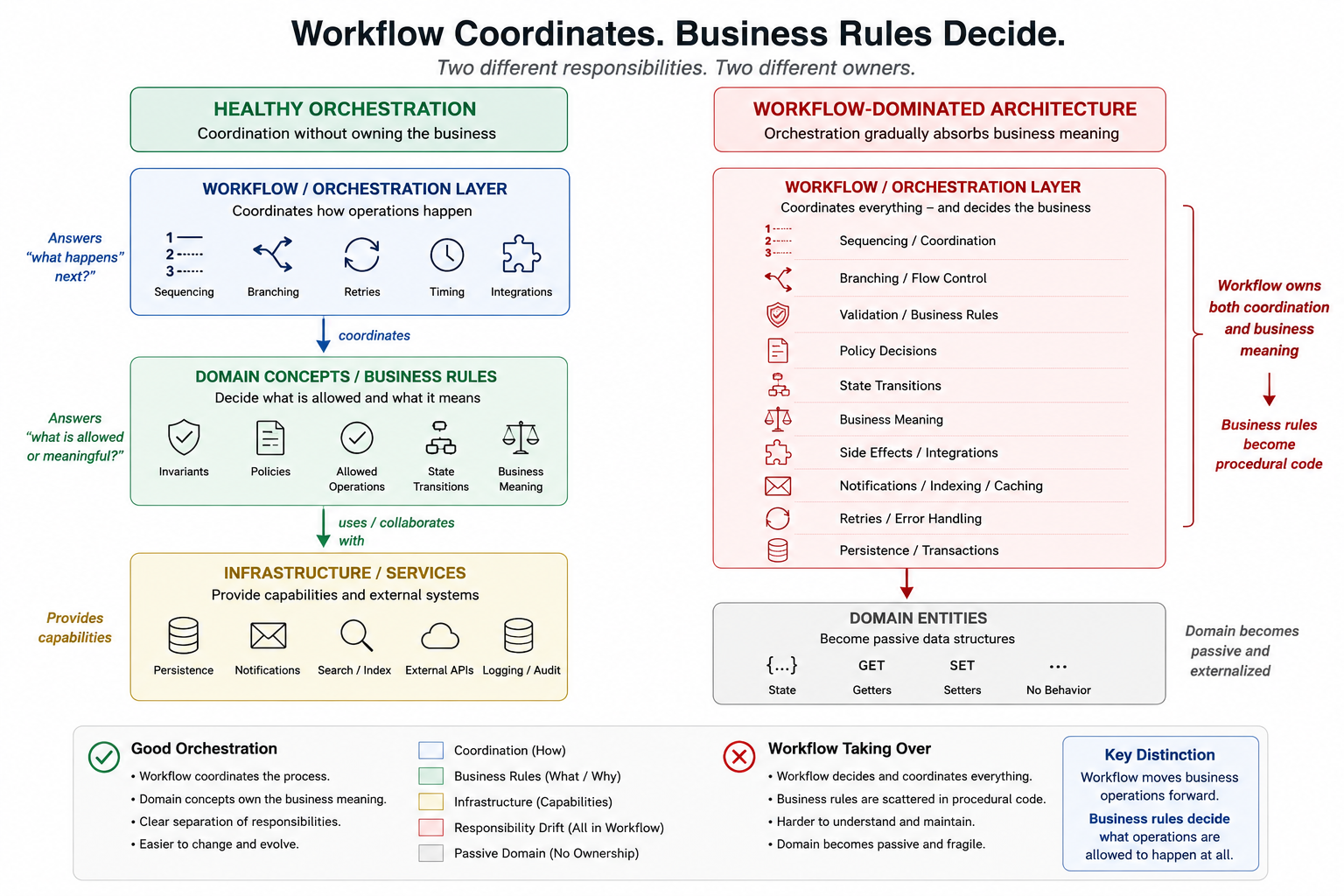
Healthy orchestration coordinates how operations move forward, while business rules decide what operations are allowed and meaningful.
The workflow is no longer merely coordinating the publishing process. It is beginning to decide what publishing means.
Over time, additional business rules often follow naturally:
if (request.RequiresEditorialReview && !request.IsApproved)
{
    return PublishResult.Rejected();
}
if (request.PublishAfterUtc > _clock.UtcNow)
{
    return PublishResult.Scheduled();
}
Eventually the orchestration layer may become the primary owner of:
- approval policy,
- visibility rules,
- state transitions,
- scheduling behavior,
- publication eligibility,
- and business invariants. At that point, the workflow is no longer simply moving operations through the system. It is increasingly acting as the domain itself.
This shift often happens because workflows naturally sit at the intersection of many concerns:
- sequencing,
- integration,
- persistence,
- validation,
- notifications,
- authorization,
- timing,
- and state management. The orchestration layer becomes an attractive place for logic because it already “knows what is happening.”
This creates several long-term problems.
First, business meaning becomes fragmented.
Some publishing rules may live:
- in the workflow,
- others in validators,
- others in DTOs,
- others in UI conditions,
- and others in domain objects. The system gradually loses a coherent place where the meaning of publishing actually lives.
Second, workflows become increasingly procedural.
As more business decisions accumulate, orchestration code often grows into large conditional structures coordinating:
- sequencing,
- state mutation,
- policy decisions,
- validation,
- and side effects simultaneously. For example:
if (request.IsApproved && article.ContentMarkdown.Length >= 500 &&
    article.HasMetadata && !article.IsArchived)
{
    article.IsPublished = true;
    await _notificationService.NotifyAsync(
        article.Id,
        ct);
    await _searchIndexer.IndexAsync(
        article.Id,
        ct);
}
The orchestration layer now owns:
- workflow coordination,
- business policy,
- and state transitions simultaneously. This often makes workflows difficult to reason about because operational sequencing and business meaning become tightly coupled together.
Third, the domain model itself often becomes increasingly passive.
As workflows absorb more decisions, the business concepts gradually lose responsibility for protecting their own invariants. Entities become state containers manipulated externally by orchestration code.
The architecture slowly shifts from:
- protected business behavior, to:
- distributed procedural coordination.
This responsibility drift mirrors the architectural problems explored in When DTOs Start Becoming Your Domain Model. 1
This problem is especially deceptive because the workflow code may initially appear highly organized.
The handlers may:
- follow clean naming conventions,
- use dependency injection,
- separate infrastructure concerns,
- and coordinate operations cleanly. Yet the actual business meaning may still be dissolving into orchestration layers simply because those layers became the easiest place to add logic over time.
A useful warning sign is:
When developers inspect workflow handlers to understand business policy, orchestration may already be absorbing too much meaning.
That does not mean workflows should contain no conditional logic or no decision-making at all. Real orchestration often requires:
retries,
branching,
timing decisions,
compensation handling,
and coordination complexity. The important distinction is whether the workflow is:
coordinating business operations, or:
becoming the primary owner of the business decisions themselves.
5. The rise of procedural application services
One of the most common consequences of workflows absorbing business meaning is that application services gradually become increasingly procedural.
At first, this often appears reasonable.
Application services already coordinate:
- repositories,
- transactions,
- notifications,
- integrations,
- authorization,
- and orchestration flow. Because they already control the sequence of operations, they naturally become attractive places for additional logic.
Over time, however, the orchestration layer often begins accumulating:
- validation,
- policy decisions,
- state transitions,
- workflow branching,
- and business meaning itself. The service gradually stops coordinating business operations and starts directly implementing the business behavior instead.
For example, an application service may initially look relatively simple:
public async Task PublishAsync(
    Guid articleId,
    CancellationToken ct)
{
    var article =
        await _repository.GetByIdAsync(
            articleId,
            ct);
    article.Publish(_clock.UtcNow);
    await _repository.SaveAsync(article, ct);
    await _notificationService.NotifyAsync(
        article.Id,
        ct);
}
In this version:
- the workflow coordinates,
- while the domain object protects the publishing rules themselves. The orchestration layer moves the operation through the system without owning the meaning of publishing.
But over time, more logic often migrates into the application service itself:
public async Task PublishAsync(
    PublishArticleRequest request,
    CancellationToken ct)
{
    var article =
        await _repository.GetByIdAsync(
            request.ArticleId,
            ct);
    if (article is null)
    {
        throw new ArticleNotFoundException();
    }
    if (!request.IsApproved)
    {
        throw new InvalidOperationException(
            "Approval is required.");
    }
    if (article.ContentMarkdown.Length < 500)
    {
        throw new InvalidOperationException(
            "The article content is too short.");
    }
    if (article.IsArchived)
    {
        throw new InvalidOperationException(
            "Archived articles cannot be published.");
    }
    article.IsPublished = true;
    article.PublishedAtUtc = _clock.UtcNow;
    await _repository.SaveAsync(article, ct);
    await _notificationService.NotifyAsync(
        article.Id,
        ct);
    await _searchIndexer.IndexAsync(
        article.Id,
        ct);
}
At this point, the application service is no longer merely orchestrating workflow.
It is now simultaneously:
- coordinating sequencing,
- protecting business rules,
- mutating state,
- validating policy,
- and defining publishing behavior itself. The service has effectively become a procedural implementation of the domain.
This creates several architectural problems.
First, business meaning becomes increasingly distributed.
If developers want to understand:
- what publishing means,
- when it is allowed,
- what rules protect it,
- or what transitions are valid, they must inspect orchestration code directly rather than coherent business concepts.
Second, workflows become tightly coupled to business policy.
Changing sequencing may accidentally affect business behavior. Changing business rules may require restructuring orchestration flow. Operational coordination and domain meaning become difficult to evolve independently.
Third, procedural orchestration tends to grow continuously over time.
Each new requirement often becomes:
one more conditional,
one more validation,
one more flag,
one more branch,
one more workflow exception. Eventually the orchestration layer becomes a large procedural script coordinating:
infrastructure,
business decisions,
state transitions,
and side effects simultaneously. This also increases cognitive load significantly.
Developers reading the application service must mentally separate:
- operational coordination,
- workflow mechanics,
- policy decisions,
- state mutation,
- and business invariants all within the same procedural flow.
The architecture may still appear layered externally, but the actual responsibility ownership has become blurred internally.
This is one reason procedural application services often become difficult to maintain despite initially appearing straightforward.
The complexity has not disappeared. It has merely accumulated inside orchestration code.
A useful distinction is:
Application services should coordinate business operations — not become the place where business meaning is implemented procedurally.
That does not mean application services should remain thin wrappers around domain methods. Real orchestration often legitimately includes:
transaction management,
integration coordination,
retries,
authorization flow,
asynchronous processing,
and sequencing logic. The important distinction is whether the orchestration layer is:
coordinating business concepts, or:
gradually replacing them with procedural workflow logic. A useful warning sign is:
When application services become the primary location for understanding business policy, orchestration may already be overshadowing the domain itself.
This orchestration drift closely relates to the responsibility ownership discussed in Application Services Should Orchestrate — not own Everything. 2
6. Why sequencing is not the same as ownership
Workflow often involves sequencing.
One step happens before another. A request is validated before data is saved. A notification is sent after a state change. An index is updated after publishing. A background job runs after the main transaction completes.
Because the workflow controls the sequence, it can easily appear to own the decisions inside that sequence.
But sequencing is not the same as ownership.
A workflow may decide when to ask whether publishing is allowed. That does not necessarily mean the workflow should decide what makes publishing allowed.
For example:
public async Task PublishAsync(
    Guid articleId,
    CancellationToken ct)
{
    var article = await _repository.GetByIdAsync(
        articleId,
        ct);
    if (article is null)
    {
        throw new ArticleNotFoundException();
    }
    article.Publish(_clock.UtcNow);
    await _repository.SaveAsync(article, ct);
    await _searchIndexer.IndexAsync(article.Id, ct);
}
The application service owns the sequencing:
- load the article,
- ask the article to publish itself,
- save the result,
- update the index. But the article owns the publishing decision.
That is an important separation.
The workflow knows what must happen next. The domain object or policy knows whether the requested operation is valid.
When this distinction is lost, orchestration code often starts accumulating business rules because it already controls the flow:
if (!article.IsArchived && article.ContentMarkdown.Length >= 500 &&
    article.ApprovedByEditor)
{
    article.IsPublished = true;
    article.PublishedAtUtc = _clock.UtcNow;
}
This code may be located in the correct sequence, but that does not mean it is located in the correct owner.
The workflow is the place where publishing happens in time. It is not necessarily the place where publishing should be defined.
This distinction matters because ownership determines where future changes belong.
If the content-length rule changes, should developers look in:
- the publishing workflow,
- the article entity,
- a publishing policy,
- a validator,
- or the UI? If sequencing and ownership are blurred, the answer becomes unclear.
A workflow can also coordinate several business decisions without owning them.
For example:
if (!_publishingPolicy.CanPublish(article))
{
    return PublishResult.Rejected();
}
article.Publish(_clock.UtcNow);
await _repository.SaveAsync(article, ct);
await _notificationService.NotifyAsync(article.Id, ct);
Here, the workflow controls the order:
- evaluate policy,
- perform state transition,
- persist,
- notify. But the policy owns the decision.
That separation makes the system easier to reason about because the orchestration layer does not need to contain every rule directly.
A useful test is:
Is this code deciding what happens next, or is it deciding what the business operation means?
If it is deciding what happens next, workflow ownership may be appropriate.
If it is deciding what the operation means, what rules protect it, or which states are valid, the responsibility probably belongs closer to the business concept itself.
This does not mean workflows should never branch.
Real workflows often need branching:
- retry or fail,
- continue or compensate,
- run synchronously or enqueue background work,
- notify one group or another,
- stop if a prerequisite is missing. The important distinction is what the branch represents.
A branch based on operational sequencing belongs naturally in workflow code.
A branch that defines the meaning or validity of a business operation probably does not.
A useful warning sign is:
When workflow code owns rules simply because it happens to execute first, sequencing may be mistaken for responsibility.
Clear ownership allows workflow to coordinate operations without becoming the hidden owner of the business itself.
7. Good orchestration protects business concepts
Good orchestration does not attempt to replace business concepts.
Instead, it coordinates operations in ways that protect:
- ownership,
- discoverability,
- consistency,
- and the integrity of the domain itself. A healthy workflow moves business operations through the system while allowing the business concepts to remain the primary owners of meaning.
For example:
public async Task PublishAsync(
    Guid articleId,
    CancellationToken ct)
{
    var article =
        await _repository.GetByIdAsync(
            articleId,
            ct);
    if (article is null)
    {
        throw new ArticleNotFoundException();
    }
    article.Publish(_clock.UtcNow);
    await _repository.SaveAsync(article, ct);
    await _notificationService.NotifyAsync(
        article.Id,
        ct);
    await _searchIndexer.IndexAsync(
        article.Id,
        ct);
}
In this example:
the workflow coordinates,
while the business concept protects meaning. The orchestration layer:
loads data,
sequences operations,
coordinates infrastructure,
and handles process flow. But the Article object still owns:
what publishing means,
what conditions are required,
and what state transitions are valid. That distinction keeps responsibility discoverable.
If developers want to understand:
- when publishing is allowed,
- what rules protect it,
- or why publishing may fail, they naturally look toward the business concept itself rather than reconstructing meaning from orchestration flow.
Good orchestration also protects business concepts from becoming coupled to operational concerns.
For example:
- retries,
- messaging,
- indexing,
- notifications,
- transaction coordination,
- background processing,
- and integration timing often change independently of the business meaning itself.
A publishing rule may remain stable for years while:
- the notification system changes,
- the search infrastructure changes,
- the deployment topology changes,
- or asynchronous processing evolves completely. Separating orchestration from business ownership allows those operational concerns to evolve without forcing the domain concepts to dissolve into workflow mechanics.
Good orchestration also reduces duplication.
When workflows coordinate business operations rather than defining them procedurally, the business rules can remain centralized:
article.Publish(now);
instead of repeatedly duplicated across:
handlers,
controllers,
UI logic,
background jobs,
and orchestration pipelines. This makes the system easier to maintain because business meaning remains protected by the same concepts regardless of:
API structure,
sequencing changes,
infrastructure changes,
or workflow implementation details. Good orchestration also tends to produce clearer architectural boundaries.
For example:
- workflows coordinate,
- policies evaluate,
- domain concepts protect invariants,
- repositories persist state,
- and infrastructure handles external systems. The system becomes easier to reason about because responsibilities remain conceptually distinct even when they collaborate closely.
This does not mean orchestration should become artificially thin or avoid all decision-making.
Real workflows often legitimately coordinate:
- retries,
- branching,
- compensation,
- authorization flow,
- transaction handling,
- integration timing,
- concurrency,
- and asynchronous execution. The goal is not to eliminate orchestration complexity. The goal is to prevent orchestration complexity from quietly becoming the primary owner of business meaning.
A useful distinction is:
Good orchestration moves business operations through the system while allowing business concepts to remain responsible for what those operations actually mean.
This also improves discoverability significantly.
Developers should not need to reconstruct business policy by mentally traversing:
- controllers,
- handlers,
- queues,
- pipelines,
- notification flows,
- and infrastructure coordination. The architecture should naturally guide them toward the concepts that actually own the business decisions themselves.
This idea closely relates to the architectural guidance discussed in Architecture Should Make Wrong Code Feel Wrong. 3
A useful warning sign is:
When workflows become easier to understand than the business concepts they coordinate, orchestration may already be overshadowing the domain.
8. Practical signs the workflow is taking over
Workflows rarely become the dominant architectural force intentionally.
The transition usually happens gradually through many individually reasonable decisions:
- one more validation rule,
- one more conditional branch,
- one more workflow flag,
- one more orchestration exception,
- one more approval check,
- one more state transition handled procedurally. Because each individual addition appears small, the architectural shift often remains difficult to notice until the system has already become harder to reason about.
For that reason, it is useful to recognize the warning signs early.
One common sign is that developers increasingly inspect workflow handlers to understand business policy.
For example, if someone wants to understand:
when publishing is allowed,
what approval requires,
why an article becomes visible,
or what state transitions are valid, and the answer primarily exists inside:
orchestration handlers,
pipelines,
application services,
queues,
or workflow coordinators, then workflow may already be absorbing business meaning.
Another warning sign is increasingly procedural orchestration code.
For example:
if (request.IsApproved && article.ContentMarkdown.Length >= 500 &&
    !article.IsArchived && article.HasMetadata)
{
    article.IsPublished = true;
    article.PublishedAtUtc = _clock.UtcNow;
    await _repository.SaveAsync(article, ct);
    await _notificationService.NotifyAsync(
        article.Id,
        ct);
    await _searchIndexer.IndexAsync(
        article.Id,
        ct);
}
At this point, the workflow is simultaneously:
- coordinating infrastructure,
- protecting business policy,
- performing state transitions,
- and defining publishing behavior itself. The orchestration layer gradually becomes the procedural implementation of the domain.
Another sign is that domain concepts become increasingly passive.
Entities may still exist, but they primarily expose:
- getters,
- setters,
- mutable state,
- and persistence-friendly structures, while orchestration layers perform the actual decisions.
For example:
article.IsPublished = true;
article.PublishedAtUtc = now;
inside workflow handlers often indicates that orchestration code is directly mutating state instead of asking business concepts to protect their own invariants.
Another important warning sign is duplicated business policy across workflows.
For example:
- one handler checks approval,
- another checks visibility,
- another checks metadata completeness,
- another checks publication timing. Over time, the same business meaning becomes fragmented across several orchestration flows rather than remaining centrally protected.
This often makes systems difficult to evolve safely because changing one business rule requires discovering every workflow that independently reimplements it.
Another sign is that workflows become easier to understand than the business concepts themselves.
Developers may begin speaking in terms such as:
“The publish handler decides this.”
“The pipeline controls approval.”
“The workflow determines visibility.”
“The orchestrator handles publishing rules.”
rather than:
“The publishing policy allows this.”
“The article can be published.”
“The domain protects that invariant.”
The language itself begins shifting toward orchestration ownership rather than business ownership.
A subtler warning sign is when operational sequencing and business policy become difficult to separate mentally.
For example:
- retries,
- persistence,
- validation,
- notifications,
- indexing,
- authorization,
- and business decisions all become intermixed inside the same procedural flow.
Developers reading the workflow must mentally separate:
- what coordinates the process, from:
- what defines the business meaning itself. This significantly increases cognitive load because orchestration and business concepts no longer have clearly distinguishable responsibilities.
Another important warning sign is when workflows become difficult to change without fear of accidentally altering business behavior.
For example:
- moving notifications to asynchronous processing,
- changing approval routing,
- restructuring retries,
- or introducing background queues may unexpectedly affect business correctness because orchestration and domain meaning have become tightly coupled together.
A useful warning sign is therefore:
When orchestration code becomes the easiest place to discover business policy, workflow may already be becoming the architecture itself.
That does not mean workflows should remain mechanically simple or avoid all coordination complexity. Real systems often require sophisticated orchestration.
The important question is whether the workflow is still:
- coordinating business operations, or:
- gradually replacing the business concepts it was originally meant to move through the system.
9. Conclusion
Workflow and business rules are closely related, but they are not the same thing.
Workflow coordinates:
sequencing,
orchestration,
retries,
integrations,
notifications,
approvals,
and process flow. Business rules protect:
meaning,
invariants,
policies,
allowed operations,
and valid state transitions. The distinction matters because the two responsibilities evolve differently and solve different problems.
Workflows often change because:
infrastructure changes,
integrations change,
operational requirements change,
or process coordination evolves. Business rules change because:
the business itself changes,
policies evolve,
regulations shift,
or domain understanding deepens. When those concerns become tightly coupled together, systems gradually become harder to understand because orchestration layers start absorbing responsibilities that conceptually belong elsewhere.
That shift rarely happens intentionally.
It usually emerges through convenience:
- the workflow already has the data,
- already controls the sequence,
- already understands the current state,
- and already coordinates the operation. Adding “just one more rule” feels natural.
Over time, however:
workflows become procedural,
business rules become fragmented,
orchestration layers become increasingly complex,
and domain concepts gradually lose ownership of their own meaning. The architecture slowly shifts from:
coordinated business behavior, to:
distributed procedural flow control. The problem is not that workflows contain logic. Real orchestration naturally requires:
sequencing,
branching,
retries,
authorization flow,
compensation,
asynchronous coordination,
and integration handling. The important distinction is whether the orchestration layer is:
coordinating business operations, or:
becoming the primary owner of the business decisions themselves. Good orchestration protects business concepts rather than replacing them.
A healthy workflow:
moves operations through the system,
coordinates infrastructure concerns,
sequences activity,
and handles operational complexity, while allowing business meaning to remain:
explicit,
protected,
discoverable,
and conceptually coherent. That separation makes systems easier to evolve because:
workflows can change operationally,
without constantly redistributing business behavior across orchestration code. A useful distinction is therefore:
Workflow coordinates. Business rules decide.
That distinction may appear subtle at first, but over time it strongly affects:
- discoverability,
- ownership,
- maintainability,
- cognitive load,
- and the ability of the system to express business meaning clearly as it evolves.
10. References
2. Application Services Should Orchestrate — not own Everything
Need a second opinion on a .NET codebase?
I offer practical architecture and maintainability advisory for .NET teams working on long-lived business applications.
Want occasional updates?
Subscribe to receive occasional practical notes on .NET architecture, maintainable software, project progress, and new articles.