Why Small Abstractions Often Age Better Than Big Ones
Architecture Principles · 2026-08-21
A practical look at why small, focused abstractions often remain easier to understand, test, change, and trust than broad abstractions that try to predict too much too early.
Why Small Abstractions Often Age Better Than Big Ones
1. Abstractions Are Supposed to Protect Meaning
An abstraction should do more than hide code.
It should protect a meaning that matters to the system.
That meaning may be a rule, a workflow, a technical boundary, or a small concept that appears in several places. The abstraction gives that meaning a name. It creates a place where the code can express what it is doing without exposing every detail of how it is done.
Used well, this makes the system easier to understand.
A caller does not need to know how an email is sent, how a file is stored, how a result is constructed, or how a value is validated. It only needs a contract that describes the responsibility clearly enough to use it safely.
This is the useful side of abstraction.
It lets one part of the system depend on a stable idea instead of a fragile implementation detail.1 It allows infrastructure to change without forcing application code to speak infrastructure language. It lets tests focus on behavior rather than internal mechanics. It gives developers a smaller surface to reason about when they make changes.
But an abstraction only helps when the meaning is clear.
When the abstraction is too broad, too vague, or too ambitious, it can stop protecting meaning and start hiding confusion. The name may sound useful, but the contract may cover several unrelated responsibilities. The implementation may grow because each new caller needs something slightly different. What started as a simplification becomes another place where decisions are harder to find.
That is why size matters.
Small abstractions often age better because they stay close to the meaning they were created to protect. They are easier to name, easier to test, easier to replace, and easier to understand. They do not try to predict every future need. They protect one useful boundary or concept and let the rest of the design evolve around it.
A good abstraction should reduce the amount of detail a caller needs to know.
It should not reduce the clarity of what the system is actually doing.
2. Why Big Abstractions Feel Appealing at First
Big abstractions often start from a reasonable desire.
A team sees several similar needs in different parts of the system. Several workflows need to send messages. Several features need to store files. Several components need to validate input, load configuration, or communicate with external services.
Instead of solving each need separately, it can feel cleaner to create one larger abstraction that covers all of them.
At first, this can look like good design.
There is one contract. One place to extend. One dependency to inject. One interface that appears to protect the application from messy implementation details. The design looks flexible because the abstraction seems prepared for many future situations.
That sense of flexibility is attractive.
A broad abstraction can make the system feel more complete than it really is. It suggests that future requirements have already been anticipated. It gives developers a central place to put related behavior. It can also feel safer because callers are no longer depending directly on concrete implementations.
But the appeal can be misleading.
The abstraction may be large because the responsibility is genuinely large. But it may also be large because the responsibility is not yet understood. Different needs may have been grouped together because they look similar, not because they mean the same thing.
This is where big abstractions can become risky.
A contract that tries to cover too much must often use vague language. It needs general method names. It needs optional parameters. It needs result types that can describe many different situations. It may need configuration switches, flags, or special cases to keep all callers satisfied.
The abstraction still hides details, but it may also hide important differences.
What looked like flexibility at the beginning can become friction later. Each new requirement must fit into the existing shape, even when the shape was created before the real boundaries were clear. The abstraction becomes something developers work around instead of something that helps them express intent.
Big abstractions feel appealing because they promise reuse, consistency, and future-proofing.
They age poorly when that promise is based on guesses rather than clear responsibility.
3. The Cost of Predicting Too Much Too Early
Many large abstractions are built around future possibilities.
A feature may only need one simple behavior today, but the design is shaped around what might be needed later. Perhaps there will be more providers. Perhaps the workflow will need more options. Perhaps the application will support more storage types, more message formats, more validation rules, or more ways to execute the same operation.
Some of that thinking is useful.
Good design should leave room for change. It should avoid locking the system into decisions that are obviously likely to move. It should not make every future extension unnecessarily painful.
But there is a difference between allowing change and predicting it in detail.
When an abstraction tries to anticipate too many future needs, it often becomes complicated before the system has earned that complexity. Methods are added before there are real callers. Options are introduced before the trade-offs are understood. General-purpose models are created before the boundaries are clear.
The code becomes flexible in theory, but harder to use in practice.
Callers may have to provide values that are not relevant to them. Implementations may have to support methods they do not naturally need. Tests may have to cover behavior that exists only because the abstraction was designed for a future that has not arrived.
This can make the design feel heavier than the problem.
The abstraction begins to shape the application around imagined requirements instead of actual ones. It may protect the system from some possible future change, but it also creates a present cost in naming, testing, implementation, and understanding.
That cost is easy to underestimate.
A small abstraction can often grow when a real need appears. A large abstraction is harder to shrink once many callers depend on it. The unused flexibility becomes part of the public contract. Removing it later can be more difficult than adding it would have been.
This is why premature generality is risky.
It asks the code to carry decisions before those decisions are real. It turns uncertainty into structure. And once that structure is in place, the system has to maintain it, explain it, and work around it.
A good abstraction should leave space for change without pretending to know every change in advance.
4. Small Abstractions Stay Close to Their Purpose
Small abstractions are usually easier to understand because they have less room to hide.
They tend to describe one responsibility, one boundary, or one concept. Their names can be more precise because they do not need to cover many unrelated situations. Their contracts can stay narrow because they are not trying to satisfy every possible caller.
This makes them easier to trust.
A small abstraction can often be understood from its name and a few members. An EmailSender sends email. A Clock provides time. A FileStore stores and retrieves files. A Result describes whether an operation succeeded and, if not, why it failed.
These abstractions may still hide implementation details, but they do not hide much about their own purpose.
That is important.
When an abstraction stays close to its purpose, callers know what kind of dependency they are taking. Tests can replace it with a simple fake. Implementations can change without turning the abstraction into a negotiation between unrelated needs. The contract remains small enough that developers can reason about it without reading the entire system.
The abstraction also becomes easier to evolve.
If a small contract needs one more capability, that change can be considered in relation to a clear responsibility. Does this new method still belong to the same concept? Does it support the same reason for change? Does every implementation naturally understand it?
Those questions are easier to answer when the abstraction has a narrow center.
By contrast, a large abstraction often has no single center. It may represent a category of things rather than a specific responsibility. New members can be added because they are roughly related, not because they truly belong. Over time, the abstraction becomes less a contract and more a container.
Small abstractions resist that drift.
They are not automatically better, and they can still be overused. But when they are grounded in a real responsibility, they tend to remain useful longer because they do not pretend to be more than they are.
They protect one meaning well.2
That is often better than protecting many meanings poorly.
5. When an Abstraction Starts Collecting Exceptions
One sign that an abstraction is becoming too large is that it starts collecting exceptions.
The contract may still look clean from the outside. It may still have a reasonable name. It may still be used from several places. But inside the implementation, the abstraction begins to contain small adjustments for different callers, providers, modes, or workflows.
At first, these exceptions may seem harmless.
One caller needs a slightly different behavior. Another needs a special option. One implementation cannot support a method in quite the same way as the others. A new flag is added. A nullable parameter appears. A result type gets one more state. A method starts to include phrases like “unless,” “except,” or “only when.”
Each change may be justified in isolation.
The problem is the pattern.
When an abstraction needs many exceptions, it may no longer represent one stable responsibility. It may be trying to cover several responsibilities that only looked related at the beginning. The abstraction becomes a place where differences are hidden instead of expressed.
This makes the code harder to reason about.
Callers may need to understand which combinations are valid. Implementations may need to support behavior that does not naturally belong to them. Tests may become wider because they have to cover many special cases, not just the central meaning of the abstraction.
The name also starts to weaken.
A precise abstraction can usually be described directly. A strained abstraction needs explanation. It cannot simply be called a sender, store, validator, or provider. It has to be described by listing what it does in different situations and what it does not quite mean for each caller.
That is often a warning sign.
The abstraction may still be useful, but it is asking for a closer look. Some of the exceptions may belong in separate abstractions. Some may belong closer to a specific workflow. Some may be telling us that the original boundary was drawn too broadly.
A small abstraction should not need many excuses.
When the explanation becomes longer than the contract, the abstraction may no longer be protecting meaning. It may be protecting an old design decision.
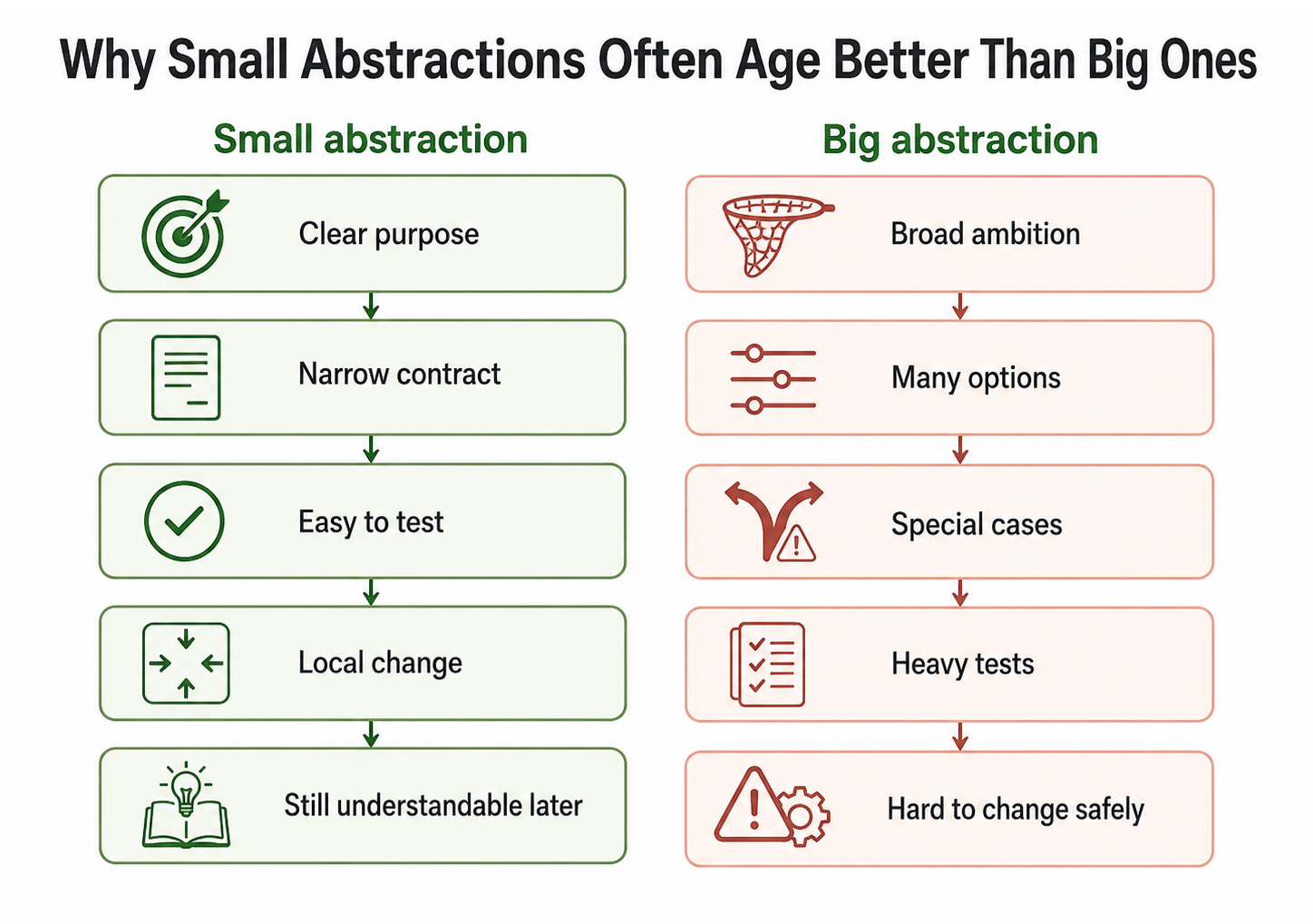
Small abstractions tend to age well when they stay close to one clear responsibility, while broad abstractions often become harder to change as exceptions and options accumulate.
6. A Narrow Contract Is Easier to Trust
A narrow contract is easier to trust because it makes fewer promises.
It describes a smaller responsibility. It exposes fewer operations. It gives callers less room to misunderstand what the abstraction is meant to do. The contract may not look impressive, but it is often more reliable because its meaning is easier to hold in mind.
That matters more than it may seem.
When a contract is broad, callers have to learn not only what it supports, but also how each operation behaves in different situations. Some methods may only apply to certain implementations. Some options may only make sense for certain workflows. Some results may mean slightly different things depending on which caller used the abstraction.
The dependency becomes harder to reason about.
A narrow contract avoids much of that weight. It gives the caller one clear expectation. If the abstraction sends a message, stores a file, provides the current time, or validates one kind of value, the caller can use it without learning a wider system of rules.
This also helps implementations.
An implementation of a narrow contract can focus on doing one thing well. It does not need empty methods, unsupported operations, vague defaults, or defensive checks for behavior that does not naturally belong to it. The implementation can remain honest because the contract has not asked it to pretend.
Tests benefit from the same clarity.
A small interface is usually easy to fake. A narrow result type is easier to assert against. A focused abstraction can be tested through the behavior it promises instead of through a long list of edge cases created by the contract itself.
Trust grows from that simplicity.
Developers become more willing to use an abstraction when they understand what it means and where it stops. They become more willing to change an implementation when the contract is stable and focused. They become more willing to refactor around it when its responsibility is clear.
A narrow contract does not guarantee good design.
But it makes bad design harder to hide.
When the contract is small, unclear responsibility becomes visible sooner. There is less space for unrelated decisions to accumulate. There are fewer places for callers to depend on behavior that was never really part of the abstraction’s purpose.
That is one reason small abstractions often age well.
They do not ask the system to trust more than the design can honestly support.
7. Small Abstractions Make Change More Local
One of the practical benefits of a small abstraction is that it limits the area affected by change.
When a contract has a narrow purpose, changes around it tend to be easier to understand. A new implementation can be added. A technical dependency can be replaced. A workflow can adjust how it uses the abstraction without forcing unrelated parts of the system to reconsider their own behavior.
The change has a smaller surface.
This is not only about fewer lines of code. It is about fewer meanings being involved. If an abstraction represents one clear responsibility, a change to that abstraction can be evaluated against that responsibility. Developers do not have to ask whether the change might accidentally affect several different workflows that were grouped together for convenience.
That makes the code safer to evolve.
For example, replacing one email provider with another should not require application code to understand provider-specific status codes, authentication details, retry behavior, or delivery mechanics. A small abstraction can keep that concern at the edge. The application depends on the idea of sending a message, while the implementation deals with how that happens.
The same applies to time, storage, file access, validation, or external APIs.
When the abstraction is small, the implementation can change without pulling the rest of the system into the details. The caller depends on the responsibility, not the mechanism.3 That is what makes the change local.
Large abstractions often make this harder.
Because they represent more responsibilities, a change in one part of the abstraction can create uncertainty elsewhere. A new method may affect all implementations. A new option may be irrelevant to most callers. A change made for one workflow may force other workflows to adapt to a contract that is becoming less focused.
The abstraction becomes a shared negotiation point.
Small abstractions reduce that pressure. They make it easier to replace one piece without disturbing the whole design. They also make it easier to decide when a new abstraction is needed, because the existing one has a clear boundary and does not have to absorb every related idea.
Local change is one of the quiet strengths of good architecture.
It means the code does not resist every improvement. It means the system can adapt without each change becoming a tour through unrelated decisions. And small abstractions often support that better than large ones because they keep the reason for change close to the code that owns it.
8. Reuse Should Grow from Repeated Meaning, Not Ambition
Reuse is most useful when it grows from repeated meaning.
That is different from designing for every possible future use. A small abstraction may begin with one clear responsibility. Later, another part of the system may need the same responsibility for the same reason. At that point, reuse is not forced into the design. It emerges because the system has revealed a real shared concept.
That kind of reuse tends to be safer.
The abstraction already has a purpose. Its name is grounded in something the system actually does. Its contract has been shaped by real use, not by speculation. When another caller depends on it, the relationship is easier to understand because the shared meaning already exists.
Ambitious reuse is different.
It starts by trying to cover a wide category of possible needs. The abstraction is designed to be reusable before the system has shown what should actually be reused. It may be called general, flexible, extensible, or provider-independent, but those words can hide uncertainty if the responsibility is not yet clear.
This often creates pressure on the contract.
The abstraction must be broad enough to justify its ambition. It must anticipate variations. It must support callers that do not exist yet. It must describe behavior in general terms because the specific meaning has not had time to appear.
The result may look reusable, but it can be difficult to use well.
Real reuse usually becomes visible through repetition over time. The same concept appears in several places. The same rule is needed for the same reason. The same boundary protects the same kind of decision. When that happens, extracting or strengthening an abstraction can make the design clearer.
But until that meaning repeats, reuse may only be a guess.
Small abstractions age well because they do not need to justify themselves by covering everything. They can begin with one honest responsibility. If that responsibility turns out to be useful elsewhere, the abstraction can grow carefully. If it remains local, it has not burdened the rest of the system with unnecessary generality.
The goal is not to avoid reuse.
The goal is to let reuse follow meaning instead of ambition.
9. How Small Abstractions Improve Testing
Small abstractions often make tests simpler because they give tests less to fake.
When a contract has one clear responsibility, a test double can usually be small and explicit. It can return the current time. It can capture an email message. It can store a file in memory. It can return a simple success or failure result. The test does not need to simulate a broad system of behaviors just to exercise one workflow.
That helps keep tests focused.
A test should usually describe the behavior that matters to the code under test. If the abstraction is narrow, the test can replace the external dependency without bringing in details that do not belong to the scenario. The abstraction becomes a small seam in the design, not another complicated object that the test has to understand.
This is one reason small abstractions often support better design.
They make it easier to test through meaningful outcomes.4 The test can say, “when this workflow runs, a message is sent,” or “when this operation fails, the caller receives a useful failure result.” It does not have to know how the message provider works, how the file system behaves, or how an external service reports every possible technical state.
Large abstractions can make this harder.
If an interface contains many operations, options, modes, or result shapes, tests may need more setup than the behavior deserves. A fake implementation may have to support methods that are irrelevant to the test. A mock may need several configured calls before the actual behavior can be exercised. The test begins to reflect the abstraction’s complexity instead of the workflow’s intent.
That is usually a warning sign.
Tests should not become heavy because the contract is too broad. If many tests need to work around unused parts of an abstraction, the abstraction may be doing too much. If a fake needs caller-specific behavior, the contract may not represent one clear responsibility.
Small abstractions also make failure easier to express.
A focused result type can describe the failure the caller needs to handle. A narrow dependency can expose only the outcome that matters at that boundary. This keeps tests closer to application behavior and further away from provider-specific mechanics.
The benefit is not only easier testing.
Tests become more useful as documentation. They show how the workflow uses the abstraction. They reveal what the caller actually depends on. And because the abstraction is small, the test can stay readable even when the implementation behind the contract changes.
Good abstractions do not exist only to make testing convenient.
But when an abstraction is hard to fake, hard to set up, or hard to assert against, the tests may be showing that the contract is larger than the responsibility it represents.
10. When a Bigger Abstraction Is Actually Justified
Small abstractions are often safer, but that does not mean every abstraction should stay small forever.
Sometimes a larger abstraction is the right shape.
A bigger abstraction may be justified when the responsibility itself is genuinely broad. Some concepts are naturally made up of several related operations. A repository may need to load, save, and query entities. A licensing service may need to activate, validate, and restore licenses. A message pipeline may need to prepare, send, track, and report delivery outcomes.
The question is not whether the abstraction has more than one method.
The question is whether those methods belong to the same responsibility.
A larger abstraction can work well when it has a clear center. The operations support the same workflow, protect the same boundary, or describe the same concept from different angles. The contract may be broader, but it is still coherent. A caller can understand why the members belong together without reading a long explanation or knowing the history of every feature that uses it.
That coherence matters.
A bigger abstraction becomes risky when it is large because unrelated needs have been grouped together. It becomes healthier when it is large because the concept itself has real breadth. In the first case, the size hides confusion. In the second, the size reflects the responsibility honestly.
There are also cases where a larger abstraction protects an important boundary.
For example, an application may need one stable contract around a complex external system. The implementation may involve authentication, retries, mapping, provider-specific errors, and configuration. The caller should not need to know those details. A carefully designed abstraction can keep that complexity at the edge.
But even then, the contract should not expose more than the caller needs.
A bigger abstraction should still be deliberate. Its methods should use the language of the application, not the language of the underlying mechanism. Its result types should communicate meaningful outcomes. Its options should represent real choices, not every technical setting the implementation happens to support.
The best larger abstractions often grow from smaller ones.
They begin with a clear responsibility. Over time, related behavior appears. The contract expands because the system has shown that those operations belong together. The abstraction becomes broader without becoming vague.
That is different from starting with a large contract because the future might need it.
A bigger abstraction is justified when the responsibility is big enough to deserve it, the contract remains coherent, and the callers benefit from depending on one stable idea.
Size is not the problem by itself.
Unclear responsibility is.
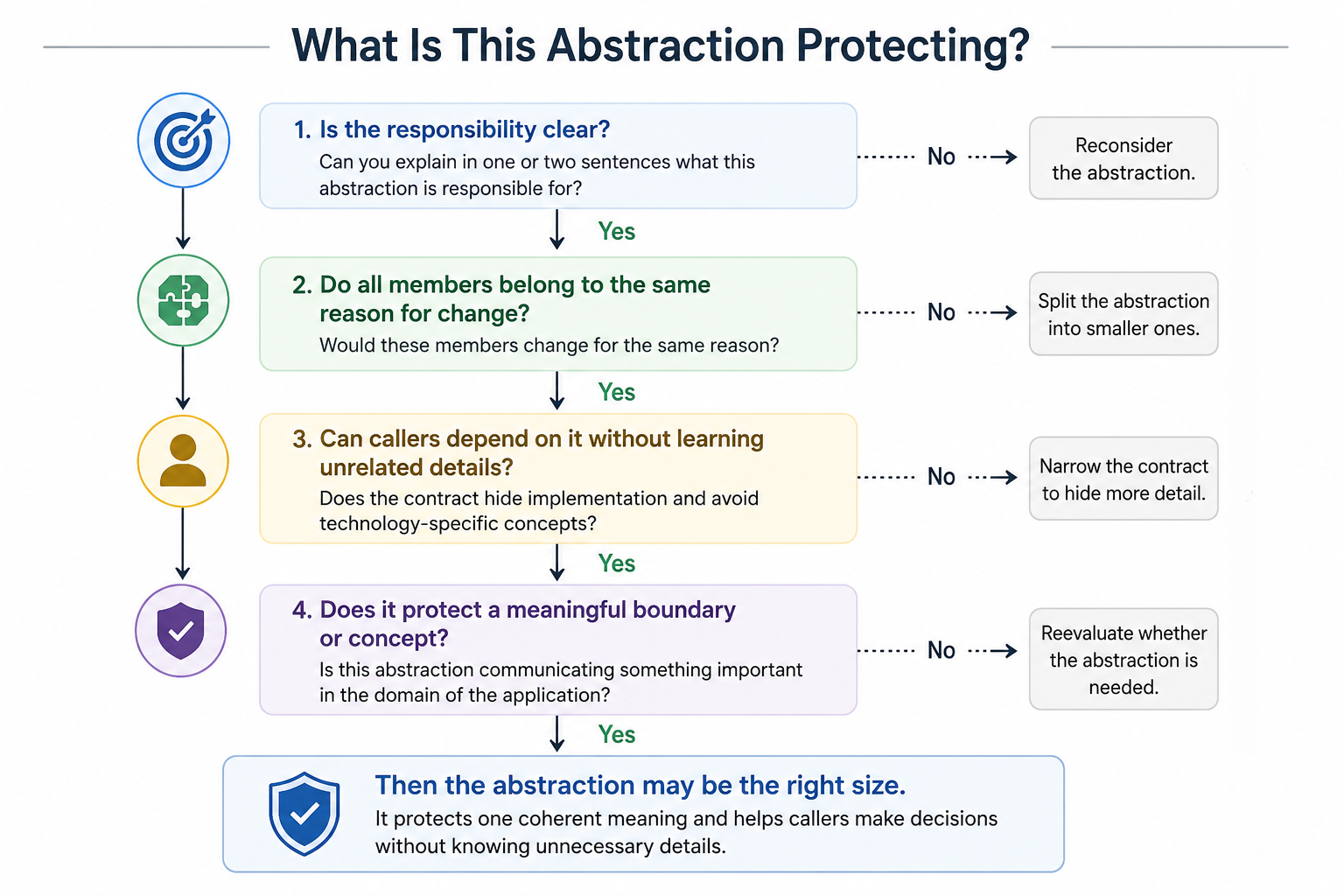
The right size for an abstraction depends less on the number of methods and more on whether the contract protects one coherent meaning.
11. Refactoring Large Abstractions Into Smaller Ones
When an abstraction has grown too large, the best response is usually not to replace it all at once.
Large abstractions often become important because many parts of the system already depend on them. They may contain useful behavior, even if the contract has become too broad. Removing them in one step can create more risk than the original design problem.
A safer approach is to look for smaller responsibilities inside the larger shape.
Some methods may belong together because they support one workflow. Others may exist only for one caller. Some may describe technical operations that should stay near infrastructure. Others may represent application-level outcomes that deserve a clearer contract.
The goal is to find the real seams.
A broad interface called something like IMessageService, IFileProvider, or IApplicationHelper may contain several smaller ideas. One part may prepare a message. Another may send it. Another may format a result. Another may translate provider-specific failure details. Those responsibilities may be related, but they do not necessarily need to live behind the same contract.
Refactoring can begin by naming those responsibilities more precisely.
A method that sends notifications may move behind a notification sender. A method that creates message content may become part of a message builder. A method that translates provider errors may belong in an adapter. A workflow-specific rule may move back into the workflow that owns it.
This does not have to happen everywhere at once.
One caller can be moved to a smaller abstraction. One implementation can be split. One set of tests can be rewritten around a more focused contract. The old abstraction can remain temporarily as a wrapper or adapter while the system moves toward clearer ownership.
Tests are useful during this work because they reveal what each caller actually needs.
If a caller only uses one method from a large interface, that may suggest a smaller dependency. If several tests have to configure behavior unrelated to the scenario, the abstraction may be forcing unnecessary knowledge into the test. If different callers expect different meanings from the same method, the method may need to be split.
As the smaller abstractions appear, the design often becomes easier to read.
The number of types may increase, but the amount of guessing decreases. A developer can see which responsibility a class depends on. The names become more specific. The tests become less burdened by irrelevant setup. Changes become easier to localize because each contract has a narrower reason to change.
This is the practical value of refactoring large abstractions gradually.
It does not treat size as the enemy. It treats unclear responsibility as the problem. The aim is not to make every contract tiny, but to make each contract honest about what it protects.
12. Closing
Abstractions are not valuable because they are large.
They are valuable when they protect a meaning the system needs to preserve.
A good abstraction gives callers a stable idea to depend on. It hides details that should not matter at that level. It makes decisions easier to find, easier to test, and easier to change. But it only does that well when the responsibility behind the abstraction is clear.
Small abstractions often age better because they stay close to that responsibility.
They do not try to describe every possible future need. They do not ask every caller to understand a wide contract. They do not create a large surface where unrelated decisions can slowly accumulate. Instead, they protect one concept, one boundary, or one kind of behavior with enough clarity that the rest of the system can depend on it safely.
That does not mean every abstraction should be tiny.
Some responsibilities are naturally broader. Some boundaries deserve a larger contract. Some workflows need several related operations to be treated as one coherent idea. But size should follow meaning. It should not come from ambition, prediction, or the desire to make the design look flexible before the need is real.
The question is not, “Can we make this abstraction more general?”
The better question is, “What meaning is this abstraction protecting?”
If the answer is clear, the abstraction has a chance to age well. If the answer is vague, the contract may become a place where future work gets harder rather than easier.
Small abstractions are not modest because they lack ambition.
They are modest because they respect the shape of the problem.
And in many systems, that modesty is what allows the design to keep changing without losing its clarity.
Need a second opinion on a .NET codebase?
I offer practical architecture and maintainability advisory for .NET teams working on long-lived business applications.
Want occasional updates?
Subscribe to receive occasional practical notes on .NET architecture, maintainable software, project progress, and new articles.