The Best Senior Developers Reduce Cognitive Load
Architecture Principles · 2026-06-19
A practical exploration of how experienced developers reduce cognitive load through clearer ownership, discoverability, and architecture that is easier to reason about over time.
The Best Senior Developers Reduce Cognitive Load
1. Introduction: Seniority Is Not Measured by Complexity
Many discussions about senior developers focus on technical depth.
People often associate seniority with:
- advanced frameworks,
- sophisticated abstractions,
- performance optimization,
- distributed systems,
- architecture patterns,
- or the ability to solve extremely difficult technical problems.
Those skills certainly matter.
But in long-lived systems, one of the most valuable abilities of experienced developers is often something quieter and less visible:
- reducing mental friction,
- improving clarity,
- and making systems easier for other people to understand safely.
The best senior developers are not necessarily the ones who can hold the most complexity in their own heads. They are often the ones who reduce how much complexity everyone else must carry.
That distinction becomes increasingly important as systems grow.
Small systems can often survive confusion because a single developer still remembers:
- where rules live,
- why certain decisions were made,
- which workflows are fragile,
- and which parts of the code should not be touched casually.
But over time:
- teams change,
- systems evolve,
- features accumulate,
- integrations grow,
- and architectural shortcuts compound.
At that point, the primary challenge is often no longer writing functionality. The challenge becomes understanding the system safely enough to change it confidently.
This is where cognitive load begins to matter enormously.
Every additional thing developers must mentally track increases the effort required to:
- understand behavior,
- debug problems,
- make changes safely,
- review code,
- onboard new developers,
- and evolve the architecture over time.
For example, developers may need to mentally traverse:
- controllers,
- handlers,
- DTOs,
- validators,
- workflows,
- repositories,
- mapping layers,
- feature flags,
- and infrastructure coordination
simply to understand one business operation.
The issue is not that these concepts are inherently wrong. Real systems naturally contain layers and complexity. The problem appears when the architecture no longer helps developers discover:
- where behavior lives,
- who owns decisions,
- which layer protects which rules,
- or how the system is intended to be understood.
At that point, the system begins imposing unnecessary cognitive cost.
This is one reason experienced developers often become less interested in:
- cleverness,
- hidden abstractions,
- excessive indirection,
- or architectural “magic”
and more interested in:
- clarity,
- discoverability,
- ownership,
- and understandable flow.
A senior developer may still build sophisticated systems, but the sophistication is often directed toward making the system feel simpler rather than more impressive.
For example:
- reducing duplicated rules,
- clarifying ownership,
- removing unnecessary traversal,
- simplifying workflows,
- improving naming,
- reducing hidden behavior,
- and making incorrect usage feel difficult.
These changes may not appear dramatic individually, but together they substantially reduce the mental effort required to work safely inside the system.
That reduction in cognitive load becomes one of the most valuable forms of architectural quality because it directly affects:
- maintainability,
- onboarding,
- debugging,
- reviewability,
- confidence,
- and long-term system evolution.
A useful distinction is therefore:
Great senior developers are not the ones who can personally survive the most complexity. They are the ones who reduce how much complexity everyone else must survive.
That idea may initially sound less technical than discussions about frameworks, scalability, or architecture patterns. But over time, it often becomes one of the defining characteristics of systems that remain understandable as they grow.
2. What Cognitive Load Actually Means in Software
Cognitive load is the amount of mental effort required to understand and work safely within a system.
In software development, this often includes:
- remembering where behavior lives,
- understanding ownership,
- tracing workflows,
- tracking state transitions,
- reasoning about side effects,
- and predicting how changes may affect other parts of the system.
Some complexity is unavoidable.
Real systems naturally contain:
- business rules,
- infrastructure concerns,
- integrations,
- workflows,
- concurrency,
- persistence,
- and operational requirements.
The problem is not that systems contain complexity. The problem is when the architecture forces developers to carry more complexity mentally than necessary.
For example, consider a simple publishing operation.
In a low cognitive-load system, a developer may quickly discover:
- where publishing rules live,
- who owns the decision,
- how workflows are coordinated,
- and where side effects occur.
The mental traversal remains relatively small.
But in a high cognitive-load system, understanding the same operation may require inspecting:
- controllers,
- DTO flags,
- validators,
- application services,
- workflows,
- repositories,
- feature toggles,
- mapping layers,
- event handlers,
- background jobs,
- and UI conditions
before the actual behavior becomes clear.
The difficulty is not necessarily the number of files alone. The difficulty is the amount of uncertainty developers must continuously carry while trying to understand the system.
For example:
- Which layer actually owns this rule?
- Is this validation authoritative or duplicated elsewhere?
- Does another workflow bypass this logic?
- Is this state transition protected centrally?
- Which conditions are business rules versus UI behavior?
- Is this DTO merely transport data or part of the domain behavior?
- Is this abstraction meaningful or just another traversal step?
Every unresolved question increases cognitive load.
This is why architectural clarity matters so much.
Good architecture reduces:
- uncertainty,
- hidden ownership,
- duplicated behavior,
- unnecessary traversal,
- and implicit coupling.
It helps developers naturally locate:
- where behavior belongs,
- which layer owns which responsibility,
- and how the system is intended to work.
A useful way to think about cognitive load is:
Every additional place developers must inspect increases mental cost.
This becomes especially important in long-lived systems because cognitive load compounds over time.
For example:
- duplicated validation,
- workflow drift,
- passive domain models,
- abstraction-heavy architectures,
- unclear boundaries,
- and hidden coupling
may individually seem manageable.
But together they create systems where developers gradually become afraid to make changes because understanding the consequences requires too much mental reconstruction.
This often explains why some systems feel:
- fragile,
- exhausting,
- unpredictable,
- or “hard to touch”
even when the individual code pieces appear technically reasonable.
The architecture may still contain:
- layers,
- interfaces,
- patterns,
- abstractions,
- and conventions.
But if developers must continuously reconstruct ownership mentally, the system imposes a large cognitive burden regardless of how organized it looks externally.
Cognitive load also affects communication.
When systems become difficult to reason about:
- onboarding slows,
- code reviews become harder,
- debugging takes longer,
- architectural discussions become less precise,
- and developers increasingly rely on tribal knowledge instead of discoverable structure.
This is one reason experienced developers often care deeply about:
- naming,
- ownership,
- discoverability,
- consistency,
- explicitness,
- and architectural boundaries.
Those concerns are not merely stylistic preferences. They directly affect how much mental effort the system requires from every developer working inside it.
A useful distinction is therefore:
Complexity is not only about what the system does. It is also about how much of the system developers must mentally carry in order to understand it safely.
That distinction strongly influences whether a system remains understandable as it evolves over time.
3. Why Complexity Accumulates Silently
Most systems do not become difficult to understand all at once.
The complexity usually grows gradually through many individually reasonable decisions:
- one more abstraction,
- one more workflow flag,
- one more validation layer,
- one more DTO property,
- one more helper service,
- one more special case,
- one more architectural shortcut.
Each individual addition may appear harmless in isolation.
A developer duplicates a rule temporarily “just to be safe.” A workflow gains another conditional because a deadline is approaching. A DTO receives a convenience property because the UI already needs the data. A new abstraction is introduced because future flexibility might eventually become useful.
None of these decisions necessarily looks dangerous at the time.
The problem is that complexity compounds.
Over time, the system gradually accumulates:
- duplicated ownership,
- hidden dependencies,
- unclear boundaries,
- procedural orchestration,
- passive domain models,
- and increasing mental traversal.
Eventually developers no longer understand the system by reading a single business concept or workflow. They understand it by reconstructing behavior from many scattered locations simultaneously.
This is one reason cognitive load often feels disproportionate to the apparent size of the codebase.
A system may contain:
- clean formatting,
- reasonable naming,
- layered projects,
- dependency injection,
- abstractions,
- tests,
- and architectural patterns,
yet still feel exhausting to work in because understanding behavior requires carrying too many interconnected details mentally at the same time.
Complexity is especially dangerous because systems adapt around it gradually.
Developers learn:
- which workflows are fragile,
- which services should not be modified casually,
- which abstractions are misleading,
- which rules are duplicated,
- and which side effects are hidden.
The team slowly develops survival knowledge.
At that point, the architecture may still technically function, but much of the understanding now lives in developer memory rather than discoverable structure.
This is one reason highly experienced developers often become skeptical of complexity that exists “for flexibility later.”
Many systems already contain enough unavoidable complexity:
- business rules,
- integrations,
- concurrency,
- operational concerns,
- deployment realities,
- and evolving workflows.
Additional accidental complexity therefore becomes extremely expensive because it consumes mental capacity that developers already need elsewhere.
A useful distinction is:
Complexity becomes dangerous when developers must remember the system instead of being guided by it.
For example, developers may begin relying on memory for questions such as:
- “This workflow bypasses validation.”
- “This handler behaves differently in production.”
- “This DTO flag is only valid after approval.”
- “This abstraction is not actually authoritative.”
- “This repository method should not be used directly.”
- “This workflow must call another service first.”
When important architectural understanding exists mainly as tribal knowledge, cognitive load has often already become too high.
This also explains why complexity often feels invisible to the people who created it.
Developers who built the system already understand:
- the historical decisions,
- the hidden assumptions,
- the workflow sequencing,
- and the architectural compromises.
The cognitive cost is carried more heavily by:
- new team members,
- future maintainers,
- reviewers,
- and developers modifying unfamiliar areas.
This is one reason experienced developers often optimize for:
- explicitness,
- discoverability,
- predictable ownership,
- understandable flow,
- and reduction of unnecessary traversal.
The goal is not eliminating all complexity. Real systems will always contain complexity.
The goal is preventing accidental complexity from silently becoming the dominant experience of working inside the system.
A useful warning sign is:
When understanding a feature requires reconstructing behavior from many unrelated places, complexity may already be accumulating faster than the architecture is containing it.
This accumulation is especially dangerous because it often appears gradual and manageable right until the point where developers begin avoiding changes simply because understanding the consequences feels too expensive mentally.
4. The Hidden Cost of Unclear Ownership
One of the largest contributors to cognitive load in software systems is unclear ownership.
When developers cannot quickly determine:
- where a rule belongs,
- who protects an invariant,
- which layer owns a decision,
- or where behavior is intended to live,
the mental effort required to work safely inside the system increases dramatically.
This problem rarely appears as a single obvious architectural failure.
Instead, ownership gradually becomes blurred across:
- workflows,
- DTOs,
- services,
- validators,
- repositories,
- UI conditions,
- policies,
- and infrastructure coordination.
Eventually the same business behavior may partially exist in several places simultaneously.
This kind of ownership drift closely relates to the distinction between orchestration and business behavior discussed in another article in this series.1
For example:
- the UI validates a rule for user feedback,
- the DTO validates the same rule for transport correctness,
- the application service checks it again procedurally,
- and the domain object may partially enforce it independently.
Each individual layer may appear reasonable in isolation. The problem is that developers no longer know which layer is actually authoritative.
At that point, understanding behavior requires mentally reconstructing:
- which validations are duplicated,
- which checks are mandatory,
- which workflows bypass the rules,
- and which components are truly responsible for protecting correctness.
The cognitive cost becomes substantial because the architecture no longer communicates ownership clearly.
This is one reason experienced developers often care deeply about:
- explicit boundaries,
- responsibility clarity,
- and discoverable behavior.
The issue is not merely organizational elegance. Clear ownership directly reduces the amount of uncertainty developers must carry mentally.
For example, consider two different systems.
In the first system:
- publishing rules live inside the publishing concept,
- workflows coordinate sequencing,
- repositories own persistence,
- and DTOs remain focused on transport.
A developer can often predict where behavior belongs before opening the code.
In the second system:
- validation exists partly in DTOs,
- workflows own some business decisions,
- services mutate state procedurally,
- repositories apply hidden filtering,
- and UI logic duplicates business behavior.
The system may still technically function, but developers must continuously traverse multiple locations to understand even simple operations.
The difference is not merely style. It is cognitive effort.
A useful distinction is:
Clear ownership reduces how much of the system developers must mentally reconstruct.
This also affects confidence.
When ownership is unclear:
- developers become hesitant,
- changes feel risky,
- debugging becomes slower,
- reviews become more difficult,
- and onboarding requires increasing amounts of tribal knowledge.
Developers begin relying on memory rather than architecture.
For example:
- “This rule is also checked elsewhere.”
- “This workflow behaves differently.”
- “That DTO property is only valid after approval.”
- “This repository silently filters archived items.”
- “That service bypasses the normal validation path.”
These kinds of hidden assumptions increase mental burden continuously because the architecture no longer reliably communicates intent.
Unclear ownership also creates fear around change.
Developers may avoid modifying parts of the system because understanding the consequences requires mentally tracing:
- side effects,
- duplicated rules,
- hidden dependencies,
- workflow variations,
- and implicit coupling.
The system gradually becomes psychologically expensive to work in.
This is one reason senior developers often optimize for:
- discoverability,
- explicitness,
- architectural guidance,
- understandable flow,
- and clear responsibility boundaries.
Those qualities reduce uncertainty.
The goal is not creating perfectly rigid architectures or eliminating all trade-offs. Real systems always contain exceptions and compromises.
The important distinction is whether the architecture helps developers naturally discover:
- where decisions belong,
- who owns correctness,
- and how behavior is intended to work.
A useful warning sign is:
When developers regularly need historical knowledge to understand ownership, the architecture may no longer be communicating responsibility clearly enough.
Good architecture reduces the amount of the system developers must keep in their heads at one time. Clear ownership is one of the most important ways it accomplishes that.
5. Good Architecture Reduces Mental Traversal
One of the clearest signs of good architecture is that developers do not need to mentally traverse large portions of the system to understand a single behavior.
The architecture helps them arrive naturally at the correct place.
For example, if a developer wants to understand:
- how publishing works,
- when approval is required,
- what rules protect visibility,
- or what state transitions are allowed,
the system should guide them toward those answers relatively directly.
The goal is not necessarily fewer files or fewer layers. The goal is reducing unnecessary mental traversal.
A developer should not need to inspect:
- controllers,
- DTO flags,
- validators,
- repositories,
- workflows,
- mapping layers,
- background jobs,
- feature toggles,
- and UI conditions
simply to understand one business operation.
Every additional traversal step increases cognitive load because the developer must continuously:
- retain context,
- compare assumptions,
- track ownership,
- and reconstruct behavior mentally.
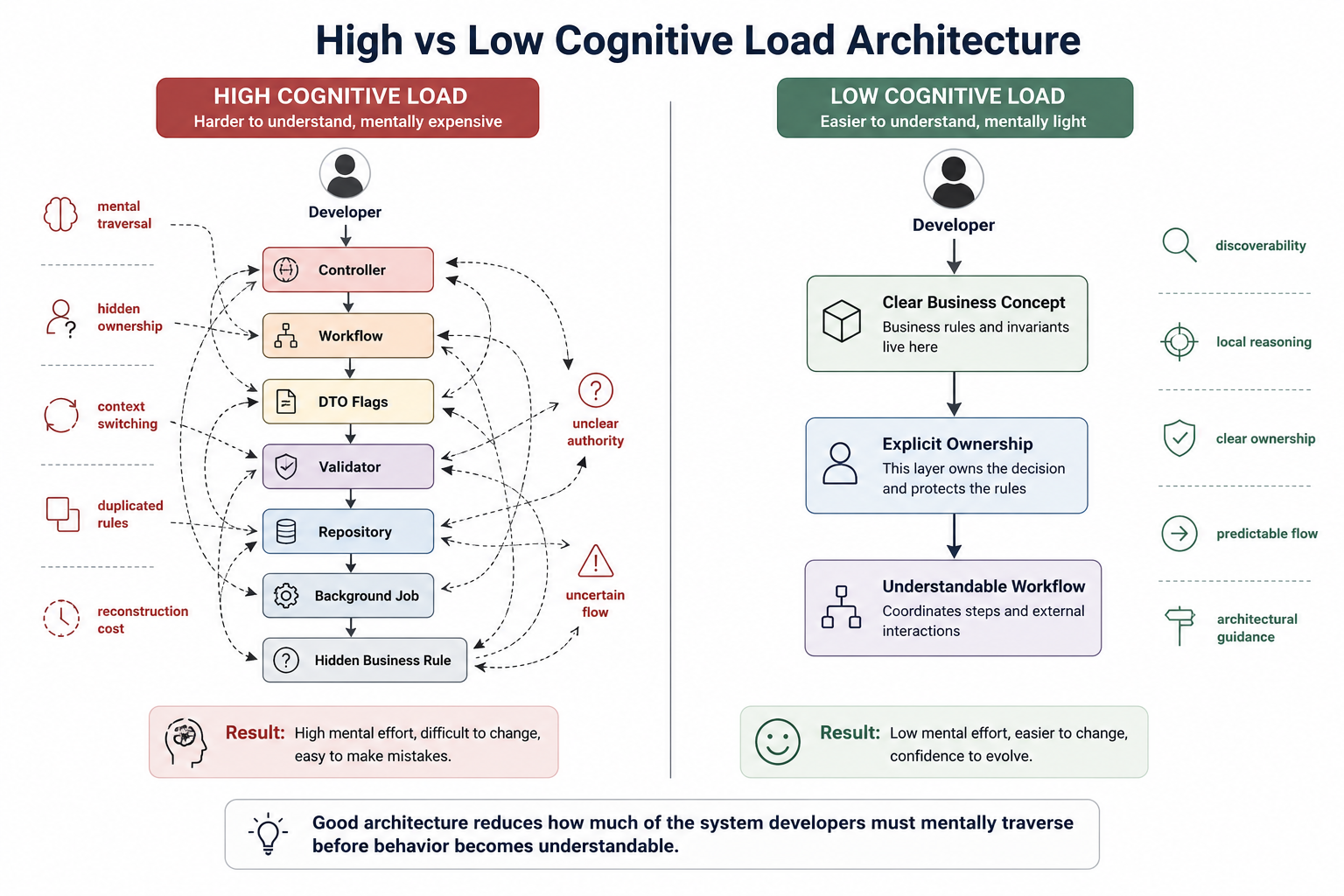
High cognitive-load architectures force developers to mentally traverse many scattered layers before behavior becomes understandable, while clearer architectures reduce mental traversal through explicit ownership and discoverable flow.
High cognitive-load architectures force developers to mentally traverse many scattered layers before behavior becomes understandable, while clearer architectures reduce mental traversal through explicit ownership and discoverable flow.
This is one reason experienced developers often care deeply about:
- discoverability,
- explicit ownership,
- predictable structure,
- and intention-revealing design.
These qualities reduce the amount of the system developers must mentally hold at one time.
For example, compare two approaches.
In one system, publishing behavior may be scattered across:
- DTO validation,
- controller branching,
- workflow handlers,
- UI conditions,
- and repository filtering.
Understanding the operation requires mentally stitching together many partial pieces of behavior.
In another system, the publishing concept itself may clearly express:
- when publishing is allowed,
- what rules protect it,
- and what transitions occur.
The workflow coordinates the process, but the ownership remains discoverable.
The difference is not merely organizational preference. It directly affects how difficult the system feels to work in.
A useful distinction is:
Good architecture reduces the number of places developers must inspect before behavior becomes understandable.
This also explains why certain kinds of architectural complexity feel especially exhausting.
For example:
- indirection-heavy abstractions,
- duplicated validation,
- procedural workflows,
- passive domain models,
- hidden side effects,
- and unclear boundaries
all increase traversal cost because developers must move through additional layers of interpretation before they understand what the system is actually doing.
The issue is not that abstraction or layering are inherently wrong. The issue is whether they clarify understanding or merely increase the number of mental hops required to reach it.
For example, an abstraction may be valuable when it:
- clarifies ownership,
- hides genuine complexity,
- protects boundaries,
- or communicates intent clearly.
But an abstraction that simply forwards behavior through additional layers may increase cognitive load without improving understanding.
This is one reason experienced developers often optimize for:
- directness,
- explicit flow,
- understandable ownership,
- and architectural guidance.
They are not necessarily trying to make the system smaller. They are trying to make the system easier to reason about safely.
Good architecture therefore often feels calmer.
Developers can:
- predict where behavior belongs,
- trust ownership boundaries,
- locate important rules quickly,
- and modify features without reconstructing large portions of the system mentally.
This significantly affects maintainability because developers spend less energy:
- searching,
- guessing,
- tracing,
- and validating assumptions.
Instead, more mental capacity remains available for:
- solving actual business problems,
- improving workflows,
- refining architecture,
- and evolving the system safely.
A useful warning sign is:
When developers must repeatedly traverse unrelated layers to understand a single operation, the architecture may no longer be reducing cognitive load effectively.
This does not mean every system should aggressively collapse layers or eliminate separation. Real systems often require substantial structure.
The important question is whether the structure helps developers understand the system — or whether understanding increasingly depends on mentally traversing the structure itself.
6. Naming, Structure, and Discoverability Matter More Than Cleverness
Many systems become difficult to understand not because the individual developers were inexperienced, but because the architecture gradually optimized for flexibility, abstraction, or cleverness instead of discoverability.
At first, clever solutions can feel impressive.
A highly generic abstraction may reduce duplication. A dynamic workflow engine may appear elegant. A sophisticated inheritance hierarchy may initially seem reusable. A heavily abstracted architecture may appear flexible and technically advanced.
But over time, one question becomes increasingly important:
Can developers quickly discover how the system actually works?
This is where naming, structure, and discoverability become far more valuable than cleverness alone.
For example, consider two different approaches.
In one system, behavior is hidden behind:
- generic abstractions,
- implicit conventions,
- dynamic configuration,
- reflection-based wiring,
- deeply nested inheritance,
- and heavily indirect workflows.
The architecture may technically function well, but understanding behavior requires substantial mental reconstruction.
Developers may constantly ask:
- “Where is this actually implemented?”
- “Which abstraction owns this behavior?”
- “Which configuration path is active?”
- “What eventually calls this?”
- “Which workflow variant is currently executing?”
The system becomes mentally expensive because understanding depends heavily on tracing indirection.
By contrast, a highly discoverable system often appears simpler externally even when the underlying functionality is sophisticated.
The structure naturally guides developers toward:
- where behavior lives,
- which layer owns responsibility,
- and how operations are intended to flow.
A useful distinction is:
Cleverness often optimizes for what the original developer already understands. Discoverability optimizes for what future developers must understand later.
This becomes especially important in long-lived systems because the future developers are often:
- teammates,
- reviewers,
- maintainers,
- new hires,
- or even the original developer months later.
Code that initially feels elegant can become exhausting if understanding it requires:
- tracing hidden conventions,
- mentally simulating abstractions,
- reconstructing workflow state,
- or navigating excessive indirection.
This is one reason experienced developers often value:
- predictable structure,
- explicit naming,
- understandable flow,
- and architectural transparency
more than highly clever implementations.
For example, clear naming significantly reduces cognitive load.
A method named:
Publish()
often communicates more effectively than:
ExecuteWorkflowTransitionAsync()
when the operation is fundamentally about publishing.
Similarly, structure matters because developers mentally navigate systems spatially.
If related behavior is:
- scattered,
- duplicated,
- hidden behind abstractions,
- or distributed across unrelated layers,
developers must continuously reconstruct context mentally.
Good structure reduces this reconstruction cost.
This also explains why discoverability is deeply connected to ownership.
If developers can naturally predict:
- where rules belong,
- where workflows are coordinated,
- where validation lives,
- and where business meaning is protected,
then the architecture itself begins helping developers think.
A discoverable system often feels calmer because developers spend less effort:
- searching,
- guessing,
- tracing,
- and validating assumptions.
Instead, the architecture communicates intent directly.
This does not mean sophisticated architecture is automatically wrong. Real systems often require:
- abstractions,
- infrastructure separation,
- workflow coordination,
- asynchronous processing,
- distributed systems,
- and operational complexity.
The important distinction is whether the sophistication:
- reduces cognitive load, or:
- merely redistributes complexity behind additional layers of interpretation.
A useful warning sign is:
When understanding a feature requires explaining the architecture before explaining the behavior, discoverability may already be too low.
The best senior developers often build systems that appear simpler than the underlying problem itself.
Not because the problem is small, but because the architecture reduces how much mental effort other developers must spend understanding it.
7. Why Experienced Developers Optimize for Clarity
One of the clearest differences between less experienced developers and highly experienced developers is often not technical intelligence, but optimization priorities.
Less experienced developers frequently optimize for:
- making the code work,
- reducing visible duplication,
- increasing flexibility,
- using sophisticated patterns,
- or demonstrating technical capability.
Experienced developers still care about those things, but over time many begin optimizing for something else:
- clarity,
- discoverability,
- predictable ownership,
- understandable flow,
- and reduction of cognitive load.
This shift usually happens gradually through experience with real systems.
Developers eventually encounter architectures where:
- every operation requires tracing several layers,
- workflows contain hidden behavior,
- abstractions obscure ownership,
- DTOs absorb business meaning,
- validation is duplicated,
- and no single place clearly communicates how the system is intended to work.
At that point, they begin realizing that the largest long-term cost in many systems is not writing functionality. The largest cost is understanding the functionality safely enough to change it.
This changes how experienced developers evaluate design decisions.
For example, a more junior developer may see duplicated code and immediately want abstraction.
A more experienced developer may first ask:
- Does the abstraction actually improve understanding?
- Does it clarify ownership?
- Does it reduce traversal?
- Does it make the system easier to reason about?
- Or does it merely hide duplication behind indirection?
Similarly, less experienced developers often optimize heavily for future flexibility.
Experienced developers usually become more cautious because they have seen many speculative abstractions become permanent cognitive overhead long after the imagined flexibility was needed.
This does not mean experienced developers avoid abstraction or architecture. Quite the opposite.
The difference is that they increasingly treat architecture as a tool for reducing mental effort rather than displaying sophistication.
For example, experienced developers often care deeply about:
- explicit boundaries,
- intention-revealing naming,
- clear workflows,
- visible ownership,
- understandable APIs,
- discoverable behavior,
- and predictable structure.
Those concerns are not merely stylistic preferences. They directly affect:
- onboarding,
- debugging,
- reviewability,
- maintainability,
- and the confidence developers feel when modifying the system.
This is one reason many senior developers become increasingly skeptical of:
- hidden magic,
- overly generic designs,
- excessive indirection,
- implicit conventions,
- framework-driven architecture,
- and abstraction-heavy systems that require large amounts of mental traversal.
The issue is not that those approaches are always wrong. The issue is that they often increase the amount of the system developers must mentally reconstruct before behavior becomes understandable.
Experienced developers also tend to value local reasoning highly.
For example, if understanding a business operation requires mentally traversing:
- several workflows,
- multiple abstractions,
- DTO flags,
- event pipelines,
- validators,
- repositories,
- and infrastructure coordination,
then the architecture may already be imposing too much cognitive cost.
A calmer architecture allows developers to understand important behavior relatively locally:
- the business concept protects its rules,
- workflows coordinate sequencing,
- boundaries remain visible,
- and ownership stays discoverable.
This significantly reduces fear around change because developers can reason about behavior with greater confidence.
A useful distinction is:
Experienced developers often optimize less for writing impressive code and more for making the system understandable to other human beings.
This is one reason truly senior developers are frequently associated with systems that feel:
- calmer,
- clearer,
- more predictable,
- and easier to work in over time.
The sophistication still exists, but it is often directed toward removing unnecessary mental burden rather than increasing architectural complexity.
A useful warning sign is:
When developers must continuously explain how the architecture should be understood, the architecture may not be communicating clearly enough on its own.
Good architecture reduces the amount of explanation required because the structure itself helps developers naturally discover:
- where behavior belongs,
- who owns decisions,
- and how the system is intended to evolve safely over time.
This idea strongly connects to the broader architectural principle that systems should naturally guide developers toward correct usage and ownership.2
8. Practical Signs a System Creates Too Much Cognitive Load
High cognitive load rarely appears as a single obvious architectural problem.
More often, it emerges gradually through many individually reasonable decisions:
- one more abstraction,
- one more workflow layer,
- one more DTO flag,
- one more validation path,
- one more “temporary” special case,
- one more hidden dependency.
Because the accumulation is gradual, developers often adapt to the complexity before they fully recognize how much mental effort the system now requires.
For that reason, it is useful to recognize the warning signs early.
One common sign is that developers become afraid to make changes.
For example:
- seemingly small modifications require extensive investigation,
- developers repeatedly ask who understands a subsystem,
- changes feel risky even when the functionality appears simple,
- or teams avoid touching certain workflows entirely.
The fear itself often indicates excessive cognitive load.
A healthy system should not require developers to mentally reconstruct large portions of the architecture before making ordinary changes safely.
Another warning sign is excessive mental traversal.
For example, understanding a single business operation may require inspecting:
- controllers,
- handlers,
- DTOs,
- validators,
- workflows,
- repositories,
- feature flags,
- background jobs,
- event pipelines,
- and infrastructure coordination.
At that point, developers are spending large amounts of mental effort simply locating ownership and reconstructing flow.
Another sign is duplicated behavior across layers.
For example:
- validation repeated in DTOs and workflows,
- filtering duplicated in repositories and services,
- UI conditions reimplementing business rules,
- or orchestration layers partially owning domain behavior.
Several of these problems closely resemble the responsibility drift explored in another article in this series.3
When developers must compare several locations to understand which rule is authoritative, cognitive load increases substantially.
Another important warning sign is reliance on tribal knowledge.
For example:
- “This service should not be called directly.”
- “This DTO flag only works after approval.”
- “This workflow bypasses validation.”
- “This abstraction is misleading.”
- “This repository behaves differently in production.”
When important architectural understanding exists mainly in developer memory rather than discoverable structure, the system is already imposing additional mental burden.
A subtler sign is excessive architectural explanation.
For example, developers may need long verbal explanations such as:
- how workflows are actually intended to function,
- which abstractions are authoritative,
- which validations are duplicated,
- or which services own real business behavior.
The architecture itself no longer communicates these relationships clearly enough.
This also appears in onboarding.
In high cognitive-load systems:
- onboarding takes longer,
- new developers hesitate more,
- debugging becomes slower,
- and understanding even simple changes requires substantial guidance.
Developers spend increasing amounts of time learning how to mentally navigate the architecture rather than solving business problems directly.
Another warning sign is that developers begin optimizing for safety through avoidance.
For example:
- avoiding refactoring,
- avoiding cleanup,
- avoiding simplification,
- or avoiding architectural improvements
because the system feels too interconnected or unpredictable.
At that point, cognitive load is directly limiting the system’s ability to evolve.
This is one reason experienced developers often prioritize:
- ownership clarity,
- discoverability,
- understandable flow,
- local reasoning,
- and reduction of unnecessary indirection.
These qualities reduce the amount of uncertainty developers must continuously carry mentally.
A useful distinction is:
Systems become cognitively expensive when understanding behavior depends more on reconstructing hidden relationships than on reading explicit structure.
This also explains why some systems feel:
- calm,
- predictable,
- and easy to work in,
while others feel:
- exhausting,
- fragile,
- and mentally expensive
even when both systems technically function correctly.
The difference is often not the amount of functionality. The difference is how much of the architecture developers must mentally carry at one time.
A useful warning sign is therefore:
When developers spend more effort understanding how the system works than solving the actual business problem, cognitive load may already be dominating the architecture.
9. Conclusion
The best senior developers are not necessarily the ones who can personally navigate the most complexity.
They are often the ones who reduce how much complexity everyone else must carry.
That distinction becomes increasingly important as systems evolve over time.
Most long-lived software eventually accumulates:
- workflows,
- integrations,
- operational concerns,
- infrastructure complexity,
- business rules,
- abstractions,
- and architectural trade-offs.
Some complexity is unavoidable.
The real architectural challenge is preventing unnecessary complexity from silently becoming the dominant experience of working inside the system.
This is why cognitive load matters so much.
Every additional thing developers must mentally reconstruct:
- ownership,
- workflows,
- duplicated rules,
- hidden side effects,
- unclear boundaries,
- procedural coordination,
- or abstraction layers
increases the effort required to:
- understand behavior,
- review code,
- debug problems,
- onboard safely,
- and evolve the system confidently.
The cost is not only technical. It is psychological.
Systems with high cognitive load often create:
- hesitation,
- fear around change,
- reliance on tribal knowledge,
- slower onboarding,
- and increasing architectural fragility.
Developers spend more energy understanding the system than improving it.
By contrast, systems with lower cognitive load often feel calmer.
Developers can:
- predict where behavior belongs,
- discover ownership naturally,
- reason about workflows locally,
- and make changes with greater confidence.
The architecture itself helps developers reason safely.
This is one reason experienced developers often optimize for:
- discoverability,
- explicit ownership,
- understandable flow,
- intention-revealing structure,
- and reduction of unnecessary traversal.
Those concerns are not merely stylistic preferences. They directly affect the long-term maintainability and evolvability of the system.
Good architecture therefore is not only about:
- scalability,
- performance,
- layering,
- or technical sophistication.
It is also about reducing the amount of the system human beings must continuously keep in their heads at one time.
A useful distinction is therefore:
Great senior developers do not merely survive complexity. They reduce how much complexity other developers must survive.
That reduction in cognitive load often becomes one of the most valuable forms of technical leadership because it improves:
- maintainability,
- onboarding,
- reviewability,
- confidence,
- communication,
- and the long-term health of the system itself.
The best architectures are not necessarily the ones that appear most sophisticated from a distance.
Very often, they are the ones that make understanding feel unexpectedly calm.
Need a second opinion on a .NET codebase?
I offer practical architecture and maintainability advisory for .NET teams working on long-lived business applications.
Want occasional updates?
Subscribe to receive occasional practical notes on .NET architecture, maintainable software, project progress, and new articles.