The Value of Returning Results Instead of Throwing Everywhere
Development · 2026-08-29
A practical look at when expected failures should be returned as meaningful results instead of hidden behind exceptions, and how clear result types make failure handling easier to read, test, and change.
The Value of Returning Results Instead of Throwing Everywhere
1. Not Every Failure Is Exceptional
Not every failure should be treated as an exception.
Some failures are surprising. A database connection disappears. A file system operation fails unexpectedly. A third-party service returns a response that violates its contract. These situations may be exceptional because the code cannot reasonably continue as if the normal workflow still applies.
But many failures are not like that.
A user enters an invalid value. A requested item is not found. A license key has expired. A validation rule prevents an operation. A payment is declined. A message cannot be sent because the recipient address is invalid.
These are failures, but they are also part of the expected behavior of the system.
The application should usually know how to respond to them. It may show a message, reject a command, return a specific status, log a meaningful event, or ask the caller to choose a different path. The important point is that these outcomes are not accidental. They are part of the workflow.
When expected failures are thrown as exceptions, the code can become harder to read.
The normal path is visible, but the failure path is hidden somewhere else. A caller may appear to receive a value, while in reality it also needs to understand which exceptions might be thrown and what each one means. The method signature says one thing, but the real contract is wider than it appears.
Returning a result can make that contract more honest.
A result says that the operation may succeed, but it may also fail in a way the caller is expected to handle. It brings the failure into the normal shape of the code. The caller must decide what to do with the outcome instead of relying on hidden control flow.
This does not mean exceptions are wrong.
It means exceptions should be reserved for situations that are truly exceptional at the level where they occur. Expected workflow outcomes often deserve a different shape. They deserve to be represented as part of the operation’s result.
That makes the code clearer.
It tells the caller: this can fail, and that failure is part of the design.
2. Why Exceptions Become the Default
Exceptions often become the default because they are convenient.
A method reaches a condition it cannot handle. Throwing an exception is quick. The current code does not need to decide what the caller should do. It does not need to define a result type. It does not need to model different outcomes. It can simply stop and let the failure move upward.
That can feel clean at first.
The main path stays short. The method can focus on the happy case. Error handling can be moved to a higher level, or sometimes to a global handler. The code appears simpler because the failure path is no longer mixed into the local logic.
There are also good historical reasons for this habit.
Many frameworks use exceptions for failed operations. Many libraries throw when input is invalid, when resources are unavailable, or when an operation cannot be completed. Developers learn early that exceptions are the standard way to report failure, and that pattern naturally spreads into application code.
The problem is not that exceptions exist.
The problem is that they can become the answer to every kind of failure.
When that happens, the code loses an important distinction. A programming error, a missing infrastructure dependency, a validation failure, and a rejected business operation may all travel through the system in the same form. They are all thrown, caught, logged, translated, or allowed to bubble upward.
That makes the code less precise.
The caller may not know whether it is expected to handle the failure or whether the failure means something has gone wrong outside the normal workflow. The method signature does not help much. It shows the return type for success, but not the possible outcomes that are part of expected behavior.
This is how exceptions can hide design questions.
Should the caller recover? Should the user see a message? Should the workflow stop? Should the failure be logged as an error, or simply returned as an expected result? Those decisions still have to be made, but they are often made later, farther away from the code that understands the meaning of the failure.
Returning results does not remove the need to make those decisions.
It makes them harder to avoid.
3. The Cost of Hidden Control Flow
Exceptions create hidden control flow.
A method may look as if it returns one kind of value, but it may also leave the normal path at several points. The caller cannot see that from the method signature. It has to know the implementation, the documentation, the conventions of the codebase, or the behavior of the dependencies being called.
That hidden path can be useful for truly unexpected failures.
If the application cannot connect to the database, it may be reasonable to let that failure interrupt the normal flow. If a dependency violates its contract, the caller may not have a meaningful local response. In those cases, the exception signals that something outside the expected workflow has happened.
But expected failures are different.
When a user cannot be found, a command is invalid, a rule blocks an operation, or an external provider returns a known failure state, the caller may need to respond deliberately. It may need to choose a message, return a status, retry later, ask for different input, or stop the workflow in a controlled way.
If those outcomes are hidden behind exceptions, the caller’s real responsibility becomes less visible.
The code may appear simple because the main path is uninterrupted. But the actual behavior is spread across the method, the exceptions it may throw, and the catch blocks that may exist somewhere above it. Understanding the workflow requires following paths that are not visible in the ordinary structure of the code.
This can make changes risky.
A developer may update a method without realizing which exceptions callers depend on. A caller may catch a broad exception type and accidentally handle failures that should not be treated the same way. A global handler may turn very different problems into the same response because it lacks the context to understand them.
Hidden control flow also makes testing less direct.
A test may need to assert that an exception is thrown, but the exception may not explain what the caller is supposed to do next. If several expected outcomes are represented as exceptions, the tests can become more about interruption than behavior.
Returning a result makes the possible path more explicit.
The caller receives an outcome and must decide how to handle it. Success, validation failure, not found, rejected operation, or provider failure can be represented in a shape that belongs to the workflow instead of escaping it.
The code may contain a few more lines.
But those lines often make the real control flow easier to see.
4. Results Make Expected Failure Visible
A result makes expected failure visible.
Instead of pretending that an operation only has a successful path, the method returns an outcome that represents what actually happened. The caller can see that success is only one possibility. Failure is not hidden behind an exception, a global handler, or an undocumented convention.
That changes how the code reads.
A method that returns a result tells the caller that there is a decision to make. The operation may have completed successfully. It may have failed validation. It may have found that the requested item does not exist. It may have been rejected by a business rule. It may have received a known failure response from an external service.
Those possibilities become part of the contract.1
This is useful because many failures are not just technical interruptions. They have meaning in the workflow. A failed validation is not the same as a lost database connection. A missing record is not the same as a programming error. A declined operation is not the same as a broken dependency.
When those differences are represented in a result, the caller can respond at the right level.
It can show a useful message. It can return a specific status. It can stop the workflow without treating the situation as a system error. It can log the outcome with the right severity. It can choose whether retrying makes sense.
The code becomes more explicit, but not necessarily more complicated.
There may be an extra branch. There may be a small result type. There may be named outcomes instead of one thrown exception. But that structure often reflects a decision the system needed to make anyway.
The difference is that the decision is now visible where it matters.
This also helps readers.
A developer looking at the caller can understand not only what happens when the operation succeeds, but also what the workflow considers possible failure. The code becomes a better description of the system’s behavior.
A good result does not merely say that something failed.
It helps the caller understand what kind of failure occurred, and what kind of response is appropriate.
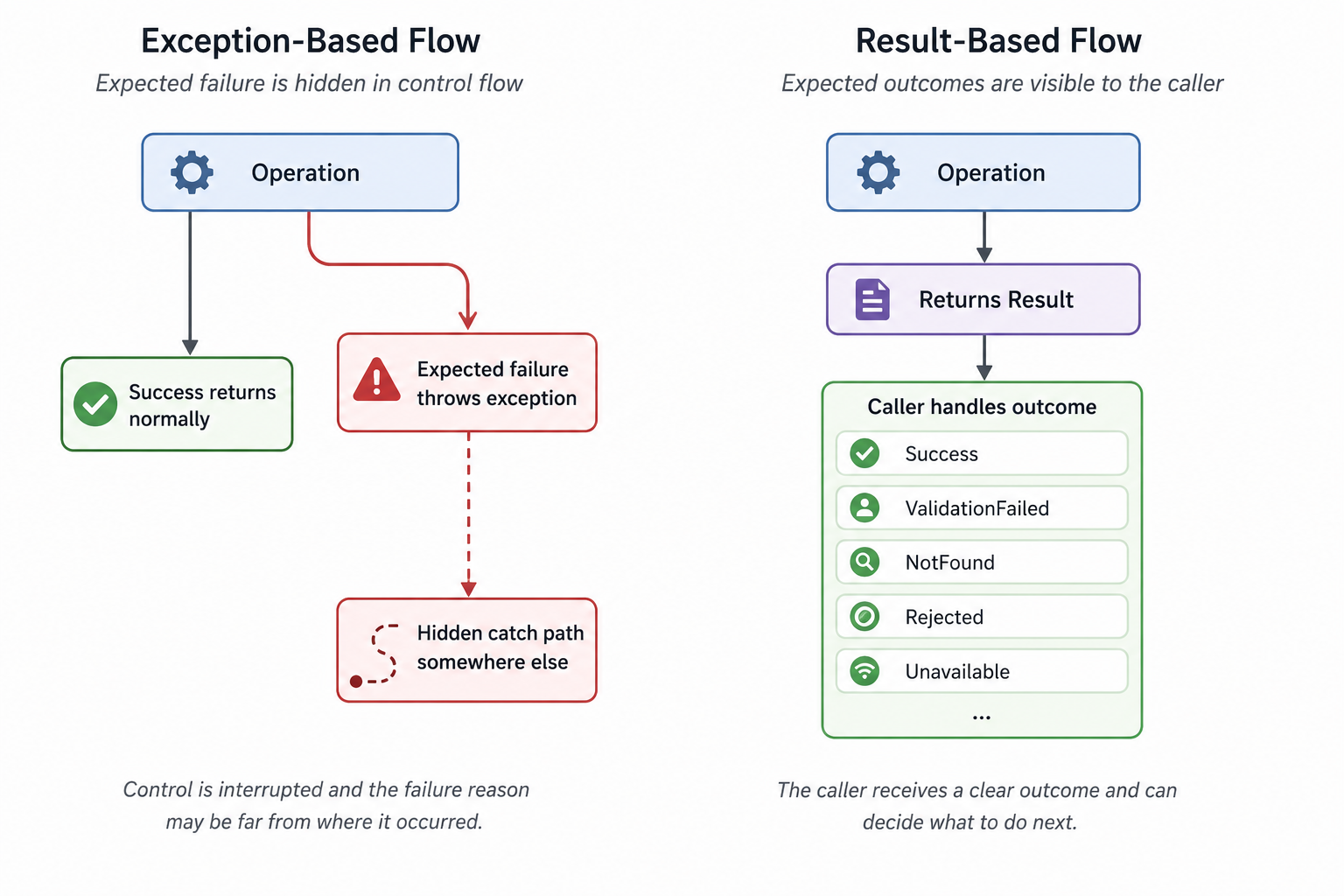
Exceptions interrupt the normal path, while results make expected outcomes visible where the caller can decide what to do next.
5. A Good Result Type Should Help the Caller Decide
A result type is only useful if it helps the caller decide what to do next.
It should not merely replace an exception with a different kind of container. A result that only says Success or Failed may be enough in some cases, but often it is too vague. The caller knows that something went wrong, but not what kind of response the workflow expects.
That can lead to the same problem as exceptions.
The failure is no longer thrown, but the meaning is still unclear.
A good result type should express the outcomes the caller can reasonably handle. It may distinguish between validation failure, not found, rejected operation, conflict, unavailable dependency, or a provider response that needs translation. The exact shape depends on the workflow, but the goal is the same: the caller should receive enough information to make a correct decision without learning unnecessary implementation details.
This does not mean every result needs many states.
Some operations only need success or failure. Others need a small error code, a message, or a collection of validation errors. Some need a typed value on success and a structured reason on failure. The important thing is that the result matches the decisions the caller actually has to make.
The result should also use the language of the application.
If an email cannot be sent because the address is invalid, the caller should not need to understand the provider’s SMTP response. If a license cannot be activated because it has expired, the caller should not need to inspect a low-level exception. Those technical details may still be logged or preserved internally, but the result returned to the caller should describe the outcome at the right level.
This makes the code easier to work with.
The caller can switch on a small set of meaningful outcomes. Tests can assert behavior without depending on provider-specific mechanics. UI or API layers can translate the result into messages or status codes without guessing what the failure means.
A weak result type hides the decision.
A good result type carries the decision to the place where it belongs.
6. Separating Technical Failure from Workflow Failure
One of the practical benefits of returning results is that it helps separate technical failure from workflow failure.
Those two things are often related, but they are not the same.
A technical failure describes something about how an operation was attempted. A network call timed out. A database command failed. A provider returned an unexpected response. A file could not be read. These details may be important for logging, diagnostics, retry behavior, or operational monitoring.
A workflow failure describes what the application should do next.
A license could not be activated. A message could not be sent. A command was rejected. A user could not be created. A requested item was not available. These are outcomes the application may need to handle in a meaningful way.
The distinction matters because callers usually do not need every technical detail.
If an email provider rejects a recipient address, the workflow may need to tell the user that the address is invalid. It probably should not expose the provider’s raw error code. If a payment provider declines a transaction, the workflow may need to return a declined result. It does not necessarily need to throw the provider exception all the way through the application.
A result gives the boundary a place to translate.2
The infrastructure layer can deal with technical signals. It can catch provider-specific exceptions, inspect status codes, preserve diagnostic details, and decide whether something should be logged or retried. Then it can return an application-level result that describes the outcome in language the caller understands.
That keeps technical failure from leaking too far into the workflow.
Without that translation, application code may start depending on infrastructure details. A service may check for provider-specific exception types. A UI may react to low-level error codes. Tests may need to simulate technical failures that should have been hidden behind a clearer application contract.
Returning results does not mean technical details are lost.
They can still be logged. They can still be attached as internal diagnostics. They can still be used by the adapter or infrastructure component that understands them. But the caller receives a result shaped around the decision it has to make.
That is the useful separation.
Technical failure explains what went wrong underneath.
Workflow failure explains what the application should do about it.
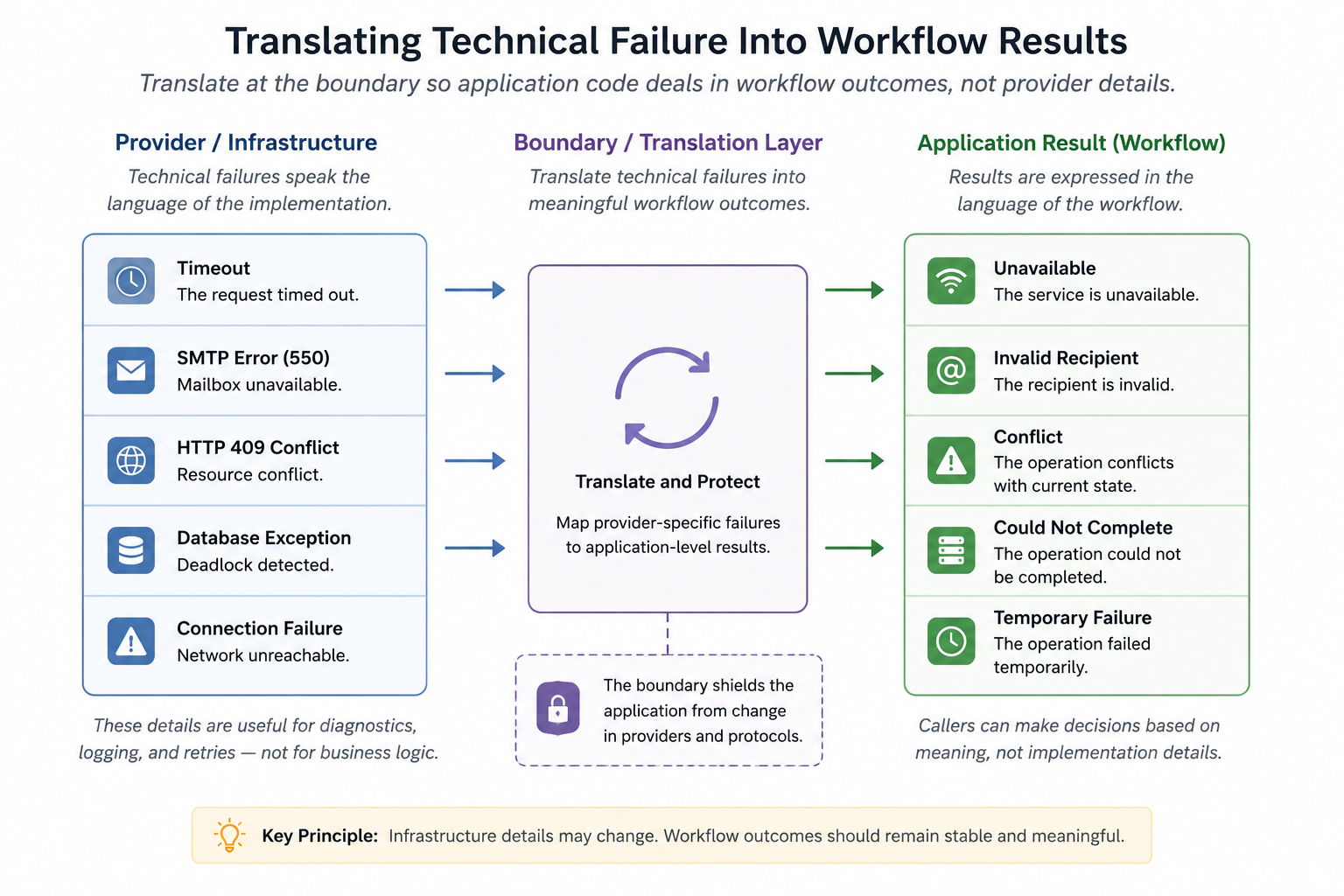
Technical failures often need to be translated at the boundary into workflow outcomes the application can handle deliberately.
7. When Exceptions Still Belong
Returning results does not mean exceptions should disappear.
Exceptions still have an important place. They are useful when something happens that the current level of code cannot reasonably treat as part of the normal workflow. They signal that execution has left the expected path in a way the caller may not be able to handle locally.
A programming error is one example.
If a required dependency is missing, an invariant is violated, or a method is called with arguments that should never occur from valid application code, an exception may be appropriate. The problem is not an expected outcome of the workflow. It is a sign that something is wrong with the code, configuration, or assumptions.
Unexpected infrastructure failures may also belong as exceptions at some levels.
If the database is unavailable, a file system operation fails unexpectedly, or an external service returns a malformed response, the code may not have a meaningful business result to return immediately. The failure may need to interrupt the operation, be logged, trigger retries, or be translated at a boundary that understands the larger context.
The important phrase is at some levels.
An exception may be appropriate inside an adapter, but not as the final shape returned to application code. A provider exception may be useful while talking to the provider, but the application service may need a result such as Unavailable, Rejected, or CouldNotSend. The exception can still exist, but it should be translated before it leaks into code that should not understand provider details.
This is where the distinction becomes practical.
Use exceptions for unexpected failures, invalid states, broken assumptions, and situations where the current code cannot make a meaningful workflow decision. Use results for outcomes the caller is expected to handle as part of the application behavior.
The boundary between the two is not always perfect.
Some failures begin as technical exceptions and become workflow results after translation. A timeout may be technical in the HTTP client, but meaningful as ServiceUnavailable in the application. A provider-specific error may be exceptional in the adapter, but expected enough to become a named result for the caller.
That is not a contradiction.
It is a sign that different layers have different responsibilities. Exceptions and results can both be useful when they are used at the right level.
The goal is not to avoid throwing.
The goal is to avoid making every failure look exceptional.
8. Returning Results Can Make Tests Clearer
Returning results can make tests clearer because the expected outcome becomes part of the normal flow.
A test does not have to prove that control was interrupted. It can call the operation, inspect the result, and assert what the workflow should do next. Success and expected failure are both represented as values the test can read directly.
That usually makes the test more descriptive.
Instead of saying only that an exception was thrown, the test can say that validation failed, the item was not found, the operation was rejected, or the external dependency was unavailable. The assertion becomes closer to the language of the application.
This matters because tests are not only safety checks.
They are also documentation of behavior.
When a workflow returns a result, tests can show the possible outcomes in a direct way. One test may describe the successful path. Another may describe invalid input. Another may describe a known provider failure translated into an application-level outcome. The tests explain what the caller can expect without requiring the reader to infer meaning from exception types or catch blocks.3
This is especially useful when testing application services.
The test can arrange a dependency to return a known result, execute the service, and assert the response. It does not need to simulate low-level exception mechanics unless those mechanics are part of the behavior being tested. The focus stays on the decision the application makes.
Results also make failure assertions less brittle.
Exception-based tests often depend on a specific exception type, message, or throwing point. That can be appropriate for programming errors or invalid states, but it can be too fragile for expected workflow outcomes. A refactoring may change where an exception is thrown without changing the behavior that matters to the caller.
With a result, the test can assert the meaningful outcome instead.
For example, it can assert that the operation returned ValidationFailed, NotFound, Conflict, or Unavailable. It can assert that a message was not sent, that a record was not saved, or that a user-facing error was produced. Those assertions describe behavior more clearly than simply verifying that the operation stopped.
Returning results does not automatically create good tests.
A vague result type can still lead to vague assertions. But when the result type is designed around caller decisions, the tests usually become easier to read because they can assert the decision directly.
Good tests should make important behavior visible.
Returning meaningful results often helps them do exactly that.
9. Results Should Not Become Vague Containers
A result type can improve clarity, but only if it has a clear shape.
If the result becomes too vague, it can recreate many of the same problems it was meant to solve. The code may no longer throw exceptions everywhere, but the caller may still have to guess what happened and what it is supposed to do next.
This often happens when a result type is designed too generally.
It may have a Boolean success flag, a string message, an optional error code, an optional exception, an optional value, and perhaps a collection of details. That kind of structure can represent many things, but it may not explain any of them very well.
The result becomes a bag of possible information.
Callers then have to inspect combinations of fields. Is Success false because validation failed, because something was not found, because the operation was rejected, or because an external service was unavailable? Should the message be shown to the user, logged, translated, or ignored? Is the exception part of the expected result, or is it only diagnostic information?
Those questions should not be left to every caller.
A useful result type should reduce ambiguity. It should make the important outcomes explicit enough that the caller can respond correctly. If the caller needs to branch on the reason for failure, the result should expose that reason in a stable form. If validation errors matter, they should be represented clearly. If diagnostic details exist only for logging, they should not become the main way the caller understands the outcome.
This does not mean every result type needs to be complicated.
The opposite is often true. A small result with a few meaningful outcomes is usually better than a large generic container that can technically represent anything. The result should be just specific enough to describe the decisions the caller needs to make.
A vague result hides responsibility.
It lets the method return something instead of throwing, but it does not clearly say what the operation means when it fails. That can move confusion from exception handling into result handling.
The goal is not merely to avoid exceptions.
The goal is to make expected outcomes easier to understand.
A result type should therefore be designed as part of the application contract, not as a dumping ground for whatever failure information happened to be available.
10. Designing Result Types Around Caller Needs
A result type should be designed from the caller’s point of view.
That does not mean the caller gets to decide every internal detail. It means the result should expose the outcomes the caller is responsible for handling. The shape of the result should follow the decisions that need to be made after the operation completes.
This is a useful way to avoid both extremes.
On one side, a result can be too small. It may only say that the operation failed, without explaining whether the caller should retry, show a validation message, return a not-found response, or stop the workflow. On the other side, a result can be too large. It may expose technical details, raw exceptions, provider codes, or diagnostic information that the caller should not need to understand.
A good result sits between those extremes.
It gives the caller enough information to make the right application decision, but not so much that the caller becomes coupled to the implementation.4 It describes the outcome in the language of the workflow.
For example, a command handler may return Succeeded, ValidationFailed, NotFound, or Conflict. A message sender may return Sent, InvalidRecipient, Rejected, or Unavailable. A license activation operation may return Activated, Expired, AlreadyUsed, or InvalidKey.
The exact names matter less than the principle.
The result should express the meaningful states of the operation. It should not force every caller to parse a message string, inspect an exception type, or reverse-engineer what happened from a generic error code.
This also helps keep responsibilities separated.
The method creating the result is responsible for understanding the operation. The caller is responsible for choosing the next step. The result is the contract between those two responsibilities. If that contract is clear, the workflow becomes easier to read and easier to change.
Designing a result type often starts with a simple question:
What does the caller need to do differently depending on the outcome?
If two failures lead to the same response, they may not need separate public result states. If two failures require different responses, they probably should not be hidden behind the same generic failure. If a technical detail is useful for diagnostics but not for the caller’s decision, it can be logged or stored internally instead of being exposed as part of the main result.
This keeps the result focused.
It becomes a small model of the caller’s choices, not a complete report of everything that happened underneath.
That is what makes a result type useful.
It turns failure handling from a vague interruption into an explicit part of the application contract.
11. Refactoring from Exceptions Toward Results
Moving from exceptions to results does not have to be a large rewrite.
It is usually safer to start where the distinction is already clear. Look for operations where failure is expected, meaningful, and handled by the caller. Validation, not-found cases, rejected commands, provider-declined operations, and known unavailable states are often good candidates.
Those failures already belong to the workflow.
The first step is often to name the outcomes. Instead of asking, “Which exception should this method throw?”, ask, “What can the caller reasonably do when this operation does not succeed?” That question usually leads to a smaller and clearer set of result states.
For example, a method that throws for invalid input, missing data, and a rejected operation might become a method that returns ValidationFailed, NotFound, or Rejected. The result does not need to describe every internal detail. It needs to describe the decision the caller must make.
The refactoring can then move gradually.
A lower-level adapter may still catch provider exceptions. A repository may still throw for unexpected persistence problems. A boundary component may translate those failures into application-level results. Callers can then be updated one at a time to handle the result instead of catching exceptions that were never truly exceptional at their level.
Tests are useful during this transition.
Existing tests that assert expected exceptions can often be rewritten to assert meaningful result states. Instead of proving that an operation threw, the test can prove that the workflow returned ValidationFailed, did not save invalid data, did not send a message, or produced a response the caller can use.
This usually makes the intent clearer.
It also helps reveal where exceptions still belong. If a failure represents a broken assumption, invalid internal state, or unexpected infrastructure problem that the current code cannot handle meaningfully, it may remain an exception. The goal is not to remove all throws. The goal is to stop using exceptions as the default shape for expected outcomes.
During the refactoring, it can be helpful to keep result types small.
Do not introduce a generic result container for every possible failure just to make the change easier. Start with the caller’s decision. Let the result express what the workflow needs to know. Add detail only when it changes how the caller should respond.
Over time, the code becomes more explicit.
Expected outcomes move into contracts. Boundary translation becomes clearer. Tests become more behavior-focused. Exceptions remain available for truly exceptional situations, but they no longer carry every ordinary failure through hidden control flow.
That is often a healthier balance.
12. Closing
Exceptions and results both have a place.
The value comes from using each one for the kind of failure it represents.
Exceptions are useful when something breaks outside the expected workflow. They can signal invalid states, broken assumptions, unexpected infrastructure problems, or situations where the current code cannot make a meaningful application decision.
Results are useful when failure is part of the workflow.
They make expected outcomes visible. They help callers understand what happened and what decision needs to be made next. They allow application code to distinguish validation failures, rejected operations, missing data, unavailable services, and other meaningful states without treating them all as exceptional interruptions.
This makes the contract more honest.
A method that returns a result says: this operation may succeed, but it may also produce an outcome the caller is expected to handle. That is often clearer than hiding expected failure behind thrown exceptions and hoping the right catch block exists somewhere above.
Good result types do not merely avoid throwing.
They express useful meaning.
They should be shaped around caller decisions, not around every technical detail that happened underneath. They should help the workflow continue, stop, retry, report, or explain the outcome at the right level.
The goal is not to turn every method into a result-returning method.
That would only replace one habit with another.
The goal is to be deliberate. Throw when the situation is truly exceptional at that level. Return a result when the outcome is expected, meaningful, and part of the application behavior.
That distinction makes failure handling easier to read, easier to test, and easier to change.
It also makes the code more honest about what can happen.
Want occasional updates?
Subscribe to receive occasional practical notes on .NET architecture, maintainable software, project progress, and new articles.