Local Reasoning Is an Architectural Superpower
Architecture Principles · 2026-07-03
A discussion of local reasoning and why maintainable systems allow developers to understand behavior without traversing large portions of the codebase. Good architecture reduces cognitive load by keeping ownership, behavior, and responsibilities visible and close together.
Local Reasoning Is an Architectural Superpower
1. Introduction: Understanding Systems Locally
One of the most valuable qualities of a well-designed software system is that developers can understand it without exploring large portions of the codebase.
A developer should be able to examine a method, a service, a component, or an API and form a reasonably accurate understanding of its behavior without needing to trace execution across dozens of files, layers, or abstractions.
When this is possible, the system supports what can be called local reasoning.
Local reasoning is the ability to understand behavior by looking at a relatively small part of the system at a time.
Developers do not need complete knowledge of the entire application. They only need enough surrounding context to understand the component they are currently working with.
This may sound like a simple idea, but it has profound implications for architecture.
Many of the systems that developers describe as "easy to work with" share this characteristic. Responsibilities are visible. Dependencies are clear. Naming communicates intent. Ownership boundaries are understandable. Important behavior can be discovered without extensive investigation.
By contrast, many systems that feel difficult to maintain suffer from the opposite problem.
Understanding even a small change often requires answering questions such as:
- Where is this behavior actually implemented?
- What other components influence this result?
- Which service owns this decision?
- What hidden side effects occur?
- What other parts of the system must I understand before I can safely make a change?
The answers may exist somewhere in the codebase, but finding them requires traversal.
Developers move from class to class, service to service, abstraction to abstraction, gradually constructing a mental model of behavior.
The larger that traversal becomes, the more difficult the system becomes to reason about.
This is one reason architectural complexity is often misunderstood.
Many developers associate complexity with:
- large codebases,
- sophisticated business rules,
- distributed systems,
- or advanced technical requirements.
Those factors certainly contribute.
However, complexity is often experienced in a different way.
A system feels complex when understanding a small piece of behavior requires understanding a large portion of the surrounding system.
A useful distinction is therefore:
Complexity is not only about how much code exists. It is also about how much of that code must be understood at the same time.
This idea connects naturally to many other architectural concerns.
For example:
- unclear ownership increases traversal,
- hidden dependencies increase traversal,
- poorly designed APIs increase traversal,
- excessive abstraction increases traversal,
- and weak boundaries increase traversal.
In each case, developers must look further away from the code they are currently reading in order to understand what is happening.
The result is increased cognitive load.
Developers spend less time solving business problems and more time reconstructing how the system works.
This is one reason experienced developers often place significant value on architectural clarity.
Their goal is not merely to make code technically correct. Their goal is to create systems where understanding remains local whenever possible.
When developers can reason locally, changes become safer, onboarding becomes easier, debugging becomes faster, and the system becomes significantly easier to evolve over time.
For that reason, local reasoning can be viewed as one of the most important—and often overlooked—qualities of good architecture.
Understanding why it matters, what causes it to break down, and how architecture can support it is the focus of this article.
2. Why Developers Need Local Reasoning
Software systems are ultimately maintained through a series of small decisions.
A developer investigates a defect. A new feature is added. A business rule changes. A performance issue is analyzed. A security concern is addressed. Most day-to-day work focuses on understanding and modifying a relatively small part of the overall system.
This is where local reasoning becomes important.
Developers rarely have the time or capacity to hold an entire application in their heads at once. Even in modest systems, the number of classes, services, workflows, integrations, and business rules quickly exceeds what any individual can actively reason about.
As systems grow, the ability to work effectively increasingly depends on reducing the amount of context required for each decision.
For example, imagine a developer needs to modify the rules governing order approval.
In one system, they can:
- locate the relevant domain object,
- understand the existing rules,
- make the required change,
- verify the behavior,
- and move on.
The work remains focused on a small and well-defined area of the codebase.
In another system, the same change requires investigating:
- multiple services,
- validation layers,
- workflow definitions,
- event handlers,
- API endpoints,
- and several different abstractions.
Before making a single modification, the developer must first reconstruct how the behavior is distributed throughout the system.
The business rule may be identical in both systems, yet the effort required to understand and change it is dramatically different.
This difference is one of the most practical consequences of local reasoning.
When developers can understand behavior locally:
- changes become safer,
- debugging becomes faster,
- onboarding becomes easier,
- reviews become more effective,
- and defects become easier to identify.
The reason is simple.
Developers can make decisions with confidence because the relevant information is visible within a manageable scope.
By contrast, when understanding depends on large amounts of distributed context, every change carries additional uncertainty.
Questions begin appearing naturally:
- Have I found all the relevant code?
- Is this behavior duplicated elsewhere?
- What side effects occur indirectly?
- Which component is actually responsible?
- What assumptions am I missing?
The need to answer these questions consumes time and attention.
This is one reason local reasoning has such a strong relationship with cognitive load.
Every additional dependency, traversal step, or ownership boundary that developers must understand increases the amount of information they must keep active in their minds.
A useful distinction is:
Developers solve problems most effectively when the information required to make a decision is located close to the decision itself.
Good architecture helps make this possible.
Rather than scattering behavior across many unrelated locations, it creates structures where responsibilities are visible and discoverable. Developers can often understand what something does by examining the component that owns it rather than tracing behavior through large portions of the system.
This principle applies regardless of technology.
Whether the system is:
- a desktop application,
- a web application,
- a distributed service,
- an API platform,
- or an enterprise system,
developers benefit when important behavior remains close to its source of truth.
Local reasoning also has a significant effect on team dynamics.
When systems require extensive global knowledge, productivity becomes concentrated among a small number of people who understand the system's hidden relationships.
Other developers become dependent on tribal knowledge.
Changes slow down because understanding is difficult to transfer.
By contrast, systems that support local reasoning are easier to share across teams. New developers can become productive more quickly because they can understand parts of the system independently without first mastering the entire codebase.
This improves maintainability, scalability, and resilience over time.
A useful observation is therefore:
The easier it is to understand a piece of behavior in isolation, the easier it becomes for the entire team to work with the system.
For that reason, local reasoning is not merely a technical convenience.
It is one of the primary ways architecture helps developers remain effective as systems grow in size, complexity, and age.
3. What Makes Local Reasoning Difficult
If local reasoning is such a valuable architectural quality, why do so many systems struggle to support it?
The answer is rarely a single design decision.
Most systems do not begin their lives as difficult-to-understand collections of hidden dependencies, scattered responsibilities, and unclear behavior. Instead, complexity tends to accumulate gradually as the system evolves.
Each individual change often appears reasonable.
A new abstraction is introduced to improve reuse. A workflow gains additional responsibilities. Validation is added in multiple locations. A business rule is duplicated temporarily. An event handler is created to support a new feature.
None of these decisions may seem particularly problematic in isolation.
The difficulty emerges when many such decisions accumulate over time.
Eventually, understanding a simple piece of behavior requires traversing an increasingly large portion of the system.
One of the most common causes is unclear ownership.
When developers cannot easily identify which component owns a decision, behavior tends to spread across multiple locations.
For example:
- business rules appear in workflows,
- validation appears in several layers,
- APIs begin making business decisions,
- user interfaces contain domain behavior,
- and services share overlapping responsibilities.
At that point, understanding the behavior requires examining several components rather than one obvious owner.
Local reasoning begins to break down.
Another common cause is hidden dependencies.
A component may appear straightforward when viewed in isolation, yet its behavior depends on:
- configuration values,
- event handlers,
- background processes,
- shared state,
- feature flags,
- or services that are not immediately visible.
The component no longer communicates its full behavior directly.
Developers must investigate surrounding infrastructure before they can confidently understand what the code actually does.
A useful distinction is:
The more behavior depends on information that is not visible locally, the more difficult local reasoning becomes.
Excessive indirection can create a similar problem.
Abstractions are valuable when they reduce complexity.
However, when developers must repeatedly navigate through layers that add little information, understanding becomes increasingly expensive.
For example, a simple operation may require traversing:
Controller
↓
Facade
↓
Coordinator
↓
Manager
↓
Processor
↓
Service
before reaching the code that actually performs the work.
Each layer may appear justified individually, but together they increase the amount of the system developers must understand before they can reason about behavior confidently.
This additional traversal creates cognitive load.
Another factor is inconsistent architectural patterns.
Developers naturally build mental models based on previous experience within a system.
When similar problems are solved differently in different areas of the codebase, those mental models become less reliable.
For example:
- one feature stores rules in domain objects,
- another stores them in services,
- a third stores them in workflows,
- and a fourth distributes them across several layers.
The result is uncertainty.
Developers cannot predict where behavior belongs, so they must search for it.
Local reasoning depends heavily on predictability.
A useful observation is:
Developers can reason locally only when they can trust the system's patterns and ownership boundaries.
When those patterns become inconsistent, understanding becomes increasingly global.
This is one reason cognitive load and local reasoning are so closely connected.
Every additional dependency, ownership ambiguity, hidden side effect, or unnecessary traversal step increases the amount of context required to understand a piece of behavior.
The system may still function correctly.
The challenge is that understanding it becomes progressively more expensive.
A useful warning sign is therefore:
When developers regularly need to inspect large portions of the system to understand a small piece of behavior, local reasoning is probably breaking down.
Recognizing these causes is important because they rarely appear all at once.
They emerge gradually as systems evolve.
The goal of good architecture is not eliminating complexity entirely. Most real systems contain unavoidable complexity.
The goal is ensuring that as much of that complexity as possible remains visible, discoverable, and locally understandable.
4. Hidden Traversal and Cognitive Load
One of the most significant consequences of poor local reasoning is the amount of traversal it introduces into everyday development work.
Traversal occurs whenever developers must move through multiple parts of a system to understand a single piece of behavior.
Some traversal is unavoidable.
Real systems contain dependencies, abstractions, integrations, and boundaries that naturally require developers to understand more than one component at a time.
The problem arises when traversal becomes the primary way behavior is understood.
Instead of looking at the code that owns a responsibility, developers find themselves repeatedly navigating through unrelated parts of the system simply to answer basic questions.
For example:
- Why was this decision made?
- Which rule produced this result?
- Where is this validation implemented?
- What causes this state change?
- What happens after this operation completes?
The answers may exist within the system, but they are no longer located near the behavior they explain.
Developers must discover them through investigation.
This creates cognitive load.
A useful distinction is:
Cognitive load increases whenever understanding requires remembering information from multiple locations simultaneously.
Consider a simple business rule.
In a system that supports local reasoning, the developer may be able to understand the rule by examining a single domain object or service.
The relationship between behavior and ownership is obvious.
In a system with extensive hidden traversal, understanding the same rule may require visiting:
API Endpoint
↓
Application Service
↓
Workflow
↓
Validation Component
↓
Domain Service
↓
Event Handler
Only after tracing through several layers does the complete picture emerge.
The business rule itself may not be particularly complicated.
The complexity comes from the amount of context required to understand it.
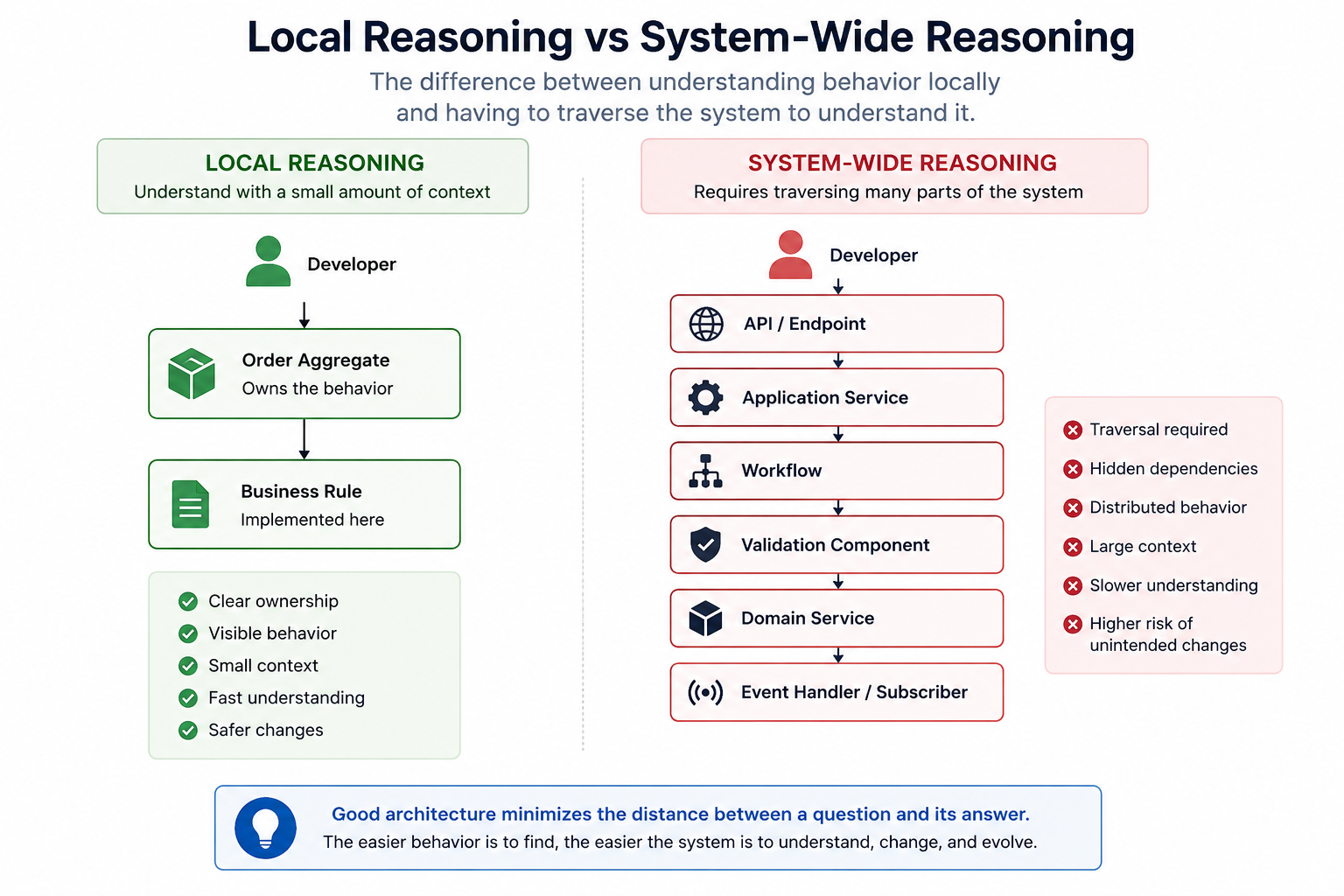
Good architecture minimizes the distance between a question and its answer.
This distinction is important because developers often attribute frustration to the wrong source.
The issue is not always that a system contains too much logic.
Frequently, the issue is that the logic is distributed in a way that forces developers to mentally reconstruct behavior from multiple locations.
The result is a growing burden on working memory.
Developers must remember:
- what they discovered earlier,
- where related behavior exists,
- which components participate,
- which assumptions remain valid,
- and which paths they have already investigated.
The more information that must be held simultaneously, the more mentally expensive the system becomes.
This is one reason local reasoning and cognitive load are so closely connected.
A useful observation is:
Developers experience complexity through the amount of context they must actively maintain while solving a problem.
This closely mirrors the broader relationship between architecture and cognitive load discussed elsewhere in this series.1
Hidden traversal increases that context.
Every additional layer, dependency, ownership boundary, or indirect behavior adds another piece of information that must be understood before a decision can be made confidently.
This effect becomes particularly visible during debugging.
When behavior is locally understandable, developers can often identify a problem by examining a relatively small area of the system.
When behavior is distributed across many components, even simple defects may require extensive investigation before the actual cause becomes visible.
The same pattern appears during feature development.
A change that appears straightforward may require understanding a surprising number of surrounding components before implementation can begin safely.
The result is slower development, increased uncertainty, and greater risk of unintended side effects.
This is one reason experienced developers often place such high value on architectural clarity.
Their goal is not merely reducing the number of classes, methods, or services.
Their goal is reducing the amount of traversal required to understand behavior.
A useful warning sign is therefore:
When developers spend more time tracing behavior than understanding behavior, hidden traversal is likely becoming a significant source of cognitive load.
Good architecture does not eliminate traversal entirely.
Instead, it minimizes unnecessary traversal by keeping responsibilities visible, ownership clear, and behavior close to the components that own it.
The less distance developers must travel to understand a decision, the easier the system becomes to reason about locally.
5. Ownership Improves Local Reasoning
One of the most effective ways to improve local reasoning is to establish clear ownership.
When developers can easily answer the question:
Who owns this decision?
understanding becomes significantly easier.
The reason is simple.
Ownership determines where developers should look when they need to understand behavior.
If a business rule belongs to a domain object, developers know where to start. If validation belongs to a specific component, developers know where to find it. If workflow coordination belongs to an application service, developers know where orchestration logic should exist.
The system becomes easier to navigate because responsibilities have obvious homes.
By contrast, unclear ownership creates uncertainty.
For example, imagine a developer needs to understand why an order was rejected.
Where should they look?
- The API endpoint?
- The application service?
- The workflow?
- The validation component?
- The domain object?
- The database?
When ownership is unclear, every location becomes a possibility.
Developers must investigate multiple parts of the system before understanding can occur.
Local reasoning begins to break down because behavior is no longer associated with an obvious owner.
This is one reason ownership and cognitive load are so closely connected.
A useful distinction is:
Clear ownership reduces the number of places developers must search for understanding.
The importance of clear ownership appears repeatedly in architectural design, particularly when defining validation responsibilities and business-rule boundaries.2
The effect becomes particularly visible when systems evolve.
Business requirements change constantly.
New rules are introduced. Existing rules are modified. Edge cases appear. Exceptions are added.
When ownership is well defined, these changes tend to occur in predictable locations.
Developers can often modify behavior by working within a relatively small area of the system.
The surrounding architecture continues supporting local reasoning.
When ownership is fragmented, the opposite occurs.
The same behavior may exist partially in:
- workflows,
- services,
- APIs,
- validation components,
- user interfaces,
- or supporting infrastructure.
Understanding a single rule requires assembling pieces from multiple locations.
The behavior may still function correctly, but understanding it becomes increasingly expensive.
This pattern appears repeatedly in architectural problems.
For example:
- DTOs begin owning business behavior.
- User interfaces make domain decisions.
- Workflows enforce business rules.
- APIs perform validation that belongs elsewhere.
- Services accumulate responsibilities that overlap with other components.
In each case, ownership becomes blurred.
The result is not merely architectural untidiness.
The result is reduced local reasoning.
Developers can no longer understand behavior by examining the component that appears responsible because responsibility is distributed across several locations.
A useful observation is:
Local reasoning improves when behavior and ownership remain closely aligned.
This alignment creates predictability.
When developers know what a component owns, they can make reasonable assumptions about where related behavior belongs.
The architecture itself begins providing guidance.
This idea connects naturally to many broader architectural principles.
For example:
- clear boundaries improve ownership,
- predictable APIs improve ownership,
- strong domain models improve ownership,
- explicit responsibilities improve ownership,
- and discoverable architecture improves ownership.
In each case, the system helps developers find answers without extensive investigation.
This is one reason experienced developers often spend significant effort defining responsibility boundaries.
Their goal is not simply organizational cleanliness.
Their goal is making the system easier to understand.
A useful warning sign is therefore:
When developers frequently disagree about where a piece of behavior belongs, ownership is probably no longer clear enough.
Good architecture does not eliminate complexity.
Instead, it gives complexity a home.
Once developers know where responsibilities belong, understanding becomes more local, changes become safer, and the system becomes significantly easier to reason about over time.
Ownership, therefore, is not merely an organizational concern.
It is one of the primary mechanisms through which architecture supports local reasoning.
6. APIs, Boundaries, and Predictability
Local reasoning depends heavily on predictability.
Developers can understand a system locally only when they can make reasonable assumptions about how its parts behave.
This is one reason APIs and architectural boundaries play such an important role.
Every boundary in a system acts as a communication point.
An API communicates:
- available operations,
- expected behavior,
- ownership,
- responsibilities,
- and assumptions that callers may safely make.
When those signals are clear, developers can often understand behavior without examining the implementation behind the boundary.
The API itself provides enough information to support local reasoning.
For example, consider the following operations:
ApproveOrder()
CancelOrder()
ShipOrder()
Most developers can make reasonable assumptions about what these operations do.
The names communicate intent.
The available actions reveal the business workflow.
The boundary itself provides guidance.
Understanding remains local because callers do not need to inspect the implementation before forming a mental model of the behavior.
The opposite occurs when boundaries fail to communicate clearly.
For example:
Process()
Execute()
Handle()
These operations provide far less information.
Developers immediately begin asking questions:
- What does this operation actually do?
- What business decision does it represent?
- Does it change state?
- Does it trigger side effects?
- How does it differ from other operations?
The boundary no longer supports understanding.
Developers must investigate implementation details before they can reason about behavior confidently.
Local reasoning begins to deteriorate.
A useful distinction is:
Good boundaries allow developers to understand behavior without crossing the boundary.
This principle aligns closely with the idea that predictable APIs reduce the amount of investigation required before developers can act confidently.3
This idea explains why predictability is so valuable.
Predictable APIs reduce the amount of context developers must acquire before they can use a component safely.
They create reliable expectations.
For example, developers naturally expect:
- queries to retrieve information,
- commands to perform actions,
- validation failures to be reported consistently,
- similar operations to behave similarly,
- and ownership boundaries to remain stable.
When these expectations prove reliable, developers can reason locally.
When they do not, understanding increasingly depends on investigation.
Boundaries also influence discoverability.
A developer encountering an unfamiliar area of a system should be able to answer questions such as:
- What capabilities are available?
- Which component owns this responsibility?
- What actions are supported?
- Where should a new behavior belong?
without tracing through large portions of the implementation.
The architecture itself should provide those answers.
This is one reason experienced developers often invest significant effort in designing interfaces, APIs, and boundaries carefully.
The goal is not merely technical correctness.
The goal is making understanding easier.
A useful observation is:
Every unclear boundary increases the amount of the system developers must understand before they can act confidently.
This effect becomes particularly visible as systems grow.
A small application may tolerate ambiguous responsibilities because developers can hold much of the system in memory.
Larger systems cannot rely on that advantage.
As complexity increases, developers become increasingly dependent on boundaries that communicate clearly and behave predictably.
This is why many architectural principles ultimately reinforce one another.
Clear ownership improves local reasoning.
Predictable APIs improve local reasoning.
Strong boundaries improve local reasoning.
Reduced cognitive load improves local reasoning.
Although these ideas are often discussed separately, they are closely connected.
Each reduces the amount of context developers must acquire before understanding can occur.
A useful warning sign is therefore:
When developers routinely cross multiple boundaries simply to understand a single piece of behavior, those boundaries may no longer be supporting local reasoning effectively.
Good architecture creates boundaries that help developers understand the system.
Poor architecture creates boundaries that developers must repeatedly investigate.
The difference has a profound effect on how easily a system can be maintained, extended, and understood over time.
7. Practical Signs Local Reasoning Is Breaking Down
Local reasoning rarely disappears all at once.
Most systems do not suddenly become difficult to understand. Instead, the ability to reason locally gradually erodes as complexity accumulates over time.
This makes the warning signs particularly important.
By the time developers explicitly describe a system as difficult to maintain, many of the underlying causes have often existed for years.
One of the earliest signs is increasing traversal.
Developers begin opening more files, navigating through more layers, and inspecting more components simply to understand behavior that once felt straightforward.
For example, a developer may need to investigate:
- an API endpoint,
- an application service,
- a workflow,
- several event handlers,
- and a domain object
before understanding why a particular decision was made.
The issue is not necessarily the number of components involved.
The issue is that understanding depends on all of them simultaneously.
Another common sign is growing dependence on tribal knowledge.
Developers begin hearing statements such as:
- "You need to know how this part works."
- "Ask Sarah before changing that."
- "There is some special logic hidden elsewhere."
- "That behavior comes from another process."
- "The implementation is more complicated than it looks."
These statements often indicate that important behavior is no longer discoverable through the structure of the system itself.
Understanding increasingly depends on knowledge that exists outside the code.
This is usually a warning sign that local reasoning is weakening.
A useful distinction is:
When understanding depends on people more than the architecture, local reasoning is often breaking down.
Another indicator is ownership uncertainty.
Developers begin asking questions such as:
- Where should this new rule go?
- Which component owns this behavior?
- Should this change be implemented here or elsewhere?
- Which version of the logic is authoritative?
When ownership becomes unclear, understanding becomes increasingly distributed.
The system stops providing obvious answers.
Developers must investigate before they can make even routine decisions.
Local reasoning becomes more difficult because the architecture no longer guides understanding.
Unexpected side effects provide another strong signal.
A developer modifies what appears to be a small piece of behavior only to discover that:
- another workflow changes,
- a notification stops working,
- a background process behaves differently,
- or an unrelated feature is affected.
These situations often occur because important dependencies are hidden.
The visible code no longer communicates the full impact of a change.
Developers cannot reason confidently because critical information exists elsewhere.
Another warning sign is decreasing predictability.
Developers lose confidence in assumptions that should normally be safe.
Questions become increasingly common:
- Does this method really do what its name suggests?
- Is there additional behavior somewhere else?
- What hidden dependencies exist?
- Which components participate in this workflow?
- Am I seeing the complete picture?
The need to continually verify assumptions increases cognitive load and slows development.
A useful observation is:
Local reasoning depends on trust. When developers stop trusting their assumptions, understanding becomes increasingly expensive.
The same pattern often appears during onboarding.
New developers struggle to become productive because understanding even simple behavior requires navigating large portions of the system.
They cannot easily learn one area at a time because behavior depends on too many surrounding components.
The architecture effectively demands global understanding before local work can occur.
This is usually a sign that local reasoning has already deteriorated significantly.
A particularly revealing warning sign is when developers become reluctant to make changes.
Comments such as:
- "I'm afraid to touch that."
- "This area is risky."
- "Nobody fully understands how this works."
- "Changing that usually breaks something."
often indicate that understanding has become too dependent on hidden relationships and distributed knowledge.
The system may continue functioning correctly, but confidence has begun to disappear.
A useful warning sign is therefore:
When developers need broad system knowledge to make small changes safely, local reasoning is probably breaking down.
Recognizing these signals early is important because local reasoning rarely improves accidentally.
Once traversal, hidden dependencies, ownership ambiguity, and cognitive load begin accumulating, they tend to reinforce one another.
Good architecture requires actively protecting the ability to understand behavior locally.
The sooner these warning signs are identified, the easier it becomes to preserve that ability before complexity becomes deeply embedded in the system.
8. Designing for Local Understanding
If local reasoning is valuable, how can architecture actively support it?
The answer is not a particular framework, pattern, or technology.
Instead, systems become easier to understand when architectural decisions consistently reduce the amount of context developers must acquire before they can understand behavior.
In practice, this means designing for local understanding.
One of the most effective ways to achieve this is through clear ownership.
When responsibilities have obvious owners, developers know where to look.
Business rules belong in predictable locations. Validation has a clear home. Workflow coordination remains separate from decision-making. APIs communicate intent without requiring callers to inspect implementation details.
The architecture itself provides guidance.
A useful distinction is:
Local reasoning improves when developers can answer "where does this belong?" quickly and consistently.
Strong boundaries support the same goal.
Boundaries should help developers understand behavior, not conceal it.
When responsibilities are separated thoughtfully, developers can reason about one part of the system without simultaneously understanding every surrounding component.
This allows knowledge to remain local.
Predictability is equally important.
Developers build mental models based on patterns they observe throughout a system.
When those patterns remain consistent, knowledge becomes reusable.
For example:
- similar operations behave similarly,
- responsibilities remain stable,
- naming follows recognizable conventions,
- and architectural decisions are applied consistently.
Developers can then make reasonable assumptions with confidence.
The architecture becomes easier to navigate because understanding one area helps explain others.
Another important principle is keeping behavior close to its source of truth.
For example, business rules should generally live near the components that own those decisions.
Validation should be implemented where ownership naturally exists.
Workflows should coordinate rather than secretly own business behavior.
When behavior and ownership remain aligned, developers spend less time searching and more time understanding.
This reduces traversal.
A useful observation is:
The closer behavior is to the component that owns it, the easier it becomes to reason about locally.
Reducing unnecessary indirection also helps.
Abstractions should make systems easier to understand, not merely add additional layers.
Every layer introduces a cost.
Developers must learn it, navigate through it, and understand its purpose.
That cost is justified when the abstraction reduces complexity elsewhere.
When it does not, local reasoning becomes more difficult because developers must traverse additional structure without gaining additional understanding.
Discoverability is another important factor.
A developer encountering an unfamiliar area of the system should be able to answer questions such as:
- What does this component do?
- What responsibilities does it own?
- What behaviors can it perform?
- How does it interact with surrounding components?
without extensive investigation.
The structure itself should reveal these answers.
This is one reason naming, ownership, APIs, and boundaries are all so closely connected.
Each contributes to the same outcome:
- reduced traversal,
- lower cognitive load,
- greater predictability,
- and improved local understanding.
A useful architectural test is therefore:
How much of the system must a developer understand before they can confidently explain this behavior?
The smaller the answer, the stronger local reasoning is likely to be.
This principle also scales well over time.
As systems grow, it becomes increasingly unrealistic to expect developers to understand everything.
Architectures that depend on global knowledge become progressively harder to maintain.
Architectures that support local understanding remain manageable because developers can work effectively within limited areas of the system.
A useful goal is therefore not eliminating complexity entirely.
That is rarely possible.
The goal is ensuring that complexity remains visible, discoverable, and close to the responsibilities that create it.
When architecture consistently supports those qualities, developers can understand behavior locally, make changes confidently, and evolve the system without continuously reconstructing how everything works.
That is ultimately the purpose of designing for local understanding.
9. Conclusion
Good architecture is often described in terms of patterns, layers, services, abstractions, and technologies.
While these things matter, they are rarely what developers experience directly when working with a system.
What developers experience is understanding.
They experience how easy it is to answer questions, how quickly behavior can be discovered, how confidently changes can be made, and how much of the system must be understood before meaningful work can begin.
This is why local reasoning is such an important architectural quality.
Throughout this article, we have explored how local reasoning allows developers to understand behavior by examining a relatively small part of the system at a time.
When this capability exists:
- changes become safer,
- debugging becomes faster,
- onboarding becomes easier,
- reviews become more effective,
- and maintenance becomes less risky.
Developers can focus on the problem they are solving rather than the mechanics of understanding the system itself.
The opposite is equally true.
When local reasoning breaks down, understanding becomes increasingly dependent on traversal.
Developers must navigate through multiple layers, dependencies, workflows, services, and abstractions before they can confidently explain what is happening.
The system may still function correctly, but the effort required to understand it grows steadily over time.
This additional effort is often experienced as complexity.
A useful distinction is:
Systems feel complex when understanding a small piece of behavior requires understanding a large part of the system.
This idea helps explain why many architectural principles reinforce one another.
Clear ownership improves local reasoning because developers know where behavior belongs.
Strong boundaries improve local reasoning because responsibilities remain discoverable.
Predictable APIs improve local reasoning because callers can make reliable assumptions.
Reduced cognitive load improves local reasoning because less information must be held simultaneously.
Although these concepts are often discussed separately, they ultimately support the same goal:
Allow developers to understand behavior without touring the entire system.
This is one reason experienced developers often place such high value on clarity.
They understand that most software is read, investigated, modified, and maintained far more often than it is initially written.
Architectural decisions therefore have a lasting impact on how easily future developers can reason about the system.
A useful observation is:
Good architecture reduces the distance between a question and its answer.
When developers need to understand a business rule, ownership should reveal where to look.
When they need to understand a workflow, the coordinating component should be obvious.
When they need to understand a behavior, the relevant context should remain close to the behavior itself.
The architecture should continuously help understanding rather than requiring investigation.
This does not mean eliminating all complexity.
Real systems contain complexity because real businesses contain complexity.
The objective is not removing complexity entirely, but preventing unnecessary complexity from spreading across the system in ways that make understanding more difficult than it needs to be.
A useful architectural test is therefore:
How much of the system must a developer understand before they can confidently explain what this component does?
The smaller the answer, the stronger local reasoning is likely to be.
Ultimately, local reasoning can be viewed as one of the defining characteristics of maintainable software.
It allows developers to work confidently within limited context, make changes safely, and evolve systems without continuously reconstructing how everything works.
In that sense, local reasoning is not merely a useful architectural technique.
It is one of the most powerful ways architecture helps people understand software.
Need a second opinion on a .NET codebase?
I offer practical architecture and maintainability advisory for .NET teams working on long-lived business applications.
Want occasional updates?
Subscribe to receive occasional practical notes on .NET architecture, maintainable software, project progress, and new articles.