Why Good APIs Feel Predictable
Architecture Principles · 2026-06-25
A practical exploration of why predictable APIs are easier to learn, easier to trust, and easier to evolve. Good APIs reduce cognitive load by making behavior discoverable, consistent, and unsurprising.
Why Good APIs Feel Predictable
1. Introduction: Predictability Is a Feature
Most developers have experienced the difference between an API that feels intuitive and one that feels frustrating.
With a well-designed API, developers can often make reasonable assumptions about how it behaves before reading extensive documentation. Method names suggest their purpose. Parameters feel natural. Return values are unsurprising. Common operations follow consistent patterns. The API gradually becomes easier to use because previous experience helps predict future behavior.
By contrast, poorly designed APIs often create uncertainty.
Developers find themselves asking questions such as:
- Does this method save changes automatically?
- Does it validate input?
- Will it trigger side effects?
- What happens when something goes wrong?
- Why does this operation behave differently from similar operations?
The answers may exist somewhere in documentation, source code, or tribal knowledge, but the need to repeatedly ask these questions introduces friction.
This is why predictability is one of the most valuable qualities an API can possess.
When developers discuss API design, the conversation often focuses on:
- naming,
- parameter choices,
- return types,
- REST conventions,
- documentation,
- or framework-specific patterns.
All of these are important. However, many of them are ultimately serving a deeper goal:
Good APIs reduce the number of decisions callers must rediscover.
A predictable API allows developers to transfer understanding from one part of the interface to another. If one operation follows a clear pattern, similar operations are expected to follow the same pattern. If one method behaves in a particular way, callers can reasonably anticipate how related methods will behave.
This significantly reduces cognitive effort.
Instead of constantly investigating behavior, developers can focus on solving business problems. The API becomes a tool that supports their work rather than an obstacle that demands continuous attention.
Predictability also builds confidence.
Developers are more willing to use and extend APIs when they feel they understand the rules governing them. They spend less time reading implementation details, less time experimenting to discover behavior, and less time worrying about hidden side effects.
This is particularly important in larger systems where APIs serve as boundaries between:
- layers,
- services,
- teams,
- applications,
- or entire organizations.
At those boundaries, misunderstandings become expensive. Every surprising behavior increases the likelihood of defects, confusion, and duplicated effort.
For that reason, good API design is not merely about aesthetics or coding style. It is fundamentally about communication.
An API communicates:
- what operations are available,
- what responsibilities belong where,
- what assumptions callers may safely make,
- and how the system is intended to be used.
The best APIs communicate these things so clearly that much of the documentation becomes confirmation rather than discovery.
A useful distinction is therefore:
Predictability is not simply a convenience. It is one of the most important ways an API reduces cognitive load and helps developers reason safely about a system.
Understanding why that matters—and what makes some APIs feel naturally predictable while others feel surprisingly difficult to use—is the focus of this article.
2. What Makes an API Feel Predictable
Most developers can quickly recognize when an API feels predictable.
The experience is often difficult to describe precisely, but easy to recognize in practice. Operations behave as expected. Similar concepts are represented consistently. Common tasks require little experimentation. The API gradually feels familiar rather than surprising.
This predictability is rarely the result of a single design decision.
Instead, it emerges from many small choices that collectively help developers build accurate expectations about how the interface behaves.
One of the most important characteristics is consistency.
For example, if an API uses a particular naming convention for one operation, developers naturally expect similar operations to follow the same convention.
Consider these examples:
CreateOrder()

UpdateOrder()

DeleteOrder()
The pattern is immediately recognizable.
By contrast:
CreateOrder()

ModifyExistingOrder()

Remove()
requires additional interpretation because similar operations are expressed differently.
The issue is not that the second example is technically incorrect. The issue is that it forces callers to spend additional mental effort determining whether the differences are meaningful or accidental.
Consistency allows developers to reuse knowledge.
A second characteristic is explicit behavior.
Predictable APIs make important actions visible.
For example, a method named:
PublishArticle()
communicates significantly more than:
ProcessArticle()
The first name allows callers to make reasonable assumptions about intent. The second requires investigation.
This becomes even more important when operations involve side effects.
If a method:
- sends notifications,
- publishes events,
- writes to storage,
- updates state,
- or triggers external integrations,
the API should help callers understand that behavior rather than conceal it.
Another characteristic is stable responsibility boundaries.
Predictable APIs usually have a clear answer to questions such as:
- Where does validation occur?
- Which component owns this decision?
- Who is responsible for persistence?
- Which operation changes state?
- Which operation only retrieves information?
When those boundaries become unclear, developers must repeatedly rediscover ownership before using the API confidently.
Good APIs also tend to minimize surprises.
For example, developers generally expect:
- query operations to avoid changing state,
- commands to clearly communicate side effects,
- validation failures to be reported consistently,
- similar operations to return similar result types,
- and errors to follow recognizable patterns.
These expectations may seem small individually, but together they dramatically influence how easy an API feels to use.
Another important characteristic is discoverability.
A predictable API helps developers find the correct operation naturally.
When browsing available methods, interfaces, endpoints, or services, the intended path should often be obvious.
Developers should not need extensive documentation simply to determine:
- which method to call,
- which parameter to provide,
- or which operation owns a particular responsibility.
The structure itself should provide guidance.
This idea closely resembles a broader architectural principle: systems should help developers make correct decisions rather than forcing them to constantly verify every assumption.
Predictable APIs therefore reduce uncertainty.
Instead of asking:
- "What does this really do?"
- "Which version should I use?"
- "Why is this operation different?"
- "Is there a hidden side effect?"
- "Where does this responsibility actually belong?"
developers can focus on solving the problem at hand.
A useful distinction is:
Predictable APIs allow developers to rely on reasonable expectations instead of continuous investigation.
This has a surprisingly large effect on productivity because it reduces the number of decisions callers must repeatedly make.
Over time, that reduction in uncertainty becomes one of the most valuable qualities an API can provide.
Developers may not consciously notice it when it exists, but they quickly notice when it is absent.
3. The Cost of Surprise
Most developers do not notice predictable APIs.
They simply use them.
Operations behave as expected. Naming feels natural. Similar concepts follow similar patterns. The interface gradually fades into the background, allowing developers to focus on solving business problems rather than learning the API itself.
Surprising APIs create the opposite experience.
Every unexpected behavior forces developers to stop, reconsider their assumptions, and reconstruct their understanding of how the system works.
Individually, these interruptions may appear small.
A method performs an unexpected side effect. A query modifies state. A validation rule behaves differently than similar rules elsewhere. An operation returns a result that does not follow the established pattern.
Each surprise may seem minor in isolation.
The problem is that surprises accumulate.
Over time, developers begin carrying increasing amounts of special-case knowledge:
- this method behaves differently,
- that endpoint has unusual validation,
- this service saves automatically,
- that operation requires a hidden prerequisite,
- this command also triggers notifications,
- that result type follows a different convention.
The API gradually becomes harder to reason about because understanding behavior increasingly depends on remembering exceptions rather than applying consistent expectations.
This is one reason surprising APIs often create disproportionately high cognitive load.
The difficulty is not necessarily the complexity of the individual operations. The difficulty is the uncertainty they introduce.
For example, consider two methods:
PublishArticle()
and
ArchiveArticle()
Most developers would reasonably expect both methods to:
- change article state,
- perform validation,
- persist the changes,
- and follow similar error handling behavior.
If one operation silently sends notifications, publishes events, updates caches, and triggers background jobs while the other does none of those things, callers must learn an additional set of hidden rules.
The names may appear consistent, but the behavior is not.
The surprise creates friction.
This becomes especially problematic in larger systems.
When APIs are consumed across:
- teams,
- services,
- applications,
- or organizational boundaries,
callers often lack immediate access to implementation details.
They must rely on the API contract itself.
Every unexpected behavior therefore increases:
- misunderstandings,
- debugging effort,
- onboarding time,
- support requests,
- and the likelihood of incorrect usage.
Surprises also undermine confidence.
Developers begin questioning assumptions that would normally feel safe:
- Does this method really do what its name suggests?
- Are there hidden side effects?
- Does this operation follow the same rules as similar operations?
- Is the documentation still accurate?
- What else happens when I call this?
The API stops feeling trustworthy.
This is one reason experienced developers often care deeply about reducing surprises.
They understand that every exception to an established pattern introduces additional mental burden for every future caller.
A useful distinction is:
Every surprising API decision increases the amount of the system callers must keep in their heads.
This idea closely mirrors a broader architectural principle: systems become easier to use when developers can rely on consistent expectations instead of memorizing exceptions.
The goal is not eliminating every unusual behavior. Real systems often contain legitimate exceptions, special cases, and business-specific requirements.
The goal is ensuring that surprises are intentional, visible, and justified rather than accidental by-products of inconsistent design.
A useful warning sign is:
When developers regularly need documentation, source code, or tribal knowledge to verify assumptions about common operations, the API may be creating more surprises than it should.
Good APIs earn trust because developers can predict their behavior accurately.
Poor APIs consume attention because developers must continuously defend themselves against unexpected outcomes.
Over time, that difference has a profound effect on how easy a system feels to use, maintain, and evolve.
4. Consistency Reduces Cognitive Load
One of the primary reasons predictable APIs feel easier to use is that they reduce cognitive load.
Developers do not need to continually rediscover how the interface works because previous knowledge remains applicable.
When an API is consistent, understanding one part of it helps developers understand many other parts as well.
For example, if one operation:
- follows a particular naming convention,
- returns a particular result type,
- reports failures consistently,
- and applies validation in a predictable way,
developers naturally expect similar operations to behave similarly.
Those expectations become reusable knowledge.
The API gradually becomes easier to navigate because each new operation requires less learning than the one before it.
This is one reason consistency is far more important than many developers initially realize.
Consistency is not merely about aesthetics or style guides. It directly affects how much mental effort callers must spend understanding and using the API.
Consider two different interfaces.
In the first, developers encounter:
CreateOrder()

UpdateOrder()

DeleteOrder()

GetOrder()
All operations follow a recognizable pattern.
The caller can reasonably predict:
- naming,
- responsibilities,
- behavior,
- and intent.
In the second interface, similar operations appear as:
CreateOrder()

ModifyOrderRecord()

Remove()

FetchCurrentOrder()
Each operation may still work correctly, but callers must invest additional effort determining whether the differences are meaningful or arbitrary.
The inconsistency creates uncertainty.
This effect becomes even more significant when APIs grow over time.
Small inconsistencies often appear harmless:
- one operation uses exceptions,
- another returns result objects,
- one method saves automatically,
- another requires an explicit save,
- one endpoint validates aggressively,
- another performs minimal validation.
Individually, none of these choices may seem particularly problematic.
Together, however, they create an environment where developers can no longer rely on patterns. Every operation becomes a new investigation.
The cognitive burden increases because callers must remember exceptions instead of applying consistent expectations.
A useful distinction is:
Consistency allows developers to reuse understanding instead of repeatedly rebuilding it.
This idea closely mirrors a broader architectural principle discussed elsewhere in this series: reducing the amount of the system developers must continuously keep in their heads.1
This idea strongly connects to a broader architectural principle: systems become easier to reason about when developers can transfer knowledge from one area to another.
The opposite is also true.
When similar concepts behave differently without a clear reason, developers begin questioning assumptions that should otherwise feel safe.
For example:
- Does this method persist changes automatically?
- Does this endpoint validate differently?
- Does this service follow the same conventions as the others?
- Is this exception intentional or accidental?
- Should I expect similar behavior elsewhere?
The API gradually becomes more mentally expensive because understanding depends increasingly on remembering special cases.
Consistency also improves discoverability.
When patterns remain stable, developers can often predict:
- where functionality belongs,
- what operations are available,
- and how new capabilities will likely be exposed.
The structure itself begins providing guidance.
This is one reason experienced developers frequently value consistency over cleverness.
A highly clever API may occasionally save a few lines of code.
A highly consistent API saves thousands of small decisions throughout the life of the system.
Those savings accumulate every time:
- a developer reads code,
- a new team member joins,
- a feature is implemented,
- an integration is built,
- or an unfamiliar area of the system is explored.
A useful warning sign is:
When developers regularly need to ask whether two similar operations follow different rules, consistency is probably breaking down.
Good APIs reduce cognitive load because they help developers build reliable expectations.
Once those expectations become trustworthy, the API fades into the background and allows attention to remain focused on the business problem rather than the interface itself.
5. Good APIs Guide Correct Usage
One of the most valuable qualities of a well-designed API is that it helps callers use it correctly.
Developers should not need extensive documentation, source code inspection, or tribal knowledge to determine the intended way to interact with the interface. The API itself should provide guidance.
In many ways, this is similar to good architecture.
Well-designed architectures help developers discover:
- where responsibilities belong,
- who owns important decisions,
- and how the system is intended to evolve.
Good APIs perform the same function at a smaller scale.
They help callers understand:
- which operations are available,
- which actions are safe,
- which parameters are required,
- and what behavior should be expected.
This guidance reduces mistakes because the intended path becomes easier to follow than the incorrect one.
For example, consider two interfaces.
In the first, callers can modify system state through several different methods:
UpdateOrder()

ModifyOrder()

ChangeOrder()

ApplyOrderChanges()
The operations appear similar, but the differences are unclear.
Developers must investigate:
- which method should be used,
- whether behavior differs,
- whether validation is applied consistently,
- and which operation is considered authoritative.
The API creates uncertainty.
In the second interface:
ApproveOrder()

CancelOrder()

ShipOrder()
Each operation communicates a clear business intention.
The available actions guide callers toward the supported workflow.
The API becomes easier to understand because the structure itself communicates meaning.
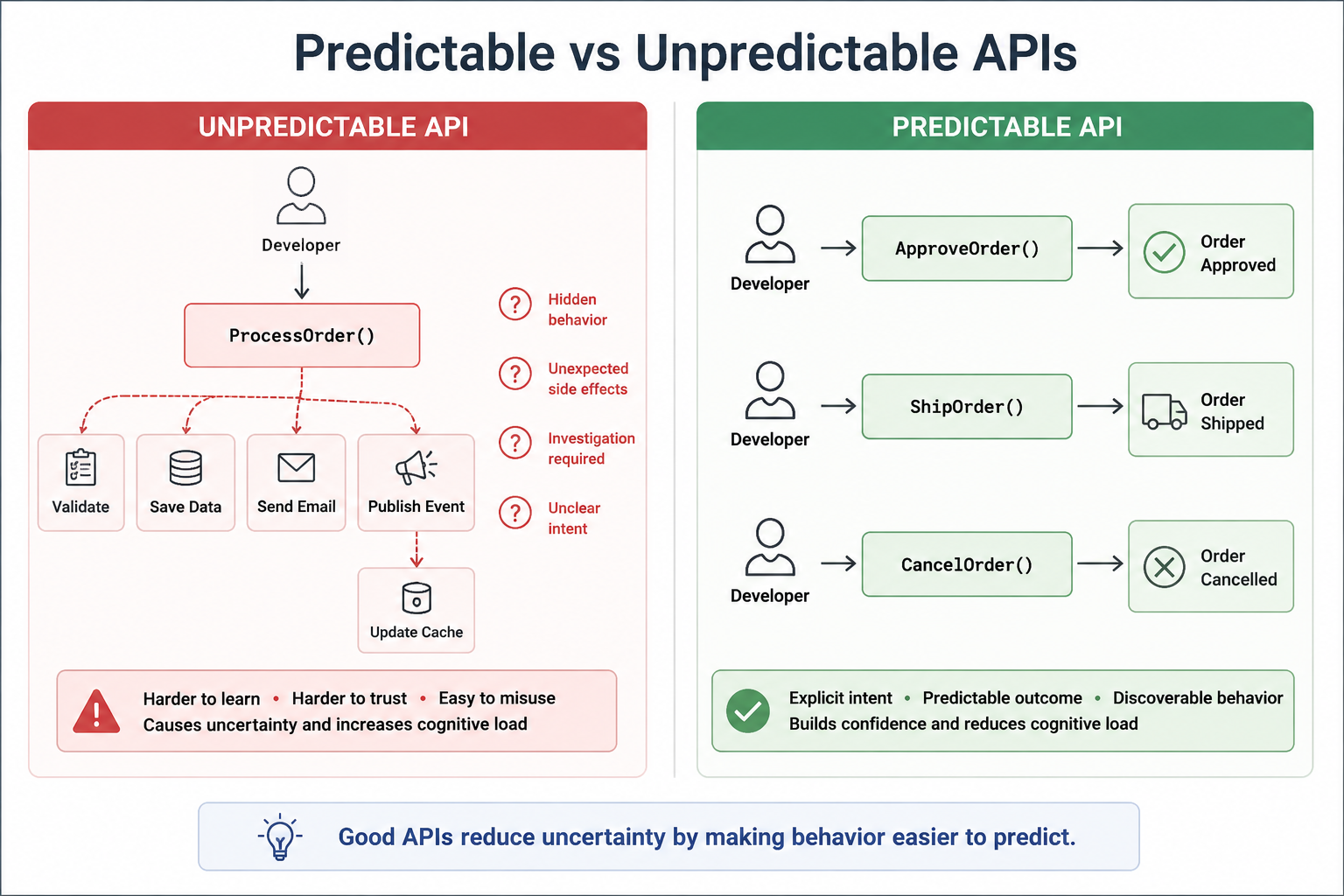
Predictable APIs make behavior visible and intentions explicit, allowing callers to understand what an operation does without investigation.
This is one reason experienced developers often prefer intention-revealing operations over highly generic interfaces.
Generic APIs may appear flexible, but they frequently transfer complexity to callers.
For example:
ExecuteOrderAction(actionType)
provides flexibility, but callers must understand:
- valid actions,
- valid transitions,
- business constraints,
- and error conditions.
By contrast:
ApproveOrder()

ShipOrder()

CancelOrder()
makes the available behavior visible.
The API itself becomes part of the documentation.
This idea closely connects to a broader architectural principle:
Systems should help developers make correct decisions rather than forcing them to continuously verify every assumption.
Good APIs encourage correct usage through their structure.
This principle aligns closely with the idea that architecture should naturally guide developers toward correct usage and ownership.2
For example, they often:
- expose valid operations clearly,
- make important actions explicit,
- limit invalid combinations,
- communicate intent through naming,
- and reduce ambiguity around ownership.
As a result, callers spend less effort deciding how to use the interface and more effort solving the actual problem.
Another important characteristic is that good APIs make incorrect usage feel awkward.
For example:
- invalid states become difficult to represent,
- unsupported workflows become difficult to express,
- and dangerous operations become highly visible.
The API naturally nudges developers toward safer behavior.
This does not eliminate all misuse. No interface can completely prevent mistakes.
However, good APIs reduce the likelihood of mistakes by making the intended path obvious and the unintended path increasingly difficult.
This is particularly important in larger systems where APIs serve as boundaries between:
- teams,
- services,
- applications,
- and domains.
At those boundaries, ambiguity becomes expensive.
Every unclear operation creates opportunities for:
- incorrect assumptions,
- inconsistent implementations,
- duplicated logic,
- and unexpected behavior.
Good APIs reduce those risks because they communicate intent directly.
A useful distinction is:
A good API does not merely expose functionality. It helps callers understand how that functionality is intended to be used.
This guidance often becomes one of the most valuable qualities of an interface because it reduces uncertainty, lowers cognitive load, and helps developers make correct decisions without constant investigation.
When an API consistently guides callers toward success, predictability becomes a natural consequence rather than a separate design goal.
6. Naming Should Reveal Intent
One of the most important responsibilities of an API is communicating intent.
When developers interact with an interface, they are constantly making assumptions about what operations do, what responsibilities they own, and how they are intended to be used. Names play a significant role in shaping those assumptions.
This is why naming is not merely a stylistic concern.
Good names reduce cognitive effort because they help callers understand behavior before reading implementation details or documentation.
Poor names create uncertainty because they force developers to investigate what the operation actually means.
For example, consider the difference between:
ProcessOrder()
and:
ApproveOrder()
The first name provides very little information.
Questions immediately arise:
- What does "process" mean?
- Does it validate?
- Does it approve?
- Does it charge payment?
- Does it send notifications?
- Does it update inventory?
The operation may be perfectly valid, but the name communicates little about its intent.
The second example is much clearer.
Most developers can make reasonable assumptions about what approving an order involves, even before examining the implementation.
The difference is not technical complexity. The difference is clarity.
This principle becomes increasingly important as systems grow.
Large systems often contain:
- hundreds of methods,
- dozens of services,
- multiple APIs,
- and many different business concepts.
Developers spend far more time reading and understanding code than writing it.
As a result, names become one of the most important communication mechanisms available.
A useful distinction is:
Good names help developers understand what an operation means. Poor names merely describe that something happens.
For example, these names communicate intent clearly:
PublishArticle()

ArchiveArticle()

ApproveInvoice()

CancelSubscription()
The business action is immediately visible.
By contrast:
Execute()

Handle()

Process()

Run()
provide very little information on their own.
Such names often force developers to rely on surrounding context to understand behavior.
This creates additional mental work because meaning is no longer local to the operation itself.
Naming also influences discoverability.
When developers browse an API, they are effectively searching for answers to questions such as:
- How do I publish an article?
- How do I cancel an order?
- How do I approve an invoice?
- How do I restore a license?
Well-named operations make those answers easy to find.
Poorly named operations force developers to search, guess, or inspect implementation details.
This is one reason experienced developers often prefer explicit names even when they are slightly longer.
For example:
SendPasswordResetEmail()
often communicates more effectively than:
ResetPassword()
if the operation merely initiates the reset process.
The longer name may require a few additional characters, but it significantly reduces ambiguity.
Another important consideration is consistency of vocabulary.
If a system uses the term "Publish" everywhere else, introducing "Activate", "Enable", or "Release" for the same concept creates unnecessary cognitive load.
Developers begin wondering:
- Are these different operations?
- Do they follow different rules?
- Is the terminology intentional?
- Is there some hidden distinction?
The inconsistency introduces uncertainty.
Good APIs therefore tend to establish a shared vocabulary and use it consistently throughout the interface.
This allows callers to transfer understanding from one area of the API to another.
A useful distinction is:
Consistent terminology allows developers to reuse understanding instead of repeatedly translating meaning.
Naming also influences trust.
When an operation's behavior matches its name, developers become more confident in their assumptions.
When names repeatedly conceal side effects, responsibilities, or business meaning, developers become increasingly cautious.
Eventually they stop trusting the interface and begin verifying everything manually.
That is usually a sign that the API is no longer communicating effectively.
A useful warning sign is:
When developers frequently need to inspect implementation details to understand what a method really does, naming may no longer be revealing intent clearly enough.
Good APIs communicate through their names.
They help callers understand responsibilities, discover available functionality, and predict behavior before reading documentation or source code.
In many cases, the quality of an API can be assessed simply by asking a straightforward question:
If a developer encounters this operation for the first time, how accurately can they predict what it does?
The closer the answer is to "very accurately," the more effectively the API is communicating its intent.
7. Why Experienced Developers Care About API Design
Less experienced developers often view APIs primarily as technical interfaces.
The focus is typically on questions such as:
- Does it work?
- Are all required operations available?
- Does it return the correct data?
- Does it support the necessary use cases?
These are important considerations, but experienced developers tend to evaluate APIs through a broader lens.
Over time, many discover that the long-term cost of an API is rarely determined by whether it functions correctly. The larger cost is often how easy it is for other developers to understand and use correctly.
This changes how API quality is assessed.
For example, a less experienced developer may primarily focus on:
- reducing code duplication,
- maximizing flexibility,
- creating highly generic interfaces,
- or exposing every possible capability.
An experienced developer is more likely to ask:
- Does the API communicate intent clearly?
- Can callers predict its behavior?
- Does it reduce cognitive load?
- Does it guide correct usage?
- Will it remain understandable in five years?
These questions are often more important than the implementation details themselves.
This perspective develops because experienced developers have spent years working with APIs that accumulated complexity over time.
They have encountered interfaces where:
- naming became inconsistent,
- responsibilities drifted,
- side effects became hidden,
- special cases accumulated,
- documentation became outdated,
- and callers relied increasingly on tribal knowledge.
Such APIs may continue functioning correctly, yet become progressively more difficult to use safely.
The problem is not usually technical correctness.
The problem is that understanding the interface requires increasing amounts of investigation.
Experienced developers recognize that every API serves two audiences simultaneously:
- the computer that executes it,
- and the humans who must understand it.
The computer only cares whether the contract is technically valid.
Developers care whether the contract makes sense.
This distinction explains why experienced developers often value:
- explicitness,
- consistency,
- discoverability,
- predictability,
- and clear responsibility boundaries.
These qualities help humans reason about the interface.
A useful distinction is:
An API succeeds not when callers can eventually figure it out, but when they rarely need to figure it out in the first place.
This idea closely mirrors many broader architectural principles.
For example, good architecture reduces:
- ambiguity,
- unnecessary traversal,
- hidden ownership,
- and cognitive load.
Good APIs achieve the same goals at the interface level.
They reduce the amount of mental effort required to:
- find the correct operation,
- understand behavior,
- predict outcomes,
- and use the system safely.
This is one reason experienced developers often prefer APIs that appear slightly more explicit or slightly less clever.
A highly clever interface may impress its creator.
A highly understandable interface helps every future caller.
The long-term value is usually far greater.
Another reason experienced developers care deeply about API design is that APIs tend to outlive their implementations.
Internal code can often be refactored, reorganized, optimized, or replaced without affecting callers.
Public interfaces are different.
Once an API becomes widely used, changing it becomes significantly more expensive.
Poor decisions therefore have a tendency to persist.
Every confusing name, inconsistent convention, or surprising behavior may continue affecting developers for years.
Experienced developers understand this and therefore treat API design as a long-term architectural concern rather than a short-term implementation detail.
A useful warning sign is:
When developers need extensive documentation to compensate for unclear API design, the interface may not be communicating effectively enough on its own.
Documentation remains important.
However, the best APIs often make documentation feel like confirmation rather than discovery.
Developers read the documentation to verify assumptions rather than to determine how the interface fundamentally works.
Ultimately, experienced developers care about API design because APIs shape how other developers experience a system.
A well-designed API reduces friction, builds confidence, and helps callers succeed.
A poorly designed API may still function correctly, but it continuously consumes attention that could otherwise be spent solving real problems.
That difference becomes increasingly valuable as systems, teams, and codebases grow over time.
8. Practical Signs an API Is Becoming Difficult to Use
Most APIs do not become difficult to use overnight.
The decline is usually gradual.
A new operation is added that follows a different naming convention. A special case introduces an exception to an existing pattern. A method gains additional responsibilities. Documentation is updated to explain behavior that is no longer obvious from the interface itself.
Each individual change may appear reasonable.
Over time, however, these small inconsistencies accumulate and begin affecting the overall experience of using the API.
This is why it is useful to recognize the warning signs early*.*
One common sign is increasing reliance on documentation for routine usage.
Documentation should help explain concepts, constraints, and business context.
However, when developers repeatedly need documentation to answer questions such as:
- Which method should I call?
- What does this operation actually do?
- Which parameter combination is valid?
- Does this method have side effects?
- How is this different from a similar operation?
the API may no longer be communicating clearly enough on its own.
Another warning sign is naming inconsistency.
For example, a system may contain:
CreateOrder()

UpdateOrder()

DeleteOrder()
alongside:
ModifyCustomerRecord()

RemoveSubscription()

ExecuteInvoiceAction()
The operations may all function correctly, but the inconsistent vocabulary makes the interface harder to learn and predict.
Developers must spend additional effort determining whether the differences are meaningful or accidental.
Another sign is the growing presence of special-case knowledge.
For example, developers begin saying things such as:
- "This method behaves differently."
- "That endpoint requires an extra step."
- "This operation bypasses validation."
- "That service automatically saves changes."
- "This result type follows different rules."
When successful API usage increasingly depends on memorizing exceptions, predictability is often beginning to break down.
A useful distinction is:
Every exception to a pattern increases the amount of the API callers must remember.
This does not mean exceptions should never exist. Real systems often require special behavior.
The problem occurs when exceptions become common enough that patterns stop providing reliable guidance.
Another warning sign is hidden side effects.
For example, a method that appears to perform a simple update may also:
- publish events,
- send notifications,
- trigger workflows,
- update external systems,
- or modify additional state.
If callers regularly discover important behavior only after reading implementation details, the interface is no longer communicating effectively.
The API may still function correctly, but it is becoming increasingly difficult to reason about safely.
Growing ambiguity around ownership is another important signal.
Many of these ownership problems resemble the same responsibility drift that can occur between workflows, services, and business rules.3
Developers may begin asking:
- Where should validation occur?
- Which service owns this rule?
- Which endpoint is authoritative?
- Which operation should be used?
- Who is responsible for persistence?
When ownership becomes unclear, callers spend increasing amounts of time investigating behavior before using the interface confidently.
This problem often mirrors larger architectural issues where responsibility boundaries have gradually become blurred.
Another sign is declining discoverability.
Developers may struggle to find the correct operation even when they know what they want to accomplish.
They begin searching through:
- documentation,
- source code,
- examples,
- issue trackers,
- or other developers' implementations
simply to determine which API operation is intended for a particular task.
The API stops providing guidance.
Instead, callers must reconstruct that guidance themselves.
A particularly revealing warning sign is when developers avoid using parts of the API.
For example:
- "I never touch that endpoint."
- "Nobody really knows how this works."
- "Use this operation carefully."
- "That service is risky to modify."
Such statements often indicate that predictability and trust have already started to erode.
The interface may technically function, but callers no longer feel confident using it.
Experienced developers pay close attention to these signals because they understand that API quality deteriorates gradually rather than suddenly.
By the time usability problems become obvious, many small inconsistencies have often accumulated over several years.
A useful warning sign is therefore:
When callers spend more effort understanding how to use an API than solving the problem the API was intended to solve, the interface is probably becoming too difficult to use.
Good APIs reduce uncertainty.
They help developers predict behavior, discover functionality, and use the interface confidently.
When those qualities begin disappearing, the resulting friction is often one of the earliest indicators that the API needs architectural attention.
9. Conclusion
Good APIs are often difficult to notice.
Developers use them without hesitation. Operations behave as expected. Naming feels natural. Responsibilities are clear. Similar concepts follow consistent patterns. The interface gradually fades into the background, allowing attention to remain focused on solving business problems.
That is not an accident.
It is the result of deliberate design choices that prioritize:
- predictability,
- consistency,
- discoverability,
- explicit intent,
- and reduction of cognitive load.
Throughout this article, we have explored how these qualities influence the experience of using an API.
Predictable APIs help developers:
- transfer knowledge from one area to another,
- rely on reasonable assumptions,
- discover functionality naturally,
- understand behavior quickly,
- and make correct decisions with confidence.
Poorly designed APIs create the opposite experience.
Callers must repeatedly:
- investigate behavior,
- verify assumptions,
- remember exceptions,
- search documentation,
- and reconstruct intent.
The result is not merely inconvenience. It is increased cognitive effort.
Every surprising operation, inconsistent convention, hidden side effect, or unclear responsibility boundary adds to the mental burden carried by every developer who interacts with the interface.
This is one reason API design should be viewed as an architectural concern rather than merely an implementation detail.
An API defines how other developers experience a system.
It communicates:
- what capabilities exist,
- how those capabilities should be used,
- which assumptions are safe,
- and what behavior can reasonably be expected.
When that communication is clear, the interface becomes easier to learn, easier to trust, and easier to evolve.
This idea closely connects to many broader architectural principles.
Good architectures help developers discover:
- ownership,
- responsibilities,
- workflows,
- and intended usage patterns.
Good APIs achieve the same goal at the boundary where developers interact with the system.
In both cases, the objective is similar:
Reduce the amount of the system people must keep in their heads at one time.
This is why experienced developers often care deeply about API design.
They understand that every interface decision influences:
- onboarding,
- maintainability,
- debugging,
- collaboration,
- and long-term system evolution.
A highly clever API may occasionally save a few lines of code.
A highly predictable API saves thousands of small decisions throughout the life of the system.
Those savings accumulate every time:
- a feature is implemented,
- a service is integrated,
- a developer joins the team,
- a bug is investigated,
- or an unfamiliar part of the system is explored.
A useful distinction is therefore:
Good APIs reduce the number of decisions callers must rediscover.
That principle captures much of what makes an interface feel intuitive.
Developers may not consciously recognize the effort being saved, but they experience the result every day through increased confidence, reduced friction, and a greater ability to focus on the problems that actually matter.
Ultimately, the best APIs are not the ones that expose the most functionality or demonstrate the most sophisticated design.
They are the ones that make understanding feel effortless.
Need a second opinion on a .NET codebase?
I offer practical architecture and maintainability advisory for .NET teams working on long-lived business applications.
Want occasional updates?
Subscribe to receive occasional practical notes on .NET architecture, maintainable software, project progress, and new articles.