The Difference Between Policy and Mechanism in Application Design
Architecture Boundaries · 2026-10-02
A practical look at the difference between application policy and technical mechanism, and why clear ownership of decisions makes systems easier to read, test, and change.
The Difference Between Policy and Mechanism in Application Design
1. Policy and Mechanism Are Easy to Confuse
Application design often becomes harder than it needs to be when policy and mechanism are mixed together.
At first, the difference may not seem important. The system receives a request, checks something, calls a service, stores data, sends a message, and returns a result. From a distance, it can all look like one flow of work. Some parts decide what should happen. Other parts perform the technical work needed to make it happen.
But those are not the same responsibility.
Policy is about the decision.
Mechanism is about how the decision is carried out.
That distinction matters because software changes for different reasons. A business rule may change. A workflow may need a new outcome. A provider may change its API. A database table may be reorganized. A message may need to be sent through a different service. A UI flow may be adjusted.
Those changes should not all affect the same code in the same way.
If policy and mechanism are mixed together, they start to pull each other around. A provider detail begins to influence an application decision. A database shape begins to define a workflow rule. A technical exception becomes part of the normal policy path. A controller decides too much because the request happened to arrive there.
The code may still work.
But the ownership of decisions becomes unclear.
This is one reason application design can become difficult to maintain even when the code is organized into layers. A system may have controllers, application services, repositories, adapters, and infrastructure projects, but still allow technical mechanisms to own decisions they should only support. The structure looks separated, while the responsibility is not.
The confusion usually grows gradually.
A small rule is added near a provider call because the data is already available there. A database state is reused as an application outcome because it seems convenient. A framework status is returned directly because it already expresses something close enough. A helper combines a decision and an implementation detail because separating them feels unnecessary at the time.
Each shortcut can seem harmless.
Together, they make the system harder to reason about.
When policy and mechanism are confused, developers have to ask more questions before making a change. Is this branch here because of a workflow rule, or because of a provider limitation? Is this status part of the application language, or only part of the database shape? Is this exception exceptional, or is it being used to express an expected outcome? Is this class deciding what should happen, or only performing the work?
Good application design tries to make those answers clearer.1
It gives policy a visible home. It keeps mechanism close to the tools, providers, frameworks, and storage systems that require it. It lets infrastructure support decisions without redefining them. It lets application code describe what the system means before it describes how the system happens to perform the work.
This does not remove complexity.
Real systems still need both policy and mechanism. The point is not to pretend that technical details do not matter. They matter a great deal. But they should matter in the right place.
When policy and mechanism are kept separate enough to understand, the system becomes easier to read, easier to test, and easier to change.
When they are confused, even small changes can become harder than they should be.
2. What Policy Means in Application Design
Policy is the part of the system that decides what should happen.
It expresses the rules, choices, constraints, and outcomes that belong to the application. It says when an operation is allowed, when it should be rejected, what result should be returned, what condition should be treated as recoverable, and what the workflow means in application terms.
Policy is not limited to formal business rules.
It can appear in many ordinary decisions. Should this license be activated? Should this payment be treated as confirmed? Should this request be accepted, delayed, rejected, or ignored? Should the user receive a message? Should a retry be attempted? Should this failure be shown to the caller as an expected outcome?
Those are policy questions.
They are about meaning and decision-making.
This matters because policy is often where the application’s real behavior lives. A system may contain a lot of technical code, but the important question is usually not only whether the system can perform an operation. The important question is under what conditions it should perform it, what the operation means, and what outcome the caller should see.
That is application policy.
It gives the workflow shape.
A policy may be simple. It may be a conditional branch in an application service. It may be a small rule object, validator, specification, result type, or method. It does not have to be large or formal to matter. If the code decides what the application should do, it is carrying policy.
Because of that, policy should usually be visible in application code.
A developer should not have to search through provider adapters, persistence mappings, controllers, or framework hooks to understand the basic decisions of a workflow. Those places may support the decision, but they should not quietly own it.
Clear policy ownership makes the system easier to reason about.
If a rule changes, there is a natural place to look. If an outcome becomes more precise, there is a clear result or workflow to adjust. If a new case is added, the application code can describe it in the language of the workflow. Tests can then verify the behavior without depending on every technical detail used to perform it.
Policy also gives boundaries something to protect.
A boundary is not only there to separate files or projects. It helps keep application decisions from being shaped too directly by external mechanisms. Provider responses, database states, UI fields, and transport statuses may all contain useful information, but the application still needs to decide what that information means.
That decision is policy.
When policy is clear, the application has a stronger center of gravity. The system can change its mechanisms more safely because the important decisions are not scattered through the tools that happen to carry them out.
Good application design does not hide policy.
It gives policy names, homes, and tests.
That is what makes the behavior of the system easier to understand and easier to change.
3. What Mechanism Means in Application Design
Mechanism is the part of the system that carries out a decision.
It is the technical means by which the application does its work. It sends the email, writes the record, calls the provider, reads the file, publishes the message, hashes the password, starts the transaction, serializes the payload, or returns the HTTP response.
Mechanism is necessary.
Without mechanism, policy would only be intention.
A workflow may decide that a license should be activated, but something still has to store that activation. A payment may be treated as confirmed, but something still has to read and interpret the provider response. A user may need to receive a message, but something still has to send it. A request may be rejected, but something still has to communicate that result to the caller.
Those technical actions matter.
They often require careful code. Providers have awkward APIs. Databases have constraints. Frameworks have lifecycles. Networks fail. Files may be missing. Messages may be retried. Authentication may expire. Timeouts, serialization rules, connection handling, logging, and configuration all need attention.
That is mechanism.
But mechanism should not be confused with the decision it supports.
A mail sender may know how to send a message, but it should not usually decide whether the workflow requires one. A repository may know how to save a record, but it should not usually decide what the application outcome means. A provider adapter may know how to interpret a raw provider response, but it should not quietly redefine the application’s policy.
Mechanism is strongest when it has a clear role.
It should perform the work the application needs without taking ownership of the application’s meaning. It should hide awkward technical details behind useful boundaries. It should translate external behavior into forms the application can reason about. It should make the technical work reliable without forcing the workflow to speak in the language of the tool.
This does not make mechanism less important than policy.
In many systems, the mechanism is where much of the difficult engineering happens. It may contain retries, idempotency, persistence consistency, provider authentication, failure handling, caching, and performance concerns. Those details are real, and they deserve careful design.
The point is that their responsibility is different.
Mechanism answers questions like: how do we call this provider, how do we persist this state, how do we publish this message, how do we format this response, how do we handle this timeout, and how do we integrate with this framework?
Policy answers a different kind of question: what should the application decide this means?
Good application design lets both kinds of code do their work.
Mechanism should be precise about how the system operates.
Policy should remain clear about why the operation matters and what decision the application is making.
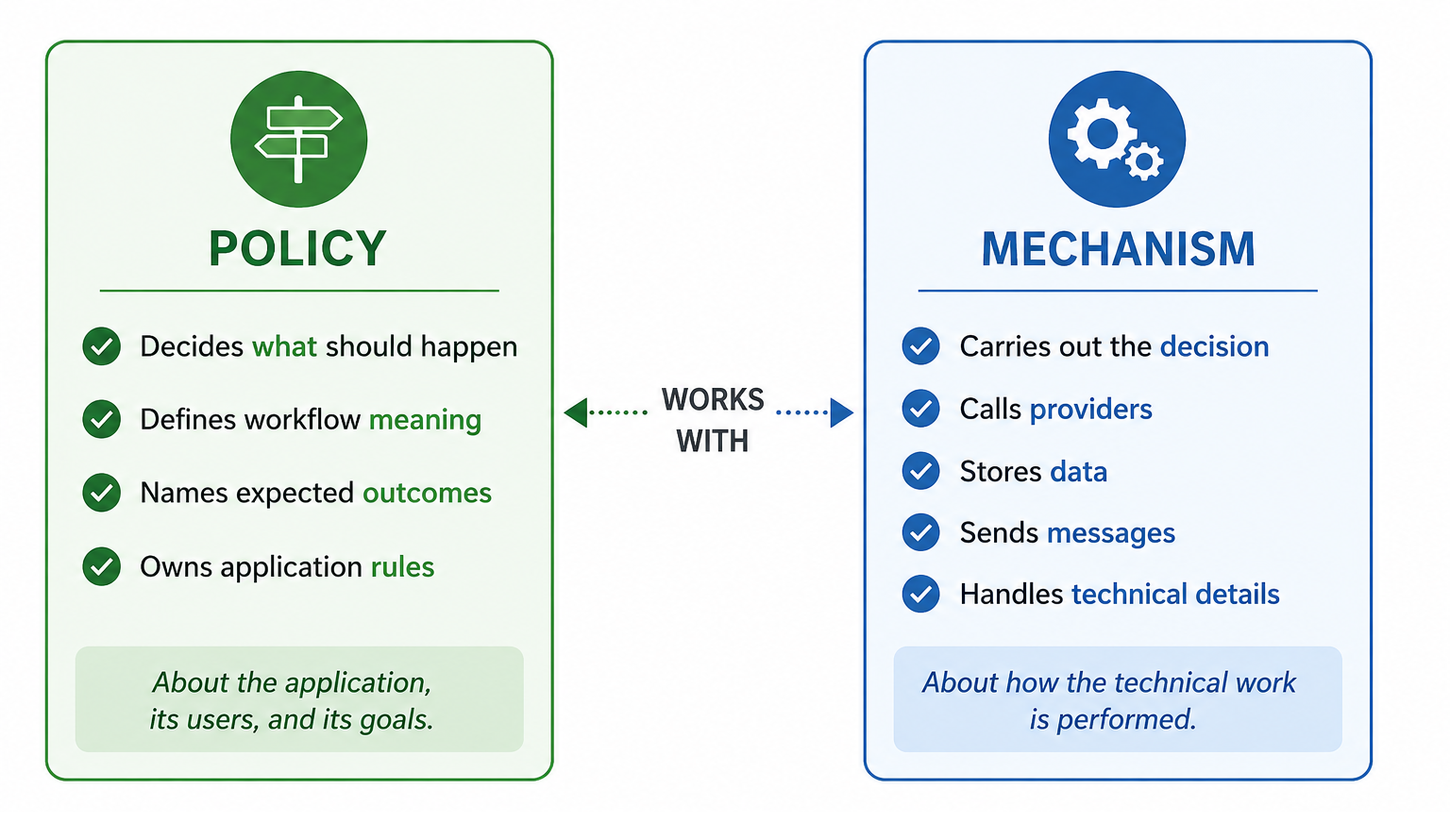
Policy decides what the application means; mechanism carries out the technical work needed to support that decision.
4. Why Mechanisms Should Not Own Application Decisions
Mechanisms should not own application decisions because they are shaped by different forces.2
A provider is shaped by its API. A database is shaped by storage needs. A framework is shaped by its lifecycle and conventions. A transport layer is shaped by protocols, status codes, headers, and request formats. Those forces are real, but they are not the same as the application’s policy.
The mechanism may know how something happened.
It does not automatically know what that should mean.
A payment provider may return a detailed status. A database may contain a stored state. An email service may return a delivery failure. An HTTP request may contain a route value or query string. Each of those details may be useful, but none of them should automatically decide the workflow.
The application still needs to interpret them.
If a provider returns a failure, the policy may decide whether the operation should be retried, rejected, delayed, or treated as unavailable. If a database record is missing, the policy may decide whether that means invalid input, an expired request, a recoverable condition, or a case the caller should never see. If an email cannot be sent, the policy may decide whether the workflow should fail or continue with a warning.
Those decisions belong to the application.
When mechanisms own them, the system becomes harder to change.
A provider change becomes a policy change. A database refactoring becomes a workflow change. A framework convention becomes part of the application language. A technical exception becomes something callers must understand. The code starts to depend not only on what the application needs to know, but on how a particular mechanism happens to express it.
That creates unnecessary coupling.
It also makes the application harder to read. Instead of seeing a clear decision, a reader sees technical branches. Instead of seeing a workflow outcome, they see provider statuses, database states, transport codes, or framework exceptions. The policy is still present, but it is hidden inside the mechanism.
This can make the system feel more precise than it really is.
Technical details often look authoritative. A provider status may be documented. A database state may be concrete. A framework response may be familiar. But precision in the mechanism does not guarantee clarity in the application. The application may need a different vocabulary because it has different responsibilities.
That is why mechanisms should usually be kept in supporting roles.
They can expose information. They can perform work. They can translate technical details into useful application signals. They can report that something happened, failed, timed out, or could not be completed. But the policy should decide what those facts mean for the workflow.
This distinction helps preserve local change.
If the mechanism changes, the adjustment can stay near the boundary that understands it. If the policy changes, the application code can change where the decision is visible. The two may interact, but they should not be so mixed that every technical change risks becoming a policy change.
Mechanisms are essential.
But they should not be allowed to redefine the application by accident.
The application should decide what the system means.
The mechanism should help carry that decision out.
5. How Policy Leaks Into Infrastructure
Policy leaks into infrastructure when technical code starts deciding what the application should mean.
This often happens quietly.
An adapter is already interpreting a provider response, so it adds one more rule about whether the workflow should continue. A repository already loads the data, so it decides whether a missing record should be treated as invalid, expired, ignored, or exceptional. A mail sender already knows whether delivery failed, so it decides whether the whole operation should fail. A persistence model already contains a state, so infrastructure begins treating that state as the final application outcome.
The decision may feel close to the mechanism.
But that does not always mean the mechanism owns it.
Infrastructure often has useful information. It may know that a provider returned a timeout, that a database record was not found, that a message could not be sent, or that an external system returned a specific status. But there is a difference between reporting that fact and deciding what the application should do with it.
That second part is policy.
When infrastructure begins to own policy, application behavior becomes harder to see. A developer reading the application service may not find the rule there because the rule is hidden inside a provider adapter, repository, mapper, or transport handler. The workflow appears simple, but only because some of its decisions have moved somewhere else.
That can be misleading.
The application code may look clean while the real behavior is scattered through infrastructure.
This makes change harder. If a business rule changes, the developer may need to inspect technical implementations to find where the decision is made. If the provider changes, it may be difficult to know whether the infrastructure code is handling provider behavior or application policy. If a test fails, it may be unclear whether the failure belongs to the mechanism or the workflow.
Policy leakage also makes infrastructure harder to reuse.
A provider adapter that only translates provider details into application-relevant outcomes can often support several workflows. But an adapter that decides workflow behavior directly becomes tied to one particular policy. A repository that retrieves and saves data can remain focused. A repository that decides what missing data means in every workflow becomes harder to use safely.
This does not mean infrastructure should be passive.
Infrastructure often needs to make technical decisions. It may decide how to retry, how to authenticate, how to deserialize, how to map provider responses, how to handle timeouts, or how to protect consistency. Those decisions belong there because they are about the mechanism.
The risk appears when those technical decisions become workflow decisions.
A retry strategy is mechanism. Deciding whether the caller should see the operation as pending, failed, or accepted may be policy. Mapping a provider code is mechanism. Deciding whether the workflow should continue may be policy. Detecting that a record is missing is mechanism. Deciding what that absence means to the user may be policy.
Good boundaries make that distinction visible.
Infrastructure should translate technical facts into useful signals. Application code should decide what those signals mean for the workflow. When that separation is preserved, infrastructure remains focused on how work is performed, and policy remains visible where the application explains what should happen.
Policy should not disappear into infrastructure just because infrastructure has the data.
The place that knows the fact is not always the place that should own the decision.
6. How Mechanism Leaks Into Application Code
Mechanism leaks into application code when workflow decisions start depending on technical details.
This is the opposite direction of policy leaking into infrastructure. Instead of infrastructure taking ownership of application decisions, the application begins to carry too much knowledge about the mechanisms around it.
That usually happens for understandable reasons.
A provider response contains a status the workflow needs to react to. A database entity already has the fields the application needs. A framework exception seems like a convenient way to detect a case. An HTTP status code already describes something close to the result the caller should receive.
So, the application code starts using those details directly.
At first, the effect may be small. One branch checks a provider-specific value. One method accepts a persistence entity. One result name mirrors a transport status. One test constructs a framework type because that is what the application service now expects.
But each of those choices gives the mechanism a stronger voice inside the application.
The workflow begins to speak in provider language. It starts thinking in database shape. It starts describing outcomes through transport codes. It starts handling framework exceptions as if they were part of the normal application vocabulary.
That makes the policy harder to see.
A developer reading the application code may have to understand the provider before they understand the workflow. They may need to know the database schema before they understand the rule. They may have to follow transport behavior before they understand the result. The code still contains the decision, but the decision is expressed through the mechanism.
This kind of leakage also makes change less local.
If the provider changes its statuses, the application may need to change. If the database shape changes, the workflow may be affected. If the transport mechanism changes, result handling may need to be rewritten. If the framework changes how a case is represented, application tests may fail even though the workflow meaning has not changed.
Mechanism leakage can be difficult to notice because the code may look precise.
A provider status is precise. A database field is concrete. An HTTP status is familiar. A framework exception is official. But precision from the mechanism is not the same as clarity in the application.
The application needs to decide what those details mean.
That usually requires translation.
A provider status can become an application outcome. A persistence entity can become a workflow model or a specific query result. A framework exception can become a meaningful failure reason. A transport status can be chosen at the edge based on the application result rather than used as the result itself.
The goal is not to remove mechanism from the system.
The goal is to keep it from becoming the application’s language.
Mechanism belongs near the tools, providers, frameworks, protocols, and storage systems that require it. Application code should receive the meaning it needs, not the full technical shape that produced it.
When mechanism leaks inward, the application becomes harder to understand.
When it is translated at the boundary, the workflow can remain clear about what it decides and why that decision matters.
7. Boundaries Should Translate Mechanism Into Policy-Relevant Outcomes
A good boundary does not only keep code separated.3
It translates.
That translation is especially important when mechanism needs to inform policy. The application may need to know that something happened outside the workflow, but it should not always need to know the exact technical form in which it happened.
A provider may return a detailed status. A database may report a constraint violation. A mail service may fail with a timeout. A message queue may reject a publish attempt. A file system may report that a file is missing or locked.
Those are technical facts.
The application needs policy-relevant outcomes.
There is a difference between telling the application that a provider returned AUTH_4027 and telling it that the operation cannot continue because authorization failed. There is a difference between exposing a database exception and returning that a requested record was not found. There is a difference between leaking a transport error and returning that the external service is temporarily unavailable.
The boundary should make that difference clear.
It should understand the mechanism well enough to translate its details into outcomes the application can reason about. It should reduce the technical vocabulary that crosses inward. It should give policy enough information to make a decision without forcing policy to depend on every detail of the mechanism.
This does not mean the boundary should decide all policy.
That is an important distinction.
The boundary may translate a provider timeout into ProviderUnavailable. The application may then decide whether that means retry, delay, fail, or return a specific result to the caller. The boundary may translate a missing record into NotFound. The application may decide whether that means invalid input, expired access, or an expected absence.
Translation supports policy.
It does not replace it.
A useful boundary therefore sits between raw mechanism and application decision. It hides details the workflow should not depend on, but it does not hide the facts the workflow needs. It gives the application a smaller, clearer set of outcomes to reason about.
That makes the system easier to change.
If a provider changes its error codes, the translation can change near the provider adapter. If a database changes how a constraint is reported, the persistence boundary can change. If a transport mechanism changes, the edge can still map application results to the correct response. The policy may remain stable because it depends on the translated outcome rather than the raw mechanism.
This also makes tests clearer.
Application tests can focus on policy decisions: what should the workflow do when the provider is unavailable, when the record is missing, when the input is invalid, or when the operation is already complete? They do not need to reproduce every provider code, database exception, or framework behavior.
The mechanism can have its own tests.
The policy can have its own tests.
The boundary connects them by translating between their languages.
That is one of the practical values of application boundaries. They are not only structural separators. They are places where technical facts are converted into policy-relevant meaning.
When that translation is clear, mechanism can remain technical.
And policy can remain understandable.
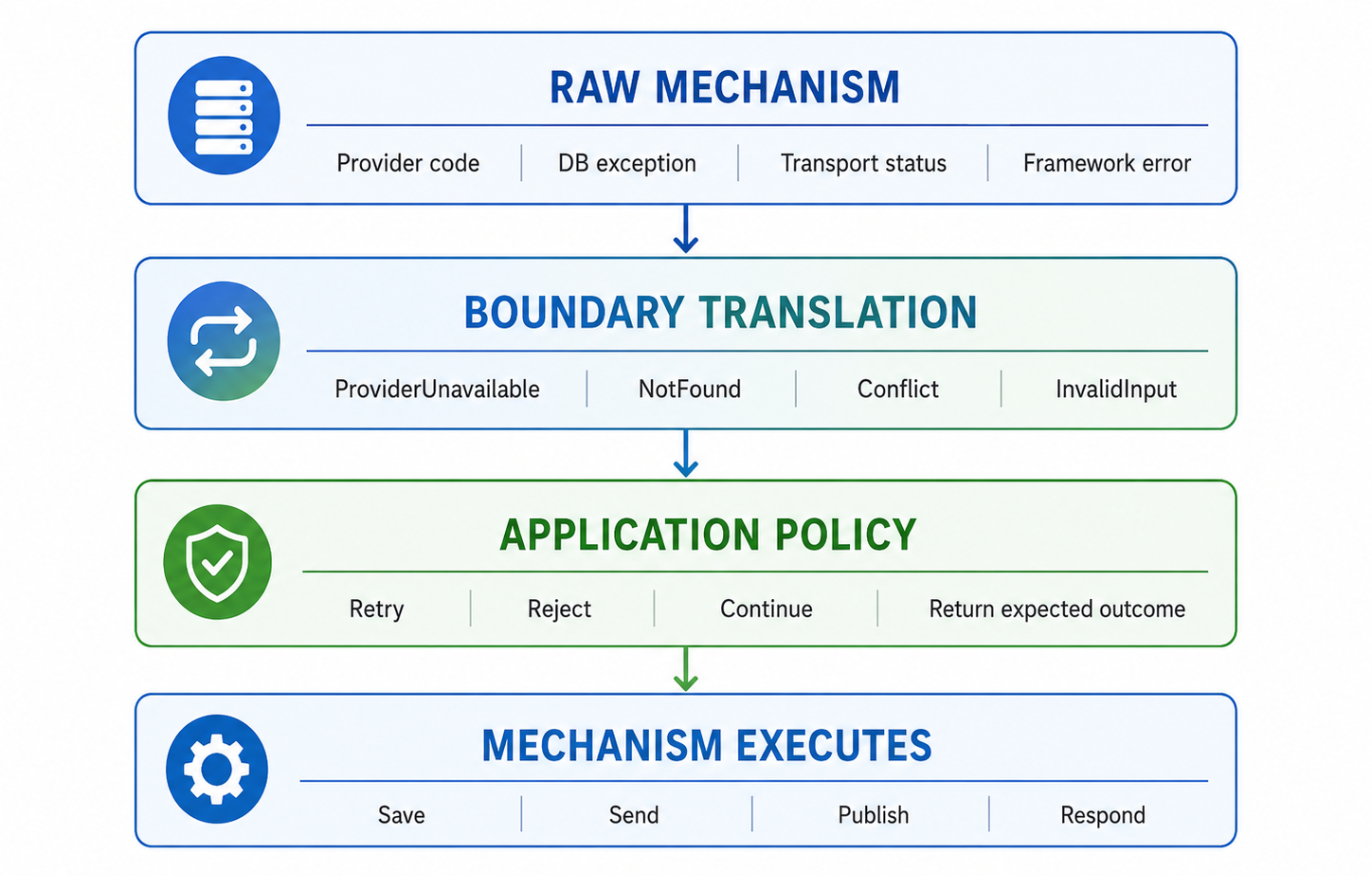
A boundary should translate technical facts into policy-relevant outcomes, so the application can decide what those facts mean for the workflow.
8. Application Services Should Express Policy Clearly
Application services should be one of the clearest places to see policy.
They are often where a use case comes together. A request has been translated into application language. The workflow has the information it needs. Infrastructure is available through collaborators. The service now decides what the application should do.
That decision should be visible.
An application service should not read only as a sequence of technical operations. Load this record. Call this provider. Save this entity. Send this message. Return this value. Those steps may be necessary, but they do not by themselves explain the policy.
The service should make the application decision easy to see.
What condition allows the workflow to continue? What condition causes it to stop? Which outcomes are expected? Which failures are recoverable? Which rules belong to this use case? What result should the caller receive?
Those questions are policy questions.
If the application service hides them behind mechanism, the reader has to reconstruct the workflow from technical movement. If the service expresses them clearly, the reader can understand the behavior before needing to inspect every implementation detail.
This does not mean all policy must be written directly inside one method.
Some rules deserve their own objects, validators, specifications, result types, or smaller services. That can make the design clearer when a rule has its own name and reason to change. But the application service should still show how those rules shape the use case. It should make the policy visible in the flow of the operation.
A useful application service reads as if the application is making decisions.
It may ask whether a license can be activated. It may decide whether a payment should be confirmed, left pending, or rejected. It may decide whether a missing record means invalid input or an expired request. It may decide whether an unavailable provider should stop the workflow or produce a retriable outcome.
Those decisions should be expressed in application language.
The service may call repositories, adapters, gateways, clocks, mail senders, or other collaborators, but those collaborators should support the decision rather than obscure it. The mechanism should appear as a helper to the policy, not as the main subject of the code.
This also helps tests.
When policy is visible in an application service, tests can describe the behavior directly. They can say what should happen when a rule is satisfied, when a rule is not satisfied, when an expected condition occurs, or when a translated technical outcome requires a decision. The tests do not need to depend on every internal mechanism in order to verify the policy.
Clear policy expression also makes change easier.
If a rule changes, there is a natural place to look. If a new outcome is added, the application service can show how it fits into the workflow. If infrastructure changes, the service can remain stable as long as the policy-relevant outcomes remain the same.
That is the practical value.
Application services should not merely coordinate dependencies.
They should explain the decisions the application owns.
9. Infrastructure Should Execute Decisions, Not Redefine Them
Infrastructure should help carry out application decisions.
It should not quietly redefine them.
This distinction matters because infrastructure often sits close to the technical facts. It knows which provider was called, which database record was saved, which message was published, which file was written, which exception was thrown, and which response was received. That knowledge is important, but it does not automatically give infrastructure ownership of the policy.
The application should decide what the workflow means.
Infrastructure should perform the work needed to support that decision.
For example, an application service may decide that a confirmation email should be sent. The mail infrastructure should then send the message as reliably as it can. It may handle SMTP details, authentication, retries, formatting, logging, and provider-specific failures. But it should not usually decide whether the workflow requires the email in the first place.
That decision belongs to the application.
The same applies to persistence. A repository or persistence adapter may know how to store a record, update a state, manage a transaction, or handle a constraint. But it should not usually decide what a missing record means to the workflow, whether a request should be rejected, or which application result the caller should receive.
Those are policy decisions.
When infrastructure starts redefining decisions, the application becomes harder to understand. A workflow may appear simple because the application service only calls a collaborator and returns a result. But if that collaborator decides important application behavior internally, the policy has not disappeared. It has only moved into a place where it is harder to see.
This can make the design misleading.
The application layer looks clean, but the meaning of the system is scattered through technical implementations.
Infrastructure should certainly make technical decisions. It may decide how to connect, how to retry, how to serialize, how to cache, how to log, how to map provider payloads, or how to handle technical failure. Those decisions belong close to the mechanism because they are about performing the work correctly.
But infrastructure should be careful when a decision affects the meaning of the workflow.
If the decision changes what result the caller receives, whether the workflow continues, whether an operation is considered accepted, rejected, pending, or failed, or whether a rule has been satisfied, it is probably policy. It should either be visible in the application or expressed through a policy-relevant outcome that the application can decide on.
This separation makes infrastructure easier to change.
A provider can be replaced without rewriting the workflow language. A persistence detail can change without redefining the application’s outcomes. A mail service can be swapped without changing the policy that decides when messages are sent. Technical code can evolve behind a stable application decision.
It also makes infrastructure easier to test.
Infrastructure tests can focus on whether the mechanism behaves correctly. Does the adapter translate provider responses properly? Does the repository persist the expected data? Does the sender handle a timeout as expected? Application tests can then focus on what the workflow decides when those translated outcomes occur.
That is a healthier division of responsibility.
Infrastructure should execute decisions with care.
But the application should remain the place where those decisions are defined.
10. Result Types Can Separate Policy From Mechanism
Result types can help separate policy from mechanism.4
They do this by giving the application a clear language for expected outcomes. Instead of allowing provider responses, database exceptions, transport statuses, or framework details to travel through the workflow unchanged, a result type can describe what the application needs to decide.
That makes the boundary between mechanism and policy easier to see.
A mechanism may report that a provider timed out, that a record was not found, that a constraint was violated, that a message could not be delivered, or that an external service returned a specific status. Those are technical facts. They may be important, but they are not always the policy.
The application still needs to decide what those facts mean.
A result type can carry that translated meaning.
For example, a provider adapter might return ProviderUnavailable, PaymentConfirmed, PaymentPending, or PaymentRejected. The application service can then decide what policy applies to each outcome. Should the workflow stop? Should the caller be told to retry? Should the payment remain pending? Should the operation be considered complete?
Those are application decisions.
The result type gives them a clearer surface.
This is different from returning the raw provider response and letting the application inspect it directly. That approach may work at first, but it makes the application depend on the provider’s vocabulary. It also spreads provider knowledge into tests, callers, and workflow code. A result type reduces that spread by naming the outcome in terms the application can understand.
The same applies to persistence.
A repository does not always need to expose every storage detail. It may return that a record was found, not found, already exists, or could not be saved because of a known conflict. The application can then decide whether that means invalid input, a duplicate request, an expired operation, or a recoverable failure.
The mechanism reports what happened.
The policy decides what it means.
Result types are especially useful for expected outcomes. If a case is part of the normal workflow, it should often be visible in the contract. A caller should not have to discover expected cases by catching technical exceptions or interpreting provider-specific values. The result should make the meaningful possibilities explicit.
This does not mean result types should become dumping grounds.
A result that simply wraps every technical detail without translation does not help much. It may hide the mechanism behind another type while still forcing the application to understand the same technical vocabulary. A useful result type should reduce and clarify. It should expose what policy needs, not everything the mechanism knows.
The shape of the result should follow the decision being made.
If the caller only needs to know whether an operation succeeded, a simple result may be enough. If the caller needs to distinguish between rejected, pending, unavailable, already completed, and invalid cases, the result should name those outcomes clearly.
Good result types make policy easier to read and mechanism easier to contain.
They let infrastructure translate technical facts into policy-relevant outcomes. They let application services decide what those outcomes mean. They let tests describe behavior without depending on raw provider, persistence, or framework details.
That is why result types can be more than error-handling tools.
They can be part of the architecture.
They help the system say: this is what happened technically, and this is the meaning the application is prepared to reason about.
11. Refactoring Toward Clearer Policy Ownership
Refactoring toward clearer policy ownership starts by noticing where decisions have become hard to place.
A workflow may depend on provider details. A repository may decide what a missing record means. An adapter may return a raw response that the application has to interpret. A controller may choose an application outcome because the request arrived there. A result type may expose mechanism instead of meaning.
Those are useful signals.
They show where policy and mechanism may have become mixed.
The first step is usually to ask what kind of decision is being made. Is this decision about the workflow, the user’s intent, the expected outcome, or the meaning of a condition? Or is it about how to call a provider, store data, send a message, handle a timeout, or translate a technical response?
That question helps identify the owner.
If the decision changes what the application means, it is probably policy. It should be visible near the workflow that owns it. If the decision changes how technical work is performed, it is probably mechanism. It should stay near the infrastructure, adapter, framework, or boundary that understands it.
This does not require a large redesign.
Often, a small refactoring is enough to make ownership clearer. Move a workflow rule out of an adapter and into the application service. Translate a provider response into an application result before it crosses the boundary. Rename a result so it describes what the caller can decide. Split a repository method if it is both loading data and deciding application meaning.
Each change should make the responsibility easier to see.
Refactoring policy ownership is not about moving every condition into one place. Some policy is simple and local. Some rules deserve their own small objects. Some decisions belong inside a workflow method because they are easiest to understand there. Others deserve names, result types, validators, specifications, or small services.
The important point is not the form.
The important point is that the policy has a clear home.
A useful refactoring should reduce the number of places a developer must inspect to understand a decision. It should make the application language more explicit. It should let infrastructure focus more clearly on mechanism. It should help tests describe the behavior without depending on every technical detail behind it.
This kind of refactoring is often best done one seam at a time.
Choose one provider response that has leaked into application code. Choose one repository method that decides too much. Choose one controller branch that belongs in the workflow. Choose one result type that still exposes technical vocabulary. Then adjust that seam so the mechanism reports useful facts and the application decides what those facts mean.
The goal is not perfect purity.
The goal is clearer ownership.
Some systems will always contain awkward edges. Some technical constraints genuinely influence policy. Some performance or consistency requirements may force a design that is not as clean as the ideal. But even then, it helps to be honest about which decision belongs where.
When policy ownership becomes clearer, future changes become easier to place.5
A policy change has somewhere natural to go.
A mechanism change has somewhere safe to stay.
And the application becomes easier to understand because its decisions are no longer hidden inside the tools that support them.
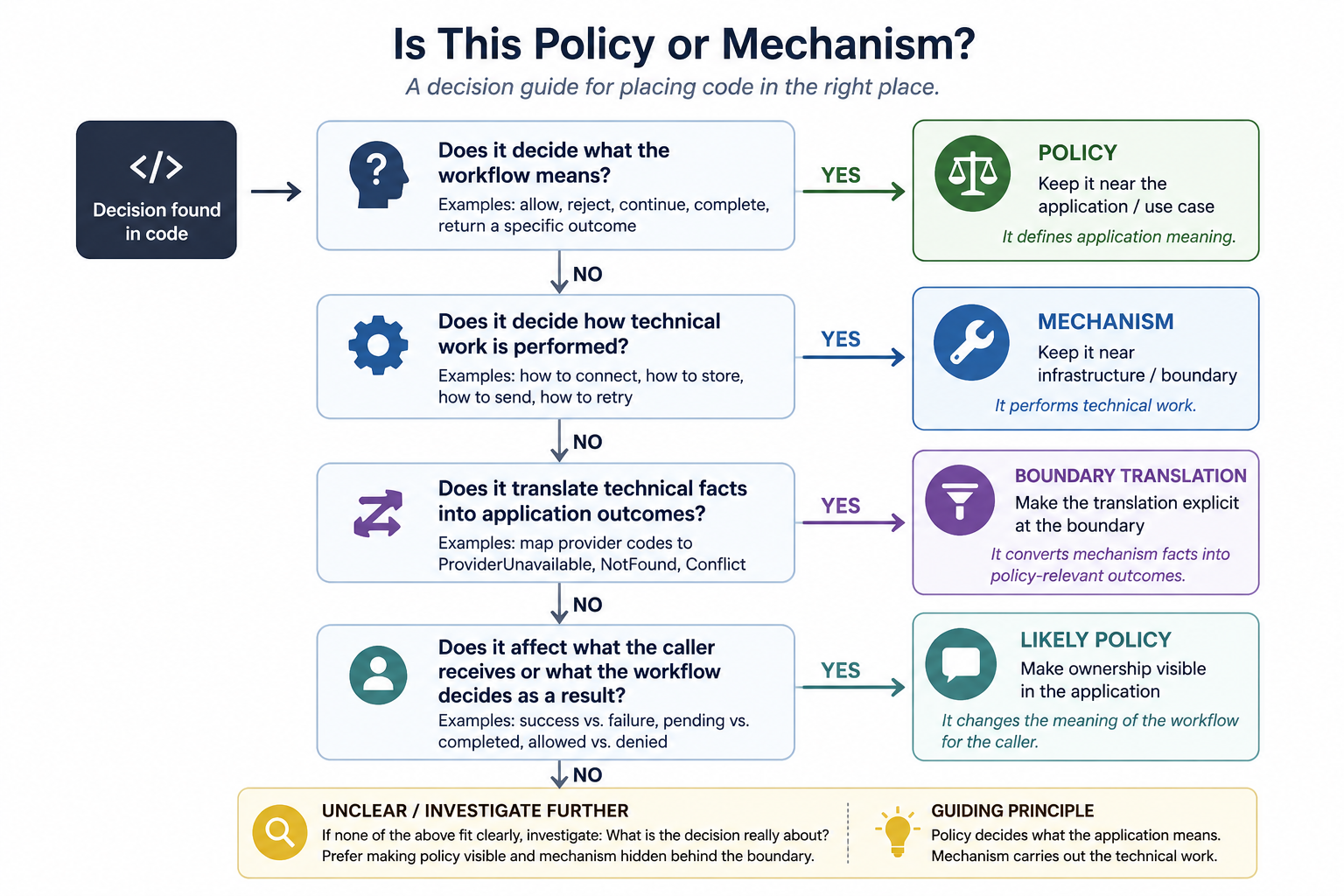
When a decision is hard to place, ask whether it changes the meaning of the workflow or only the way technical work is performed.
12. Closing
Policy and mechanism both matter.
A system needs decisions, and it needs a way to carry those decisions out. It needs workflow rules, expected outcomes, and application meaning. It also needs providers, persistence, messages, files, protocols, frameworks, and technical integrations.
The problem begins when those responsibilities become unclear.
When mechanism owns policy, application decisions become hidden inside infrastructure. When policy is expressed through mechanism, application code becomes dependent on provider statuses, database shapes, transport codes, or framework behavior. In both cases, the system becomes harder to read because the decision and the implementation are no longer easy to separate.
Good application design keeps the distinction visible.
Policy should describe what the application decides. Mechanism should describe how the technical work is performed. Boundaries should translate technical facts into outcomes the policy can reason about. Application services should make workflow decisions clear. Infrastructure should execute those decisions without quietly redefining them.
This does not require a perfect architecture.
Real systems are full of compromises. Some technical constraints affect policy. Some policies depend on what a provider can actually support. Some mechanisms must expose details because the workflow genuinely needs to understand them. The goal is not to pretend those cases do not exist.
The goal is to make ownership deliberate.
When a technical detail influences policy, the code should make that influence visible. When infrastructure returns an outcome, the application should still decide what that outcome means for the workflow. When a result type is introduced, it should clarify the decision rather than wrap the mechanism unchanged.
That clarity is valuable over time.
Providers change. Databases evolve. UI flows are redesigned. Failure cases become better understood. Workflows gain new outcomes. If policy and mechanism are mixed together, each of those changes can disturb more of the system than necessary.
If they are separated carefully, change has a better place to go.
A policy change can happen near the workflow that owns the decision. A mechanism change can happen near the boundary that understands the tool. Tests can describe behavior without depending on every technical detail. Developers can read the code and see not only what the system does, but what the system means.
Policy is the decision.
Mechanism is the means.
Good application design lets each one do its job.
Need a second opinion on a .NET codebase?
I offer practical architecture and maintainability advisory for .NET teams working on long-lived business applications.
Want occasional updates?
Subscribe to receive occasional practical notes on .NET architecture, maintainable software, project progress, and new articles.