Why Good Architecture Makes Change Local
Architecture Principles · 2026-09-10
A practical look at how good architecture helps changes stay near the responsibility that owns them, by giving decisions clear homes, keeping boundaries meaningful, and preventing small changes from spreading through unrelated parts of the system.
Why Good Architecture Makes Change Local
1. Local Change Is One of Architecture’s Practical Tests
Good architecture is sometimes described in abstract terms.
It may be called clean, flexible, scalable, layered, modular, testable, maintainable, or loosely coupled. Those words can be useful, but they can also become vague. A system can use the right vocabulary and still be difficult to change.
A more practical question is this:
When something changes, how far does the change spread?
That question does not explain everything about architecture, but it reveals a lot. If a small workflow rule requires changes in several unrelated services, controllers, helpers, tests, and infrastructure classes, the architecture may not be protecting the right things. If replacing a provider affects application logic far away from the provider boundary, the system may be allowing technical details to travel too far.
Local change is not the only goal of architecture.
But it is one of the most useful tests.
A good architecture gives decisions clear homes.1 It keeps technical details close to the edges. It lets workflow rules change near the workflow that owns them. It makes shared code represent shared responsibility rather than accidental similarity. It helps tests describe the behavior that matters instead of locking every internal step in place.
When those qualities are present, changes tend to stay smaller.
A developer can find the reason for the change, make the change near that reason, and have some confidence that unrelated parts of the system will remain stable. The architecture does not remove all difficulty, but it reduces unnecessary movement.
That matters because most software does not evolve through grand redesigns.
It evolves through many small changes.
A validation rule changes. A provider response changes. A new option is added to a workflow. An old assumption becomes false. A user message needs to be clearer. A result needs to represent one more expected outcome.
If every small change spreads widely, the system becomes tiring to work in. Developers start to hesitate before changing code. Tests become noisy. Reviews become harder. The cost of understanding the impact becomes larger than the change itself.
Good architecture tries to prevent that.
It makes the next change easier to place.
That is why local change is such a practical architectural test. It asks less about how impressive the structure looks, and more about whether the structure helps the system continue to move.
2. Why Changes Spread in Poorly Shaped Systems
Changes spread when responsibilities are not clear.
A small change may begin with one reason. A workflow rule needs to be adjusted. A provider response needs to be handled differently. A validation message needs to change. A new case needs to be represented in the application.
But in a poorly shaped system, that one reason quickly becomes many edits.
The change touches a controller because the controller knows too much about the workflow. It touches infrastructure because technical details have leaked into application decisions. It touches a shared helper because unrelated rules were gathered in one convenient place. It touches tests because the tests know too much about the internal path instead of the behavior being protected.
The change spreads because the design has not kept responsibilities apart.
This does not always happen because the code is obviously bad. Many spreading changes begin in code that looked reasonable at the time. A helper was added to avoid duplication. A service was given one more method because it was already nearby. A framework type was allowed into application code because it was convenient. A test was written against internal steps because that seemed safer.
Each decision may be small.
Together, they create a system where code changes for too many reasons.
That is one of the warning signs of weak architecture. The code may be organized into folders and layers, but the real responsibilities are still tangled. A class may sit in the right project while still knowing things it should not know. A boundary may exist in the solution structure while failing to protect the meaning of the system.
When that happens, change follows the hidden coupling.
It does not matter that the code looks separated if the decisions are still connected in the wrong places. A persistence detail can shape a workflow. A UI concern can influence a business rule. A shared abstraction can force several callers to change together even though their reasons for change are different.
Poorly shaped systems make change feel larger than it is.
They make developers ask, “Where else will this break?” more often than they ask, “Where does this decision belong?” They turn local decisions into system-wide investigations. They make simple work feel risky because the impact is hard to predict.
Good architecture works against that tendency.
It does not guarantee that every change will be small, but it tries to make the spread of change match the real responsibility. If a change has one reason, the architecture should give it a good chance of having one main place to happen.
3. Responsibilities Should Have Clear Homes
Local change depends on responsibility.
If a system does not make it clear where a responsibility belongs, changes will not stay local for long. A rule will be adjusted in one place and repeated in another. A decision will be hidden inside a helper. A technical detail will influence a workflow. A test will protect an implementation detail because the real behavior is hard to isolate.
The architecture may still look organized.
But the work has no clear home.
A clear home means that a developer can usually answer a simple question: where should this decision live?
If the decision is about a workflow, it should live near the workflow. If it is about translating a provider response, it should live near the provider boundary. If it is about persistence, it should not shape the application rule. If it is about presentation, it should not quietly become business logic.
This does not require every responsibility to have a large structure around it.
Sometimes a responsibility is small. It may be a focused method, a small service, a simple mapper, a result type, or a narrow abstraction. The important point is not the size of the code. The important point is that the responsibility is visible and named well enough that future changes have somewhere obvious to go.
When responsibilities have clear homes, developers make fewer accidental changes.
They do not need to search through unrelated code to find where a rule is enforced. They do not need to guess whether a helper is safe to modify. They do not need to copy logic because the existing location feels too risky. The design tells them where the decision belongs.
That makes the system easier to maintain.
It also makes disagreements more useful. Instead of arguing about where code happens to fit, the team can discuss what responsibility the code represents. Is this a workflow decision? Is this a technical translation? Is this shared responsibility, or only similar code? Is this a boundary, or just a folder?
Those questions are architectural questions.
They are not abstract. They affect where change will happen later.
A responsibility without a clear home will eventually find a home by accident. It will end up where the next developer had space, time, or convenience. That may work once, but it rarely ages well.
Good architecture gives responsibilities places to live before convenience gives them worse ones.
4. Boundaries Should Limit the Blast Radius
A boundary is useful when it limits how far a change can travel.
It is not enough for a system to have folders, projects, layers, or namespaces. Those structures may help organize the code, but they do not automatically protect the system from spreading changes. A boundary only becomes meaningful when it controls what knowledge is allowed to cross from one part of the system to another.
That is why good boundaries reduce the blast radius of change.
If a provider changes its response format, the change should usually stay near the provider integration. If a database table changes, application rules should not have to know the details. If a UI label changes, workflow behavior should not move with it. If a business rule changes, it should not require unrelated infrastructure code to be rewritten.
The boundary is doing its job when the change stops at the right place.
This is not about hiding everything from everything else. A system cannot function if every part is isolated from every other part. The point is more practical: each boundary should decide what kind of knowledge is allowed through and what kind of knowledge should remain local.
A provider boundary may allow an application result to pass inward, but not the provider’s raw error codes. A persistence boundary may allow saved data to be retrieved, but not persistence assumptions to become workflow rules. A UI boundary may allow user intent to enter the application, but not presentation details to decide business behavior.
These distinctions matter because technical details are often contagious.
Once they cross a boundary, they tend to spread. A provider-specific status becomes part of application logic. A database shape becomes part of workflow naming. A framework type appears in tests that were supposed to describe behavior. The system still has layers, but the layers are no longer protecting much.
Good architecture tries to stop that early.
It translates details at the edge. It names concepts in the language of the application. It keeps mechanisms from becoming policies. It makes sure that callers depend on what they need to know, not on everything the implementation happens to use.
A useful boundary does not make change disappear.
It makes change more contained.
When a boundary limits the blast radius, developers can work with more confidence. They can replace, adjust, or refine one part of the system without dragging every unrelated concern into the same change.
That is one of the practical reasons architecture matters.
It should keep necessary change from becoming unnecessary disturbance.
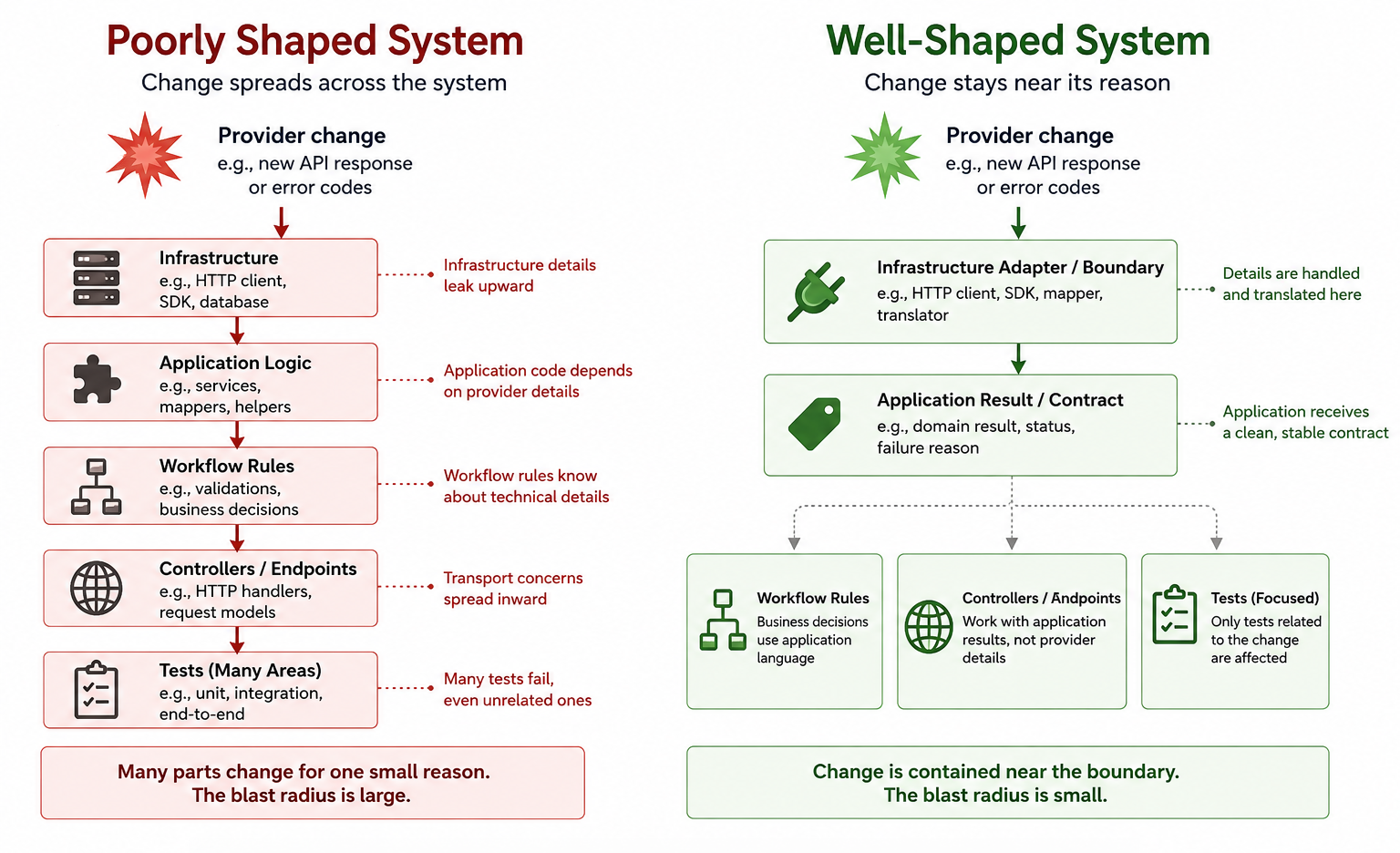
Good boundaries reduce the blast radius of change by translating details at the edge and keeping unrelated parts of the system stable.
5. Infrastructure Changes Should Stay Near Infrastructure
Infrastructure changes are unavoidable.
Providers change their APIs. Databases change shape. Message queues behave differently than expected. File formats evolve. Authentication rules are adjusted. External services return new error codes. Network failures reveal cases the original implementation did not handle.
None of that is unusual.
The architectural question is how far those changes are allowed to travel.
In a well-shaped system, infrastructure changes should usually stay near infrastructure.2 A change in a payment provider should not force workflow code to understand provider-specific terminology. A change in persistence should not rewrite the language of the application. A change in an HTTP response should not leak raw transport concerns into the use case that decides what the system should do next.
The infrastructure layer should translate.
It should take technical details from the outside world and convert them into concepts the application can use deliberately. That may be a domain object, an application result, a failure reason, a status, or a small contract that describes what the workflow actually needs to know.
This translation is not just a technical convenience.
It is what keeps change local.
When provider details leak inward, the application starts to depend on things it should not own. A workflow may begin checking a raw status code. A service may branch on an exception type from a third-party library. A test may need to construct framework objects just to exercise application behavior.
At that point, the infrastructure change has already escaped.
Good architecture tries to catch it at the edge.
That does not mean infrastructure code is unimportant or secondary. It often contains difficult details, careful error handling, retries, configuration, serialization, and integration behavior. But those details should remain close to the mechanisms that require them. They should not become the language of the workflow unless the workflow truly owns that decision.
This separation makes the system easier to change.
If a provider changes, the adapter changes. If a database detail changes, the repository or persistence mapping changes. If a transport concern changes, the transport boundary changes. The application may still need to handle a different outcome, but it should handle that outcome in its own language.
That is the point.
Infrastructure should support the application, not teach the application to think like infrastructure.
6. Workflow Rules Should Change Near the Workflow
Workflow rules should be easy to find where the workflow is described.
That may sound obvious, but many systems slowly drift away from it. A rule starts in an application service. Later, part of it moves into a helper. Another part appears in a controller. A special case is added in a mapper. A technical adapter begins deciding whether an operation is allowed to continue.
The workflow still works.
But the rule no longer has one clear home.
This makes change harder than it needs to be. When the rule changes, developers have to search through code that should not own the decision. They have to ask whether the same rule is enforced elsewhere. They have to worry that a change in one place will leave another path behaving differently.
A workflow rule should live near the workflow because that is where its meaning belongs.
If the system decides whether a request can be accepted, whether a command should be rejected, whether a user may perform an action, or whether a result should be treated as successful, those decisions should be visible in the application flow that owns them. They may call smaller collaborators, but the responsibility should not disappear into unrelated technical code.
This does not mean every rule must be written inline.
Sometimes a rule deserves its own object, specification, validator, policy, or small service. That can be a good design when the rule has a clear name and a clear reason to exist. But even then, the rule should still be connected to the workflow it serves. It should not be hidden behind a generic helper whose purpose is merely to keep code shorter.
Good architecture makes workflow decisions readable.
A developer should be able to follow the application flow and see the decisions that shape the outcome. What is accepted? What is rejected? What is translated? What is returned to the caller? What is left to infrastructure? What is deliberately not handled here?
Those questions should not require a tour through the entire system.
When workflow rules stay near the workflow, change becomes more local. A new case can be added where the workflow already explains its decisions. A result can be extended where callers already handle outcomes. A validation rule can be adjusted without changing persistence or transport code.
The workflow remains the place where the application says what it means.
That is valuable because workflows are often where business change appears first. If the rules are scattered, every business change becomes a technical investigation. If the rules have clear homes, the system gives the change somewhere natural to go.
7. Shared Code Can Make Change Less Local
Shared code is often introduced with good intentions.
Two workflows look similar. Two services perform nearly the same calculation. Two providers need comparable mapping logic. A helper already exists and can be extended. A generic abstraction seems like a way to avoid duplication and keep the codebase cleaner.
Sometimes sharing is the right choice.
But shared code can also make change less local.
The problem appears when code is shared because it looks similar, not because it represents the same responsibility. Two workflows may use similar steps today, but they may change for different reasons tomorrow. Two providers may return similar data, but their error handling may need to diverge. Two validation rules may look alike, but each may belong to a different business decision.
When those differences appear, shared code starts to pull unrelated changes together.
A change needed by one caller risks affecting another. A helper gains optional parameters. A shared method receives flags to preserve old behavior. Special cases are added for specific workflows. Tests become more complicated because every change has to prove that all existing callers still behave correctly.
The change is no longer local.
It has become tied to every place the shared code is used.
This is why reuse is not automatically a design improvement. Removing duplication can be useful, but only when the shared code protects a shared concept. If the shared code merely hides similar text, it may reduce lines while increasing coupling.
Good architecture is careful about this tradeoff.
It asks whether the callers share a responsibility, not only whether they share implementation details. It asks whether future changes are likely to happen together. It asks whether a single name can honestly describe the concept being shared. If the answer is unclear, a little duplication may be safer than premature reuse.
That can feel uncomfortable.
Developers are often trained to remove duplication quickly. But duplication and coupling are different costs. Duplication can be annoying. Coupling can make future change risky. The right choice depends on which cost is more likely to matter.
Local change often benefits from patience.
When similar code appears in two places, it may be better to watch how it changes before extracting it. If the two copies continue to change together, a shared abstraction may become obvious. If they start to diverge, keeping them separate was the right decision.
Shared code is valuable when it represents shared responsibility.3
When it does not, it can turn one local change into several unintended ones.
8. Small Abstractions Help Changes Stay Focused
Small abstractions can help change stay focused.
They do this by protecting one clear responsibility instead of trying to represent too many possible uses. A small abstraction says, in effect, that this part of the system has one reason to exist and one kind of decision to protect.
That makes change easier to understand.
If an abstraction represents a provider boundary, changes to provider translation have a natural home. If it represents a workflow policy, changes to that policy can happen where the policy is named. If it represents a result, callers can handle expected outcomes without depending on technical details.
The size of the abstraction matters less than the clarity of its responsibility.
A small interface, result type, adapter, mapper, validator, or policy object can make the system easier to reason about when its purpose is specific. Developers can see what the abstraction protects. They can understand which changes belong there and which changes do not.
That is what keeps change focused.
Large abstractions often have the opposite problem. They may begin with a clear purpose, but over time they collect extra responsibilities. More methods are added. More callers depend on them. More options appear. More behavior is controlled by flags. The abstraction becomes a place where many different changes meet.
At that point, it stops protecting local change.
Instead, it becomes a shared surface that many unrelated changes must touch.
Small abstractions are easier to adjust because they expose fewer promises. If the responsibility changes, the abstraction can change with it. If the responsibility splits, the abstraction can often be split without disturbing the whole system. If the abstraction is no longer useful, it is easier to remove.
This does not mean every small piece of code needs an abstraction.
Adding names without responsibility only creates more places to look. A small abstraction is valuable when it gives a real decision a clear home, not when it merely moves code behind another method or interface.
The goal is not to make the system more abstract.
The goal is to make the reason for change more visible.
Good architecture uses small abstractions where they help the system say what is changing, why it is changing, and where the change should happen.4
9. Tests Reveal Whether Change Is Really Local
Tests often reveal whether architecture is keeping change local.5
When a small change causes many unrelated tests to fail, the tests may be telling the truth about the design. The failure may not only be a testing problem. It may be a sign that too many parts of the system know too much about each other.
This is especially visible during ordinary maintenance.
A workflow rule changes, but infrastructure tests fail. A provider adapter changes, but application tests need to be rewritten. A result type becomes more precise, but tests far away from the decision need detailed updates. A small refactoring breaks tests that were supposed to describe behavior, but were actually describing internal steps.
Sometimes the tests are too tightly coupled.
But sometimes the code is.
That distinction matters.
A good test should usually fail when the behavior it protects has changed. It should not fail merely because the internal path to that behavior was rearranged. If every internal movement breaks many tests, the test suite may be making change less local than the architecture itself.
But if behavior tests fail across unrelated areas, the architecture may be exposing a deeper problem. A decision may be shared in the wrong place. A boundary may be leaking details. A helper may be carrying responsibilities that should have remained separate. An abstraction may be forcing unrelated workflows to change together.
Tests make these relationships visible.
They show where assumptions have spread. They show which callers depend on which details. They show whether a change can be made near the reason for the change, or whether the system requires many parts to be updated together.
That makes tests useful as architectural feedback.
A test suite is not only a safety net. It is also a map of what the system considers important. If the tests are clear, focused, and aligned with behavior, they can help confirm that changes stay near the responsibilities they affect.
If the tests are noisy, brittle, or deeply tied to implementation details, they may hide the same design problems the architecture is trying to avoid.
Good architecture and good tests support each other.
Architecture gives behavior clear homes. Tests describe those behaviors without depending on every internal detail. Together, they make it easier to change the system with confidence.
When a change is local in the code but not local in the tests, something is worth examining.
Either the tests know too much, or the design still does.
10. Local Change Does Not Mean Isolated Code Everywhere
Local change does not mean every piece of code should be isolated from every other piece of code.
That would not create good architecture.
It would create fragmentation.
A system still needs shared concepts, shared language, shared contracts, common patterns, and places where related decisions come together. If every workflow invents its own terminology, every adapter shapes results differently, and every rule is hidden in a separate private corner, the code may look decoupled while becoming harder to understand.
Good architecture is not about avoiding connection.
It is about making the right connections.
Some things should change together because they represent the same responsibility. Some concepts should be shared because they are genuinely part of the same model. Some abstractions should exist because they give several callers a stable and meaningful contract. Some tests should cover a complete behavior because the behavior only makes sense as a whole.
Local change becomes harmful when it is confused with maximum separation.
Too much separation can make the system harder to navigate. Developers may need to jump through many tiny types to understand one simple operation. Similar concepts may drift apart because they were kept separate too early. A rule that should be consistent across the system may be duplicated and slowly changed in different directions.
That is not local change.
That is scattered change.
The goal is to keep changes near the responsibility that owns them, not to force every line of code into its own isolated structure. A responsibility may be small, or it may involve several collaborating parts. What matters is whether those parts change for the same reason and whether the design makes that reason visible.
This is where judgment matters.
If two pieces of code share a real concept, keeping them together may make future change more local. If they merely look similar, separating them may be safer. If a boundary protects meaning, it is useful. If it only adds distance, it may make change harder.
Good architecture keeps related things close enough to understand and separate enough to change safely.
It avoids both extremes: the tangled system where every change spreads everywhere, and the over-separated system where every change requires searching through fragments.
Local change is not isolation.
It is alignment.
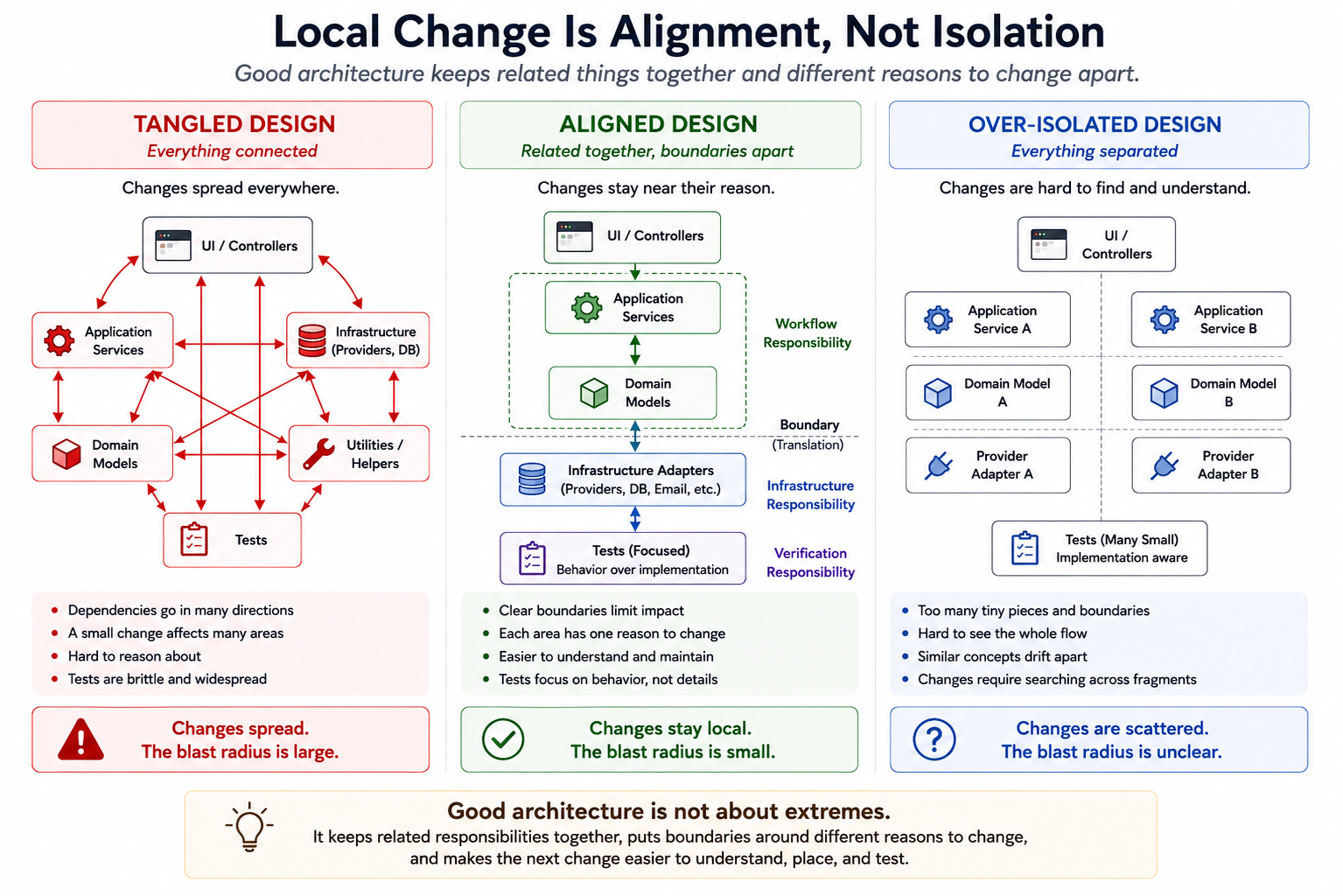
Local change does not mean isolating everything; it means keeping related responsibilities together and different reasons to change apart.
11. Refactoring Toward More Local Change
Refactoring toward local change usually starts with noticing where change spreads.
A bug fix touches too many files. A small rule change requires updates in unrelated tests. A provider adjustment leaks into application logic. A shared helper gains another special case. A service becomes harder to name because it now owns several different reasons to change.
Those moments are useful signals.
They show where the architecture may no longer be protecting the right responsibility.
The answer is not always a large redesign. In many cases, the better answer is a small refactoring that moves one decision closer to where it belongs. A workflow rule can be moved out of a controller and into the application flow. A provider-specific detail can be translated at the infrastructure boundary. A shared helper can be split when its callers no longer change for the same reason.
These changes may look modest.
But they can make the next change easier.
A useful refactoring does not have to make the architecture look more sophisticated. It only has to reduce unnecessary spread. It should make the relevant decision easier to find, easier to name, easier to test, or easier to change without disturbing unrelated code.
That is often how maintainable architecture improves.
Not through a single perfect structure, but through repeated corrections in the direction of clearer responsibility.
When a change spreads, ask why. Did the code depend on the wrong detail? Did a boundary allow too much knowledge through? Did a helper hide a decision? Did an abstraction gather unrelated callers? Did a test protect internal movement instead of behavior?
Each answer suggests a different refactoring.
Move the decision. Translate the detail. Split the abstraction. Rename the concept. Remove the flag. Let two similar pieces remain separate until they prove they really change together.
The goal is not to make every future change tiny.
Some changes are naturally broad because the responsibility itself is broad. But the spread should match the reason. If the reason is local, the change should have a good chance of staying local too.
Refactoring toward local change is therefore less about tidying code and more about restoring alignment.
It helps the system say more clearly: this decision belongs here, this detail stops there, and this change should not have to travel farther than its reason.
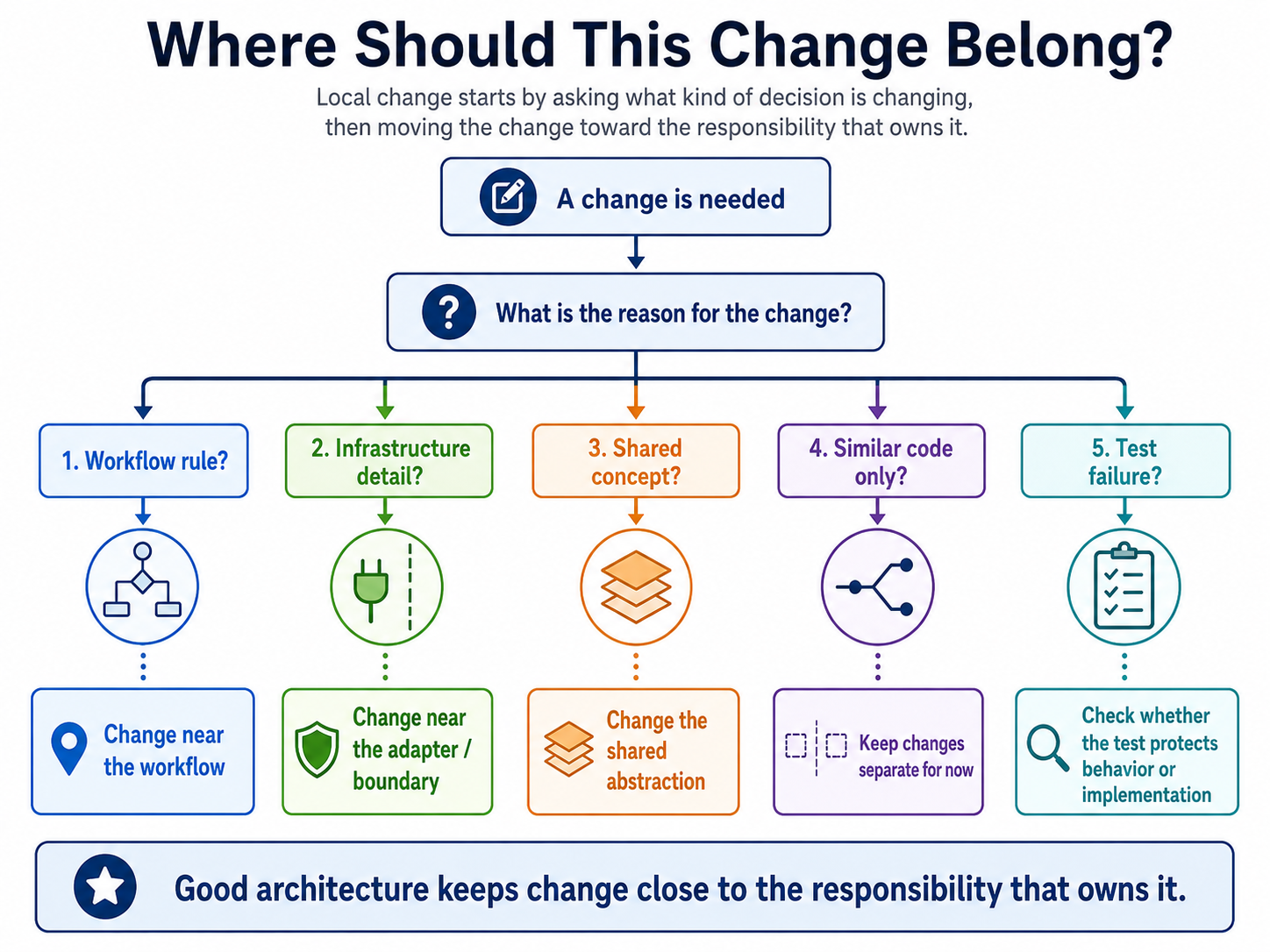
Local change starts by asking what kind of decision is changing, then moving the change toward the responsibility that owns it.
12. Closing
Good architecture makes change easier to place.
That may be one of its most practical benefits.
It gives responsibilities clear homes. It keeps infrastructure details near infrastructure. It lets workflow rules change near the workflows that own them. It uses shared code carefully, protects useful boundaries, and avoids turning every small decision into a system-wide concern.
This does not make software simple.
Real systems still contain difficult rules, awkward integrations, legacy constraints, and changing requirements. Some changes will always be broad because the responsibility being changed is broad. Architecture cannot remove the actual complexity of the problem.
But it can avoid adding unnecessary spread.
That is why local change matters.
When change stays near its reason, the system becomes easier to understand. Developers can make smaller decisions with more confidence. Tests become clearer. Reviews become more focused. Future work becomes less risky because the design gives each change a natural place to begin.
This is also why architecture should be judged by more than how it looks.
A design may appear clean, layered, abstract, or flexible. Those qualities can be useful, but they are not enough on their own. The more important question is whether the design helps the next real change happen without disturbing unrelated parts of the system.
Good architecture does not make every change local.
It makes local change possible when the reason for change is local.
That is a quieter goal than many architectural promises, but it is a valuable one. Most software is maintained through small adjustments, corrections, extensions, and refinements. A system that supports those changes well is easier to keep healthy over time.
Architecture is not only about where code lives.
It is about where change belongs.
-
Related: Architecture Is Mostly About Where Decisions Belong.↩
-
Related: When Infrastructure Starts Leaking Into Application Code.↩
-
Related: The Difference Between Shared Code and Shared Responsibility.↩
-
Related: Why Small Abstractions Often Age Better Than Big Ones.↩
-
Related: Testing Behavior Without Testing Implementation Details.↩
Need a second opinion on a .NET codebase?
I offer practical architecture and maintainability advisory for .NET teams working on long-lived business applications.
Want occasional updates?
Subscribe to receive occasional practical notes on .NET architecture, maintainable software, project progress, and new articles.