The Value of Boring Architecture
Architecture Principles · 2026-09-04
A practical look at why calm, predictable architecture often serves a system better than clever structure, and how boring design choices help keep decisions visible, boundaries stable, and change easier to manage.
The Value of Boring Architecture
1. Boring Architecture Is Not Careless Architecture
Boring architecture can sound like a compromise.
It may suggest a design without ambition, a system built without much thought, or a codebase that simply follows familiar patterns because nobody wanted to consider anything better.
But that is not what boring architecture means.
Boring architecture is deliberate. It values clarity over cleverness. It prefers decisions that can be understood, repeated, tested, and changed without requiring every developer to rediscover the original reasoning.1 It tries to make the important parts of the system visible instead of hiding them behind unnecessary novelty.
A boring design is not careless.
It is often the result of care.
It means the boundaries are where people expect them to be. It means application code speaks the language of the workflow instead of the language of infrastructure. It means abstractions are small enough to understand. It means failures are represented in ways callers can handle. It means tests describe behavior rather than internal structure.
None of that is exciting in isolation.
But over time, it matters.
A system is not maintained only by the person who first designed it. It is maintained by future developers, by tired developers, by new team members, by people fixing production issues, and by people making small changes under time pressure. For those people, an architecture that is easy to understand is usually more valuable than one that is impressive to explain.
Boring architecture reduces the amount of surprise in the system.
It does not remove all complexity. Real systems still have difficult rules, awkward integrations, legacy constraints, and competing priorities. But a good architecture should not add unnecessary complexity of its own. It should help developers find the decisions that matter and change them without disturbing unrelated parts of the system.
That is the value of boring architecture.
It is not about avoiding design.
It is about designing in a way that remains understandable after the original excitement has passed.
2. Why Exciting Architecture Is So Tempting
Exciting architecture is tempting because it feels like progress.
A new pattern is introduced. A new framework is adopted. A new structure promises more flexibility, more scalability, better separation, or cleaner code. The design begins to look more sophisticated, and that can create a sense that the system is moving in the right direction.
Sometimes it is.
New ideas can be valuable. A system may need a different structure because the old one no longer fits. A boundary may need to be introduced. A dependency may need to be isolated. A workflow may need to be separated from infrastructure. A design may need to change because the existing code makes the next change too hard.
The problem is not excitement itself.
The problem is when excitement becomes a substitute for judgment.
Architecture can become attractive for reasons that are not closely connected to the problem being solved. A pattern may feel modern. A framework may feel safer because other teams are using it. A layered structure may look more professional. A generic abstraction may feel future-proof. A distributed design may feel scalable before the system has earned that complexity.
Those choices can be difficult to question because they sound responsible.
Nobody wants to argue against scalability, flexibility, separation, or maintainability. Those are good goals. But good goals do not automatically make every architectural decision good. A design can use the right words while still making the system harder to understand.
This is where exciting architecture can become expensive.
It may introduce more concepts than the team needs. It may create more places for code to move through before anything meaningful happens. It may require developers to understand a framework, a pattern, a convention, and several layers before they can change a simple rule.
The design may be impressive, but not helpful.
Boring architecture asks a quieter question.
What problem does this structure solve, and is that problem important enough to justify the cost?
That question does not reject new ideas. It simply asks them to earn their place in the system.
3. Boring Architecture Makes Decisions Easier to Find
One of the quiet strengths of boring architecture is that decisions are easier to find.
In a well-shaped system, important decisions have recognizable homes. Workflow decisions live near the workflow. Infrastructure details stay near infrastructure. Validation rules are not scattered through unrelated helpers. Mapping code does not quietly become business logic. Tests describe behavior at the level where the behavior matters.
This makes the code easier to read.
A developer does not have to search through a clever chain of abstractions to understand why something happens. They do not have to inspect five generic services to find the rule that rejects a command. They do not have to learn a custom framework before they can answer a simple question about the application.
The design gives them a map.
That map does not need to be impressive. It needs to be reliable. If a developer needs to understand how a command is handled, there should be an obvious place to start. If they need to know how an external provider is translated into an application result, the boundary should be visible. If they need to change a rule, the rule should not be hidden behind a helper whose name says nothing about the workflow.
Boring architecture helps because it avoids unnecessary mystery.
It uses familiar shapes where familiar shapes are enough. It keeps names close to responsibilities. It avoids hiding decisions behind abstractions that sound powerful but do not explain what they protect. It makes the system easier to navigate because the structure is not trying to surprise anyone.
This matters especially during maintenance.
Most development work is not done while designing the system from scratch. It happens later, when a bug needs to be fixed, a small feature needs to be added, or an old assumption needs to be changed. In those moments, the ability to find the relevant decision quickly is valuable.
A clever architecture may be satisfying to invent.
A clear architecture is easier to return to.
Boring architecture is valuable because it leaves fewer places for important decisions to disappear.
4. Stable Boundaries Matter More Than Clever Structures
A clever structure can make a system look well designed.
There may be many layers, abstractions, pipelines, conventions, and extension points. Everything may have a place. Every operation may pass through a carefully arranged sequence of components. From a distance, the architecture can look disciplined and mature.
But structure is not the same as a boundary.
A structure describes how code is arranged. A boundary describes where responsibility changes.
That difference matters.
A system can have many layers and still have weak boundaries. Infrastructure details can still leak into application code. UI concerns can still shape business rules.2 Shared helpers can still collect unrelated decisions. A generic abstraction can still hide several responsibilities behind one impressive name.
The architecture may look organized, but the important separations may still be unclear.
Boring architecture values stable boundaries more than clever structure. It asks where decisions belong, which details should stay local, and what each part of the system should be allowed to know. It does not add layers only to make the design look more architectural. It adds separation where separation protects meaning.
A stable boundary gives developers confidence.
They know where provider-specific code belongs. They know where workflow decisions should be made. They know which parts of the system should change together and which parts should not. They can replace an implementation without dragging unrelated code into the change.
That is more valuable than a structure that is clever but fragile.
When boundaries are stable, the system becomes easier to evolve. A new provider can be introduced at the edge. A rule can change near the workflow that owns it. A result can be translated before it leaks into the wrong layer. A test can focus on behavior without rebuilding the entire structure.
Stable boundaries are not always exciting.
They are often made of ordinary decisions: clear interfaces, simple adapters, explicit mapping, focused services, and names that say what responsibility they protect.
But those ordinary decisions are what keep the architecture useful after the novelty has faded.
5. Simple Patterns Are Easier to Repeat Correctly
Architecture is not only about the first implementation.
It is also about what people will repeat.
A pattern that works once may still be a poor architectural choice if it is hard to apply consistently. If every new feature requires developers to remember a long sequence of special rules, hidden conventions, framework hooks, and exceptions, the architecture becomes fragile. The first version may be correct, but the tenth version may not be.
Simple patterns reduce that risk.
When the structure is easy to understand, developers are more likely to follow it without needing constant supervision. They can see where a command belongs, where validation should happen, where infrastructure should be translated, and where tests should be written. The architecture becomes something the team can use, not just something the original designer can explain.
This is one of the quiet strengths of boring architecture.
It makes the right path ordinary.
A simple adapter pattern, a clear application service, a focused result type, or a small interface may not feel impressive. But if the team can repeat the pattern correctly across the system, it becomes valuable.3 It creates consistency without requiring a complex framework to enforce it.
Complex patterns often have the opposite problem.
They may solve a real issue, but they can be difficult to apply safely. Developers may copy the shape without understanding the reason. They may place code in the right-looking class while putting the decision in the wrong place. They may follow the ceremony while missing the boundary the ceremony was supposed to protect.
That kind of architecture looks consistent but behaves inconsistently.
Simple patterns are easier to question, too.
When a pattern is small and visible, it is easier to see whether it still fits. If a feature needs something different, the difference can be discussed directly. With a more complex pattern, the team may keep following it because changing it feels expensive or because nobody is sure which parts are essential.
A useful architecture should make good habits repeatable.
It should not depend on every developer remembering the whole design philosophy every time they add a feature. It should make the common cases clear, the unusual cases visible, and the important boundaries hard to miss.
That is why boring patterns often last.
They are not powerful because they are clever.
They are powerful because they can be repeated correctly.
6. Boring Code Gives Future Developers Fewer Surprises
Future developers are often the real audience for architecture.
That future developer may be someone else on the team. It may be a new hire. It may be a consultant asked to make a small change. It may also be the same developer six months later, returning to code that once felt obvious.
In all of those cases, surprise is expensive.
Surprise appears when a simple-looking change touches five unrelated places. It appears when a method name hides a workflow decision. It appears when a helper contains special cases nobody expected. It appears when an abstraction promises one thing but also does several others. It appears when a test fails for a reason that has little to do with the behavior being changed.
Boring architecture tries to reduce those surprises.
It does not make every decision obvious at first glance, but it makes the design easier to predict. If something belongs to infrastructure, it is near infrastructure. If something represents workflow behavior, it is near the workflow. If a result is returned, it describes an outcome the caller is expected to handle. If an abstraction exists, it has a name that explains what responsibility it protects.
That predictability matters during real maintenance work.
Developers rarely have unlimited time to understand the whole system before making a change. They need to form a mental model quickly, make the change safely, and trust that the structure will not betray them in some hidden place. The architecture should help that process, not turn every change into a search for hidden rules.
Boring code is not code without thought.
It is code where the thought has been put into making the next change less surprising.
This may mean choosing a familiar pattern over a clever one. It may mean writing a few explicit lines instead of hiding behavior in a generic mechanism. It may mean keeping a small amount of duplication because sharing the code would create a false relationship. It may mean using names that are plain rather than impressive.
Those choices may not stand out during a design review.
But they stand out later, when a developer can open the code, understand the local decision, and make a change without fear that the real behavior lives somewhere unexpected.
That is a serious architectural benefit.
A system with fewer surprises is easier to trust.
7. The Cost of Architecture That Tries Too Hard
Architecture starts to become expensive when it tries to prove too much.
A design may try to prove that it is flexible, scalable, generic, extensible, loosely coupled, highly abstracted, or ready for every future requirement. Those goals may sound reasonable, but when they are pursued too early or too broadly, the architecture can begin to carry more weight than the system needs.
The result is often a design that is harder to work with than the problem it was meant to solve.
Simple workflows have to pass through too many layers. Small rules are hidden behind generic abstractions. Code that could have been direct becomes indirect. A developer who wants to understand one behavior has to understand a framework of architectural decisions first.
That cost is not always visible at the beginning.
Early in a project, a complex structure can feel disciplined. It gives the team places to put things. It makes the design look prepared. It may even make the first few features feel organized because the architecture appears to have an answer for every question.
But over time, the cost becomes clearer.
Every new feature has to fit the structure. Every exception to the pattern needs a justification. Every small change requires developers to ask whether they are following the architecture correctly. The design becomes something the team serves, rather than something that serves the team.
This is one of the risks of architecture that tries too hard.
It can turn good ideas into obligations.
Abstractions become mandatory even when the concrete behavior is clearer. Layers remain even when they no longer protect a useful boundary. Extension points exist for variations that never appeared. Generic models continue to shape code long after the original reason for them has disappeared.
Boring architecture is more modest.
It does not try to demonstrate architectural sophistication in every part of the system. It asks whether each structure still earns its place. It accepts that some code can be direct, some abstractions can be small, and some decisions do not need a framework around them.
That modesty is not a lack of skill.
It is a way of respecting the cost of every design decision.
Architecture should make the system easier to change. When it becomes something developers have to work around, explain repeatedly, or obey without understanding, it may be trying too hard.
8. Boring Architecture Keeps Change Local
One of the strongest signs of useful architecture is that changes stay local.
A rule changes near the workflow that owns it. A provider is replaced near the infrastructure boundary. A result type is adjusted where callers make decisions about outcomes. A test changes because the behavior changed, not because the internal structure was rearranged.
That is what boring architecture tries to protect.
It does not make change effortless. No architecture can do that. But it tries to make the reason for change easier to find and the impact of change easier to understand. When responsibilities are clear, a developer can usually tell which part of the system should move and which parts should remain untouched.
This reduces unnecessary fear.
In a fragile system, every change feels larger than it should. A small validation rule affects unrelated workflows. A change to an adapter breaks application tests. A helper update changes behavior in places nobody expected. A UI adjustment requires knowledge of persistence details.
The change spreads because the responsibilities were not kept separate.
Boring architecture limits that spread by keeping ordinary boundaries in place. It keeps infrastructure details at the edge. It keeps workflow rules near the workflow. It uses abstractions that describe real responsibilities instead of broad ambitions. It avoids sharing code merely because two pieces look similar.4
These choices are not dramatic.
But they make the system safer to change.
Local change is valuable because most software evolves through many small adjustments. Requirements are clarified. Providers are replaced. Rules are refined. Names improve. Failure handling becomes more precise. Tests become better aligned with behavior.
If each of those changes requires a tour through the entire codebase, progress slows down.
A boring architecture gives developers a better chance of making one change in one place for one reason. That may sound unremarkable, but it is one of the practical foundations of maintainable software.
The best architecture is often not the one that looks most impressive.
It is the one that lets the next change happen without disturbing everything else.
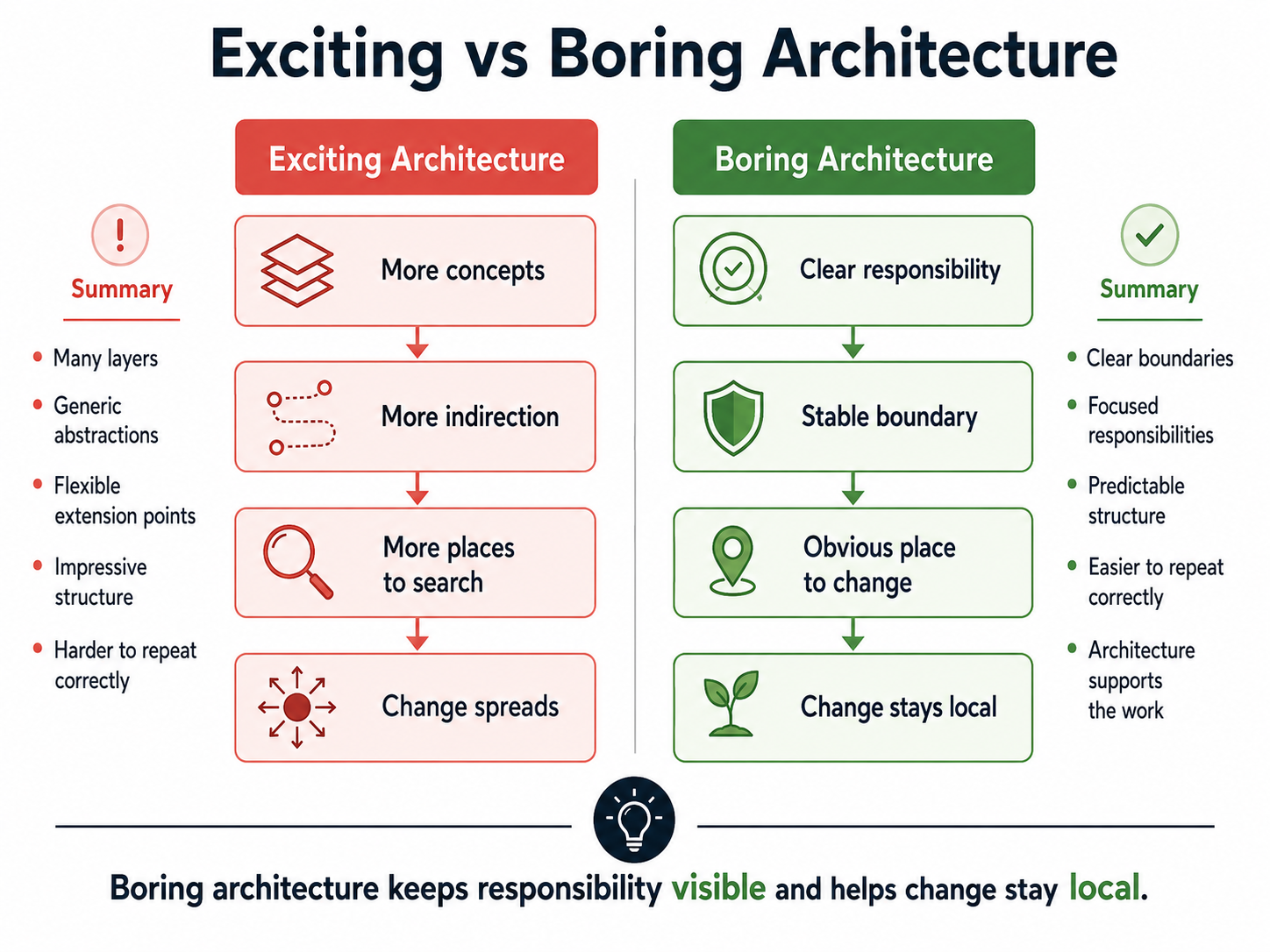
Exciting architecture often adds more concepts before the system needs them, while boring architecture keeps responsibility visible and change more local.
9. When Boring Does Not Mean Static
Boring architecture is not the same as architecture that never changes.
A calm design can still evolve. Boundaries can move. Abstractions can be introduced, split, or removed. Result types can become more precise. Tests can be reorganized. Infrastructure can be replaced. The system can grow into a different shape as the real needs become clearer.
The difference is that the change is deliberate.
Boring architecture does not chase novelty for its own sake. It does not adopt a pattern only because it is popular. It does not add a layer because the design feels too simple. It changes when the current structure no longer protects the right responsibilities.
That kind of change is healthy.
A system may start with a direct implementation because that is enough. Later, repeated meaning appears, and a small abstraction becomes useful. A provider integration may start as simple infrastructure code. Later, the application needs a clearer boundary around provider-specific errors. A workflow may begin with straightforward validation. Later, the rules become important enough to deserve a more explicit home.
The architecture should be allowed to respond to that.
Boring architecture becomes static only when simplicity is treated as a rule instead of a judgment. Sometimes a new abstraction is necessary. Sometimes a boundary needs to be stronger. Sometimes a pattern that once seemed excessive becomes justified because the system has grown into the problem it solves.
The point is not to keep the design small forever.
The point is to let the design grow for reasons the system can explain.
This is where boring architecture can be surprisingly flexible. Because it avoids unnecessary complexity early, it leaves more room to introduce the right complexity later. Because it keeps responsibilities visible, it becomes easier to see when a responsibility deserves a new home.
A design that changes carefully is not static.
It is stable enough to trust, but honest enough to improve.
10. How to Recognize Useful Boredom
Useful boredom has a particular shape.
It is not the absence of architecture. It is not a lack of standards, boundaries, or design thinking. It is the feeling that the structure of the system matches the problems the system actually has.
A boring design is useful when developers can predict where things belong.
They know where to place a workflow rule. They know where infrastructure is translated. They know which abstractions are shared because the responsibility is shared. They know which tests should describe behavior and which tests should stay close to technical details.
That predictability is a good sign.
Another sign is that the architecture can be explained without too much ceremony. A developer should be able to describe the main responsibilities, boundaries, and flow of the system without needing a long list of exceptions. The explanation may still include difficult domain rules or technical constraints, but the architecture itself should not require constant defense.
Useful boredom also shows up in changes.
When a feature changes, the relevant code is usually near the reason for the change. When a provider changes, most of the change stays near the provider boundary. When an expected failure becomes important, the result or workflow contract can be adjusted without forcing unrelated parts of the system to understand technical details.
The design feels calm because it does not make every change dramatic.
This does not mean the code is perfect.
There may still be rough edges. Some names may need improvement. Some abstractions may need to be split. Some duplication may still be waiting for a clearer pattern to appear. But the system has a basic honesty about it. Responsibilities are mostly visible. Boundaries mostly protect real decisions. Complexity mostly appears where the problem is actually complex.
That is useful boredom.
It gives developers confidence that the architecture is helping them rather than performing for them.
A useful architecture does not need every part to be interesting.
It needs the important parts to be understandable.
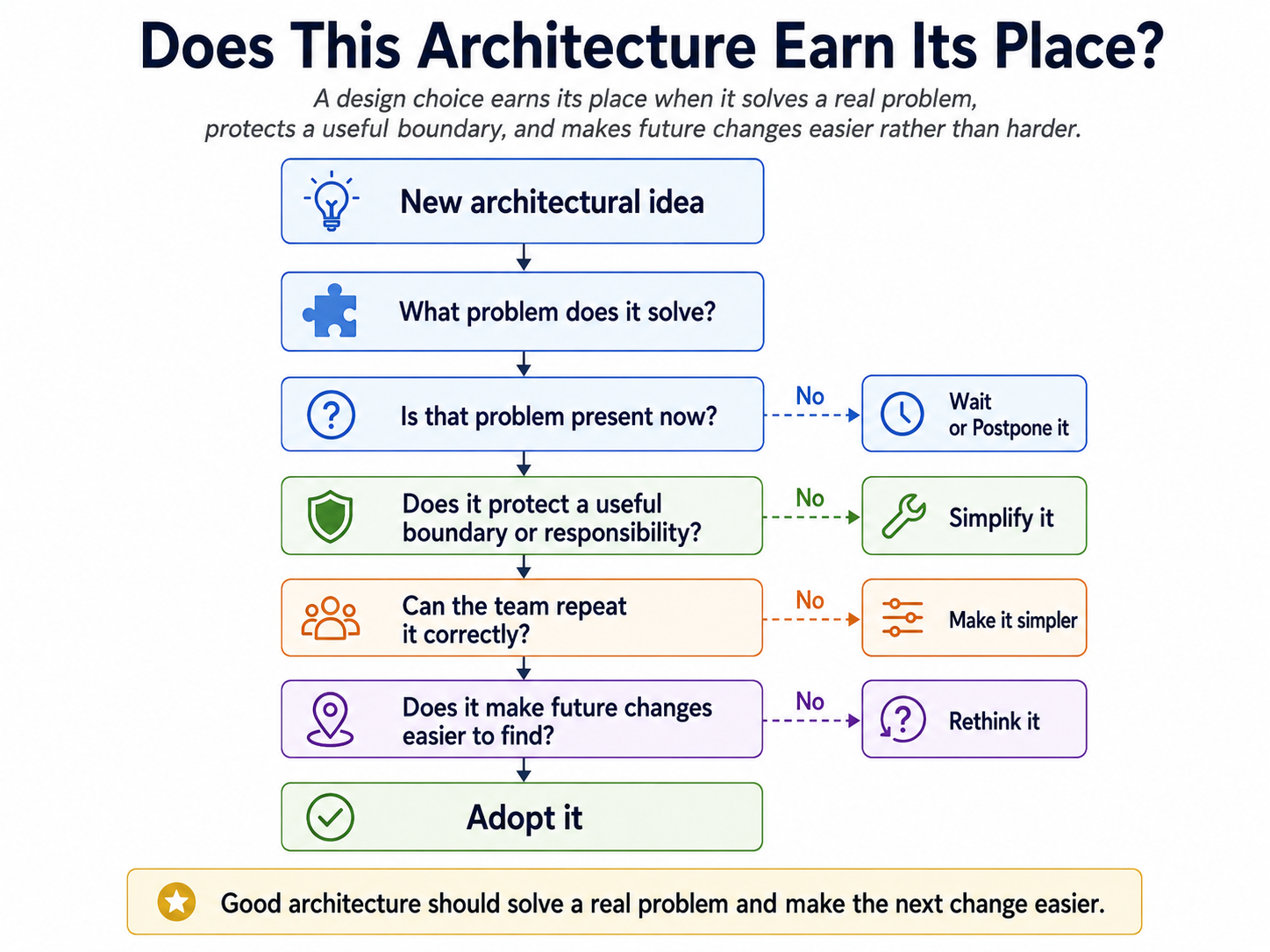
A design choice earns its place when it solves a real problem, protects a useful boundary, and makes future changes easier rather than harder.
11. Refactoring Toward a Calmer Design
A calmer design usually appears through small refactorings, not one dramatic redesign.
When an architecture has become too clever, too broad, or too surprising, the answer is rarely to replace everything at once. Large rewrites often create new risks before they remove the old ones. They can also repeat the same mistake in a different form: trying to solve too much in one architectural move.
A calmer approach starts by looking for unnecessary tension.
Where does a simple change require too much knowledge? Where are decisions hidden behind generic names? Where do tests fail for reasons unrelated to behavior? Where does application code know too much about infrastructure? Where has a shared helper become the home for several unrelated rules?
Those places often point to architecture that is carrying more complexity than it needs.
Refactoring toward a calmer design means moving responsibilities closer to where they belong. A workflow rule may move out of a helper and back into the workflow. A provider-specific exception may be translated at the boundary instead of leaking upward. A large abstraction may be split into smaller contracts. A result type may become more explicit about the outcomes callers need to handle.
None of these changes need to be impressive.
They need to make the next change easier.
That is a useful test for this kind of refactoring. If the change makes the code slightly easier to name, slightly easier to test, slightly easier to understand, or slightly less surprising, it may be moving the architecture in the right direction.
The goal is not to remove all complexity.
The goal is to stop adding complexity where the problem does not require it.
Sometimes the calmer design will have more types but less confusion. Sometimes it will have fewer abstractions but clearer boundaries. Sometimes it will accept a little duplication because sharing the code would create the wrong relationship. Sometimes it will make a decision explicit instead of hiding it behind a general mechanism.
A calmer architecture is not necessarily smaller.
It is better aligned.
It lets ordinary code stay ordinary. It gives important decisions clear homes. It keeps technical details from traveling farther than they should. It makes patterns repeatable without turning them into ceremony.
That kind of refactoring rarely looks dramatic in a commit.
But over time, it changes how the system feels to work in.
12. Closing
Boring architecture is easy to underestimate.
It does not always produce impressive diagrams. It may not introduce new terminology. It may not give the team a framework to admire. Much of its value appears only later, when the system has to be changed, understood, tested, extended, and maintained by people who were not part of every original decision.
That is exactly why it matters.
A useful architecture should reduce confusion, not decorate it. It should make decisions easier to find. It should keep boundaries stable. It should make good patterns repeatable. It should help future developers make changes with fewer surprises and less fear.
None of this requires the architecture to be primitive.
A boring architecture can still be thoughtful, disciplined, and flexible. It can still contain abstractions, layers, adapters, result types, tests, and clear boundaries. The difference is that those structures have earned their place. They exist because they protect something real, not because the design needed to look more sophisticated.
The best architecture often feels ordinary in the places where ordinary is enough.
That is not a weakness.
It is a form of respect for the system and for the people who will work in it later.
Exciting architecture may be easier to present.
Boring architecture is often easier to live with.
Need a second opinion on a .NET codebase?
I offer practical architecture and maintainability advisory for .NET teams working on long-lived business applications.
Want occasional updates?
Subscribe to receive occasional practical notes on .NET architecture, maintainable software, project progress, and new articles.